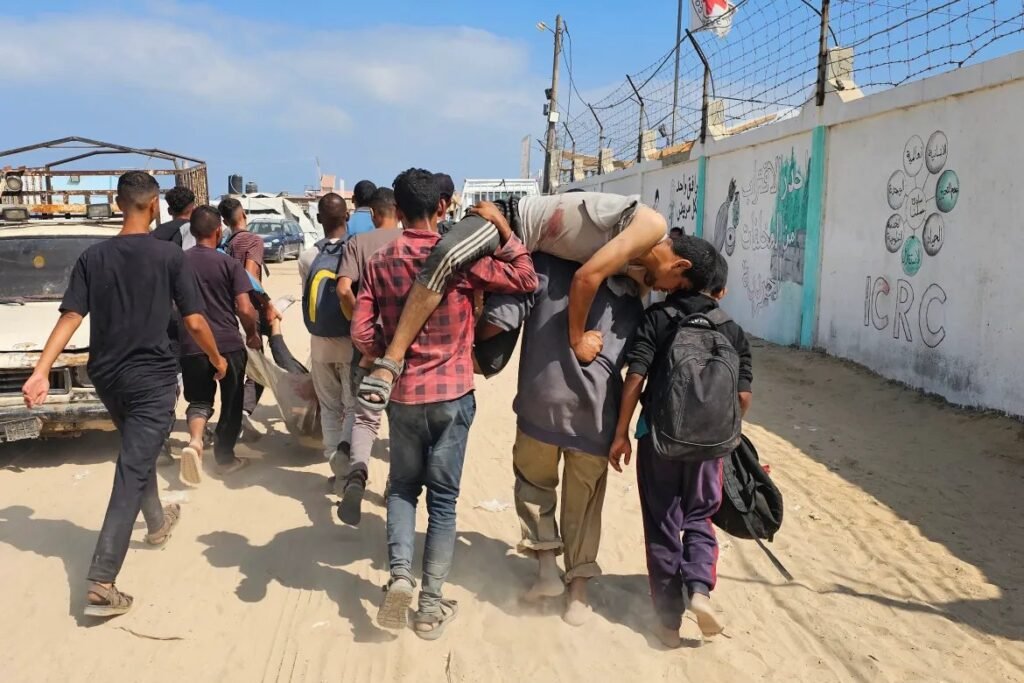
Gaza Herald — The widening gap between international promises to end the war and the brutal reality confronting Palestinians in the besieged Gaza Strip is fueling sharp criticism of the so-called Peace Council, with Palestinian writers and political analysts questioning its priorities, its handling of the ceasefire, and its failure to exert real pressure on Israel.
Despite commitments to halt hostilities, facilitate humanitarian relief, and launch reconstruction, ongoing attacks by Israeli occupation forces and strict blockade restrictions on aid and shelter supplies continue to deepen Gaza’s humanitarian emergency.
Meanwhile, political and security discussions increasingly place the disarmament of Palestinian factions at the center of the process, raising urgent concerns that immediate survival obligations toward Gaza’s civilian population are being subordinated to Israeli conditions.
Criticism from Palestinian analysts Dr. Iyad Al-Qarra and Wissam Afifa reflects a broader conviction that the council applies unequal standards to the parties involved. Their assessments point to a framework that exerts direct pressure on Palestinians to yield political and security concessions while relying largely on polite appeals when addressing Israel’s continuing ceasefire violations.
Al-Qarra: Unequal Pressure and Compliance With Israeli Conditions
Writer and political analyst Dr. Iyad Al-Qarra argues that the Peace Council has failed to translate its declared responsibilities into practical measures, specifically regarding halting Israeli attacks, opening crossings for humanitarian aid, and advancing administrative and political arrangements for Gaza.
In a press interview, Al-Qarra stated that the continuation of Israeli assaults and the killing of Palestinians, including women and children, demanded clear positions and enforcement steps proportionate to conditions on the ground. Instead, he contends that the council has fallen far short of the intervention the crisis requires.
He sharply criticized linking humanitarian and political arrangements to the issue of Palestinian factions’ weapons. In his view, that linkage subordinates urgent humanitarian and political obligations to Israeli conditions without first compelling Israel to stop attacks, withdraw its forces, and allow relief supplies into Gaza.
Al-Qarra characterized this posture as a blatant double standard: while the council uses gentle appeals and urging toward the Israeli government, it directs explicit, forceful demands at Palestinian factions regarding disarmament and the transfer of authority. That imbalance, he argued, places heavy political pressure on Palestinians while letting Israel evade commensurate pressure and accountability.
He further contended that the council has echoed misleading figures on humanitarian aid volumes entering Gaza in line with the Israeli narrative, despite reports from international and humanitarian agencies documenting acute shortages and deteriorating living conditions. His critique also extends to Gaza’s administrative transition, questioning the lack of serious follow-up on the proposed administrative committee and the failure to finalize arrangements enabling its entry into Gaza and assumption of civilian responsibilities. This delay raises doubts over whether the council is genuinely committed to empowering Palestinian governance inside the Strip.
Afifa: Humanitarian Relief Must Not Be Tied to Disarmament
Writer and political analyst Wissam Afifa evaluates the council’s record through the humanitarian catastrophe triggered by recent winter rains and camp flooding, arguing that the disaster cannot be separated from the war and ongoing restrictions imposed by Israel.
In a press statement, Afifa faulted the council for treating the fallout of the low-pressure weather system as a mere natural disaster while ignoring the political and siege conditions that magnified its toll. Widespread destruction of homes and infrastructure, prolonged displacement, and blockade barriers on shelter materials have left hundreds of thousands of Palestinians exposed to severe weather without basic protection. In this context, Afifa maintains that camp flooding stems not only from heavy rain, but also from the prolonged absence of safe housing and humanitarian protection.
Figures he cited underscore the severity of the emergency: roughly 70,000 tents were flooded within 12 hours, Civil Defense teams received around 1,500 distress calls, and five Palestinians were killed when a sand dune collapsed in Deir al-Balah. For Afifa, these figures expose the limits of a response that treats surface symptoms without confronting the policies and restrictions driving the crisis.
He warned that the council’s gravest failure is tying civilian relief once again to the weapons file, deflecting scrutiny from Israel’s obligations and the barriers blocking Gaza’s recovery. Although the council has acknowledged delays in Israel’s fulfillment of commitments, Afifa argued that it has failed to turn that recognition into real pressure.
He also questioned what he described as adopting elements of the Israeli security narrative, particularly blaming Hamas for the political deadlock, pointing to Hamas’s approval of the roadmap proposed by Nickolay Mladenov and mediator statements on Israeli violations as essential context when weighing responsibility.
UNRWA and Gaza’s Administrative Future Remain Unresolved
Controversy surrounding the Peace Council also encompasses the institutions tasked with delivering relief and managing civilian affairs in the next phase. Excluding the United Nations Relief and Works Agency for Palestine Refugees (UNRWA), despite its unmatched field experience and established service network, has raised serious questions about how humanitarian responsibilities are being allocated as displacement, poverty, and emergency needs intensify.
Simultaneously, delays in enabling the proposed administrative committee to enter Gaza and begin operating cast further doubt on the practical viability of announced arrangements. An administrative transition lacks substance while Palestinian bodies remain barred from functioning and core decisions hinge on Israeli conditions and approvals. These unresolved questions underscore a deeper issue over Palestinian agency in shaping Gaza’s future, as international deliberations over security, governance, and reconstruction unfold amid occupation realities and ongoing restrictions on the Strip.
A Framework Without Accountability Cannot Deliver Recovery
Criticism of the Peace Council goes beyond frustration over bureaucratic delays. At issue is a fundamental clash over priorities and conditions, specifically whether humanitarian obligations will be honored immediately as non-negotiable duties or treated as leverage in negotiations over disarmament and governance.
For Palestinians confronting ruined homes, waterlogged shelters, scarce supplies, and repeated displacement, that distinction carries immediate life-or-death weight. Food, medicine, weatherproof shelter, and protection from Israeli fire cannot wait for political and security negotiations to conclude. A framework that demands concessions from Palestinian factions while failing to enforce binding obligations on Israel risks entrenching inequality between the parties and prolonging the conditions obstructing Gaza’s recovery.
Immediate priorities must therefore center on halting Israeli attacks, opening crossings for unrestricted humanitarian and winter relief, enabling relief agencies to operate freely, and allowing the administrative committee to take up its duties within a comprehensive reconstruction effort that safeguards Palestinians’ rights to their homes and land and secures the return of displaced families.
Without accountability for violations and enforceable mechanisms, the Peace Council risks becoming just another political structure whose declarations remain detached from the lives of Palestinians. For Gaza’s population, genuine peace is measured not by statements or proposed frameworks, but by an end to Israeli aggression, the restoration of livable conditions, and the ability to rebuild without further displacement or coercion.