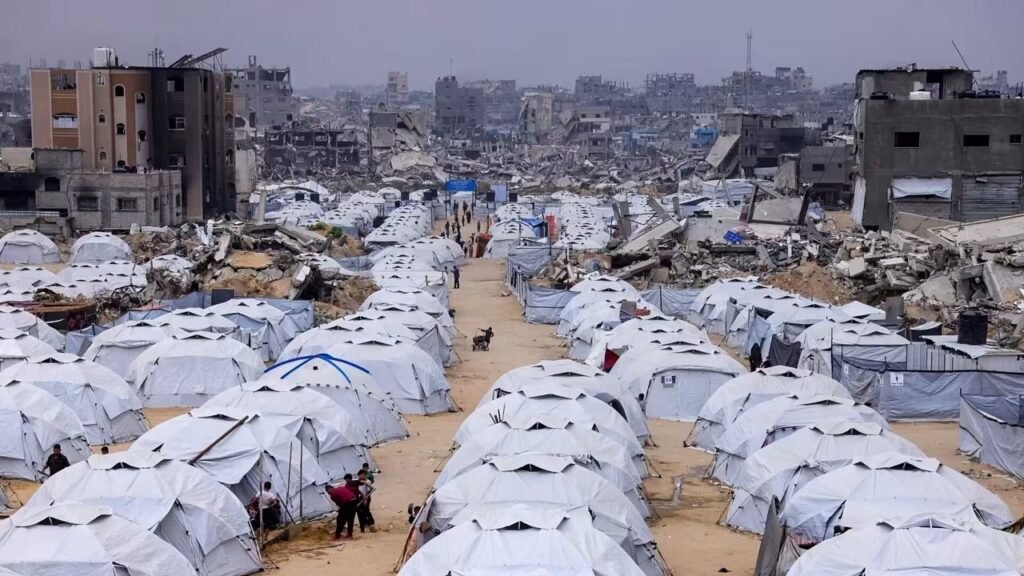
Gaza Herald — The scale of forced displacement and systematic destruction engineered across the Gaza Strip remains staggering, with approximately 1.43 million Palestinians, representing 68 percent of the territory’s population, now forced to survive inside makeshift tents.
Simultaneously, nearly 77 percent of Gaza’s road network has been damaged or obliterated by Israeli occupation forces, paralyzing civilian mobility and obstructing access to life-saving services, according to a newly released United Nations map.
The stark findings were published Monday in a comprehensive report titled “Access and Movement in the Gaza Strip – November 2026,” issued by the United Nations Office for the Coordination of Humanitarian Affairs (OCHA) in the Occupied Palestinian Territory. Synthesizing satellite imagery and field data on population distribution, infrastructure annihilation, humanitarian access, and military movement restrictions, the UN assessment illustrates how Israeli bombardment and siege policies have rendered vast swathes of the enclave uninhabitable.
According to OCHA’s population breakdown based on 2026 estimates totaling 2.1 million residents inside the territory, approximately 1.43 million Palestinians are sheltering in fragile tents, while only around 673,000 remain inside standing buildings, accounting for just 32 percent of the population. These figures underscore the magnitude of Gaza’s housing catastrophe following the wholesale erasure of entire residential neighborhoods.
77 Percent of Gaza’s Road Network Damaged or Destroyed
The UN assessment highlights the deliberate crippling of Gaza’s transportation arteries, estimating that approximately 77 percent of the territory’s road network, equivalent to 3,479 kilometers, has been damaged or destroyed. Drawing on analysis conducted by the United Nations Satellite Centre (UNOSAT) from imagery captured on July 8, 2025, and published in September, the data records 1,511 kilometers of destroyed roadways, 484 kilometers of severely damaged routes, and another 1,484 kilometers sustaining moderate damage.
Detailed mapping confirms that roadway destruction spans all five governorates of the Gaza Strip, severing both primary highways and secondary local streets linking residential districts to hospitals, water stations, and aid distribution centers. This devastation severely impedes civilian movement and humanitarian convoys while delaying ambulances and Civil Defense rescue crews attempting to reach wounded Palestinians, creating a monumental barrier to basic service restoration and future reconstruction.
82 Percent of Buildings Affected by Israeli Bombardment
Residential and civic infrastructure across the enclave has suffered near-total devastation. According to a UNOSAT structural assessment conducted on June 16, 2026, approximately 82 percent of all buildings across Gaza have been destroyed, damaged to varying degrees, or are suspected of sustaining structural damage.
In total, 201,290 structures were identified as impacted across the territory. Of those, 134,422 buildings were completely leveled, representing roughly 67 percent of all affected structures, alongside 13,848 severely damaged buildings, 28,096 moderately damaged structures, and 24,924 additional buildings suspected of damage.
The report further estimates that approximately 328,000 individual housing units have been damaged or destroyed, leaving hundreds of thousands of families with nowhere to return and trapping them indefinitely in overcrowded tent encampments.
Israeli Military Restrictions and Collapsing Essential Services
Compoundings the physical ruins, the UN map documents sweeping Israeli military restrictions governing land access and humanitarian movement. Approximately 65 percent of Gaza’s total 365-square-kilometer area remains subjected to Israeli access bans, buffer zones, or military control. The map delineates zones of Israeli troop deployment, restricted corridors, sealed border crossings, and areas where humanitarian personnel are forced to seek prior Israeli military coordination, a bureaucratic hurdle that routinely delays or blocks relief teams from reaching vulnerable communities.
Essential public infrastructure has been pushed to total collapse under this dual pressure of destruction and siege. According to data compiled in the UN map, not a single one of Gaza’s 37 hospitals is functioning at full capacity, while 53 percent of all healthcare service points across the Strip have been forced out of service entirely.
Water and sanitation networks face an equally catastrophic breakdown. The assessment reveals that 91 percent of surveyed households suffer from acute water insecurity, while 70 percent of sewage collection and treatment facilities have been destroyed or rendered inoperable. Across densely packed tent camps, the lethal combination of contaminated water, overflowing sewage, and crippled clinics exposes displaced families to soaring outbreaks of preventable disease.
Compiled by OCHA’s Information Management Unit using datasets from UNOSAT, the Food and Agriculture Organization (FAO), and humanitarian partners across 2025 and 2026, the report captures a systemic collapse of life-sustaining infrastructure.
Engineered Destruction Trapping Millions in a Prolonged Emergency
Taken together, the UN figures demonstrate that Gaza’s humanitarian catastrophe extends far beyond immediate battlefield casualties. Since October 2023, Israel’s genocidal war on Gaza, waged with unwavering U.S. military and diplomatic backing, has killed more than 74,000 Palestinians and wounded over 175,000 others, the overwhelming majority of them women and children.
Beyond this staggering human toll, Israeli occupation forces have destroyed approximately 90 percent of Gaza’s overall infrastructure, with United Nations assessments estimating reconstruction requirements at $71.4 billion. Simultaneously, Israeli authorities continue to choke off the entry of agreed quantities of food, medicines, medical equipment, winter shelter supplies, and prefabricated housing units needed to relieve suffering on the ground.
For Gaza’s broader population of roughly 2.4 million people, including 2.15 million displaced persons cited in the report, the erasure of homes and municipal networks has reduced daily existence to a relentless struggle for survival.
Without an immediate end to Israeli blockade restrictions, unimpeded humanitarian access, and massive international reconstruction support, millions of Palestinians will remain trapped between bulldozed neighborhoods and flood-prone tent encampments, denied the most basic foundations of a safe and dignified life.