
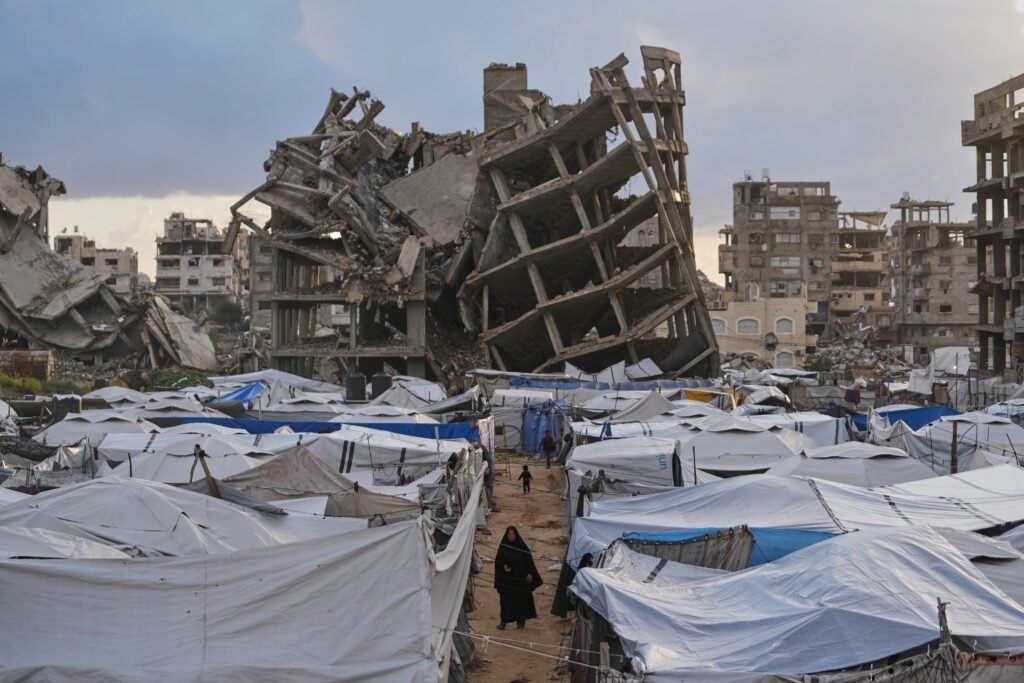
Gaza Herald — For Palestinians across the besieged Gaza Strip, the threat of losing their homes no longer stems solely from fighter-jet airstrikes, tank shelling, or remote-controlled armored demolition robots. Israeli occupation forces have escalated a systematic tactic using heavy quadcopter drones to drop explosive-laden boxes and cubes directly onto residential rooftops before detonating them, turning family homes and surrounding neighborhoods into lethal booby traps.
Field documentation confirms that this method has been deployed repeatedly across eastern Gaza City’s Zeitoun neighborhood and has expanded southward to areas near the Abu Ouda oil press, north of the Bureij refugee camp in central Gaza. Its escalating use has terrified residents, particularly families living near the so-called Yellow Line who are desperately attempting to remain in or return to their homes despite unceasing Israeli military aggression.
Crucially, the lethal danger does not end when a drone flies away, or an explosion subsides. Numerous dropped devices remain unexploded on rooftops, inside damaged rooms, or buried among surrounding debris, creating a persistent, invisible hazard that prevents displaced families from approaching their property. Even when walls remain standing, the threat of unexploded ordnance renders homes uninhabitable, deliberately prolonging forced displacement long after the initial attack.
Explosive Boxes Dropped Directly Onto Residential Rooftops
The documented tactic involves Israeli quadcopter drones hovering over residential blocks and dropping metallic boxes or cube-shaped explosive charges onto rooftops and adjacent streets prior to remote detonation. The resulting blasts inflict severe structural damage on targeted houses and neighboring buildings. According to eyewitness accounts and field reports, Israeli drones repeatedly return to the same residential blocks, releasing successive waves of explosives without requiring ground troops or armored vehicles to enter neighborhood alleys.
On November 13, local sources and eyewitnesses reported that a large Israeli quadcopter dropped explosive boxes onto the rooftops of several homes near the Yellow Line in eastern Zeitoun, in apparent preparation for wider demolition operations across the area. The blasts triggered widespread panic, forcing families to flee toward western Gaza City out of fear that imminent explosions would collapse occupied buildings.
Similar drone-bombing operations were documented along Fattouh and Al-Sikka streets in eastern Zeitoun, as well as near Dar al-Salam Hospital in northeastern Khan Younis, where Palestinian field monitors recorded dozens of explosions in the immediate vicinity of the medical facility. On Sunday, November 15, Israeli drones dropped three additional explosive boxes near the Abu Ouda oil press north of Bureij refugee camp, signaling the geographical expansion of this tactic into densely populated central Gaza.
Unexploded Ordnance Renders Homes Uninhabitable After Attacks
One of the most insidious features of this tactic is that dropped charges frequently fail to detonate upon impact, remaining live and unstable on rooftops or amid rubble long after Israeli drones depart.
Ali Hawas, head of the media department at Gaza’s Civil Defense, issued an urgent warning urging residents never to approach, touch, or handle suspicious objects, stressing that civilians lack the specialized equipment and technical training required to identify or neutralize military explosives. Hawas warned that unexploded devices can detonate at any moment and urged parents to keep children strictly away from damaged rooftops and debris piles, advising residents to immediately report suspicious objects via the Civil Defense emergency hotline at 102 or the central operations room at 109.
However, reaching targeted neighborhoods remains extraordinarily perilous for rescue crews. Areas adjacent to the Yellow Line are heavily restricted by Israeli military fire, forcing Civil Defense teams to await complex coordination through international agencies before entering. Persistent Israeli gunfire and drone surveillance routinely obstruct specialized disposal teams from reaching reported sites, leaving families trapped in limbo, unable to return home because they cannot verify whether unexploded charges remain hidden inside their houses.
Families Forced to Abandon Surviving Homes and Scatter
Beyond physical destruction, repeated drone-dropped explosives are shattering social cohesion and forcing surviving households into renewed displacement. Abdul Jawad Badwan, a resident living near the Yellow Line in eastern Zeitoun, recounted being inside his home as his family prepared lunch when an Israeli quadcopter carrying explosive charges appeared overhead.
Badwan stated that the drone dropped several explosive boxes onto neighboring houses before withdrawing and returning every few minutes to release additional charges. The successive blasts leveled an entire residential block of family homes, leaving terrified survivors with no choice but to flee.
Similarly, resident Mohammed Jamal Yassin described how Israeli quadcopters began dropping explosive devices onto nearby homes while he was outside with his family, rendering his house completely uninhabitable.
The attack scattered his household across multiple displacement sites: his mother was forced to seek refuge in a tent with his sister in Nuseirat refugee camp, his wife fled to her parents’ home, and other relatives were dispersed across overcrowded encampments. Their testimonies illustrate how a single drone operation erases household stability and forces families into secondary displacement amid an acute territory-wide shelter shortage.
Repeated Attacks Fuel Systematic Forced Displacement
Ismail al-Thawabta, director general of Gaza’s Government Media Office, warned against the escalating pattern of dropping explosive devices onto civilian homes near the Yellow Line. Al-Thawabta confirmed that similar drone attacks have been documented for the fifth consecutive time around Fattouh and Al-Sikka streets in eastern Zeitoun, characterizing the repetition as a deliberate campaign to terrorize residents and coerce them into abandoning their neighborhoods.
By transforming residential blocks into unpredictable demolition zones, Israeli occupation forces ensure that families cannot remain safely in intact structures or return to repair damaged ones. The tactic reinforces broader demolition operations along Gaza’s eastern perimeter, steadily depopulating entire residential districts through sustained terror and physical erasure.
From Waiting for Aid Drops to Fearing What Falls From the Sky
For Gaza’s besieged population, the weaponization of aerial drops carries a bitter psychological toll. During months of acute starvation engineered by the Israeli siege, residents watched the skies hoping planes might drop parcels of food and basic survival aid. Today, the sight and hum of drones overhead evoke immediate dread that metallic boxes falling from above will obliterate their homes or kill their children. Homes that should serve as sanctuaries of protection have been converted into latent explosive traps, extending destruction even without a direct artillery or missile strike.
War Crimes Concerns and Demands for International Accountability
The deliberate deployment of explosive charges against civilian dwellings constitutes a grave breach of international humanitarian law, violating the core principles of distinction and civilian protection. Human rights specialist Mustafa Ibrahim affirmed that dropping explosive boxes onto populated homes violates international law and demands urgent international accountability.
Ibrahim stressed the necessity of thorough field documentation, mapping impact sites, inspecting unexploded ordnance components, and assessing structural destruction to hold Israeli perpetrators accountable. Simultaneously, international humanitarian agencies must intervene immediately to secure safe, unimpeded access for Civil Defense disposal teams near the Yellow Line so specialists can neutralize explosive hazards before they claim additional civilian lives.
For Palestinians in Gaza, Israeli drone-bombing tactics have imposed an impossible choice: remain inside homes threatened by falling explosives and hidden unexploded charges, or abandon their neighborhoods for overcrowded, flood-prone displacement camps. By turning standing houses into lingering death traps, Israeli occupation forces are attacking not only physical structures, but the very possibility of Palestinian return, recovery, and survival.

