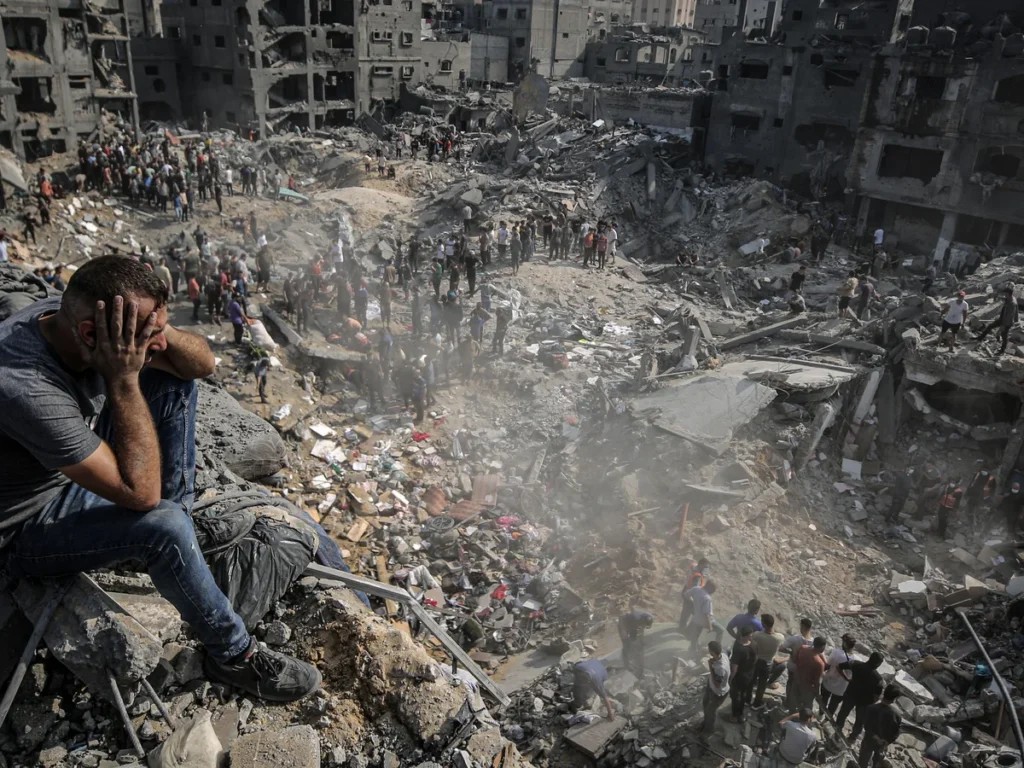
Gaza Herald — Winter is descending upon the Gaza Strip, yet for hundreds of thousands of displaced Palestinians, the lethal threat has already arrived. Torrential rains and gale-force winds have inundated makeshift encampments, destroyed fragile tents, overwhelmed shattered sanitation systems, and left families exposed to freezing temperatures and infectious diseases.
Meanwhile, more than 150,000 emergency tents procured by humanitarian organizations and international donors remain stranded outside the territory, blocked from entry by Israeli occupation authorities.
For families whose homes were obliterated during Israel’s genocidal war on Gaza, the season’s initial winter storms have transformed an already desperate shelter crisis into an immediate battle for survival.
Children are sleeping in saturated clothing, mattresses and blankets have been ruined by mud and floodwater, and parents are struggling to shield their families using torn plastic sheeting and whatever scarce materials remain available. The scale of this enforced emergency raises a critical question: how can Gaza’s displaced population survive another winter when life-saving shelter supplies are deliberately barred from crossing the border?
Storms Turn Displacement Camps Into Lethal Flood Zones
The first major winter storm to strike Gaza in November brought heavy rainfall and powerful winds that overwhelmed overcrowded displacement sites across the enclave. Thousands of families watched floodwaters pour into their tents, while thousands more lost their temporary shelters entirely.
According to Gaza’s Government Media Office, approximately 70,000 tents were flooded during the initial low-pressure system, destroying personal belongings and stripping displaced families of minimal protection against further downpours.
The Palestinian Ministry of Health confirmed that a child drowned in the rising floodwaters, while three children and their mother were killed when a rain-soaked sand dune collapsed directly onto their tent.
The United Nations Office for the Coordination of Humanitarian Affairs (OCHA) reported that by November 8, humanitarian partners had received emergency appeals from more than 26,000 households whose shelters or belongings were severely damaged, while at least 3,900 households were left completely without shelter.
The devastation extended far beyond canvas tents and personal possessions. Rising floodwaters and damaged sewage networks forced raw wastewater directly into family living spaces, exposing civilians to severe contamination inside camps already suffering from extreme overcrowding, non-existent sanitation, and acute shortages of clean water.
For displaced families, the crisis does not recede when the rain stops; wet bedding and clothing cannot dry in the cold, leaving damaged shelters defenseless against approaching storms.
Nearly One Million Palestinians Trapped in High-Risk Flood Zones
The danger encompasses far more than the tens of thousands of households inundated during the first storm. United Nations estimates indicate that approximately 940,000 Palestinians are currently living in low-lying, flood-prone zones inside makeshift shelters incapable of withstanding heavy rain or coastal winds.
This vulnerability is compounded by the destruction of municipal infrastructure and ongoing Israeli blockades on fuel and electricity, which have paralyzed rainwater pumping stations and left crews unable to drain standing floodwaters from densely packed camps.
The health consequences are particularly severe for children, elderly residents, and individuals suffering from chronic illnesses.
Medical Aid for Palestinians warned that its medical teams anticipate a sharp surge in acute respiratory infections and complications linked to cold, dampness, and overcrowding, raising urgent fears of preventable child deaths from hypothermia similar to those recorded during the previous winter.
The testimony of displaced father Raed Jamal illustrates the daily reality behind these figures. He noted that all of his children’s clothes became soaked during the storm and they quickly fell ill, while he lacks the financial means to replace their garments.
Forced to spend the night catching rainwater in cooking pots as it leaked through holes in his tattered tent roof, Jamal described watching his children suffer in the cold as heartbreaking. His ordeal reflects the reality of hundreds of thousands of families who lost their homes and livelihoods to Israeli bombardment and now rely on torn canvas as their sole barrier against the elements.
150,000 Tents and Vital Relief Supplies Stranded Outside Gaza
The most glaring indictment of the ongoing siege lies in the vast gap between urgent survival needs inside Gaza and the massive stockpiles of relief supplies sitting idle just beyond its sealed crossings.
According to OCHA’s November 8 situation report, more than 150,000 tents purchased by humanitarian partners and donor states are positioned outside Gaza, ready for immediate dispatch, alongside approximately 300,000 heavy tarpaulins and 500,000 blankets awaiting entry clearance.
Humanitarian agencies confirmed that Israeli restrictions on relief materials and equipment have crippled preparations for the rainy season and left domestic stocks virtually exhausted.
While Israeli occupation authorities announced the entry of roughly 10,000 tents during the previous week, that figure represents a tiny fraction of actual requirements, as United Nations assessments confirm that 94 percent of Gaza’s population requires urgent shelter assistance. These arbitrary restrictions also block materials needed to repair and reinforce temporary housing.
The emergency relief organization ShelterBox noted that tents it normally supplies in crisis zones have been held up outside Gaza for nearly two years, forcing aid workers to attempt makeshift solutions using plastic sheeting and wooden pallets—items that also face systematic border obstructions. ShelterBox warned that forced reliance on temporary emergency patches rather than durable housing leaves families inside structures that deteriorate rapidly under wind and rain.
Addressing the crisis requires uninterrupted access to plastic coverings, thermal mattresses, blankets, repair tools, and heavy municipal machinery, including vacuum trucks, mobile dewatering pumps, engine oil, hoses, and spare parts requested by OCHA to clear flooded encampments.
A Preventable Humanitarian Emergency Beyond Temporary Aid
The worsening disaster has prompted urgent demands for decisive international intervention to force open border crossings and halt restrictions paralyzing humanitarian operations. The Council for Arab-British Understanding urged the British government to exert immediate pressure on Israel to permit the entry of essential shelter materials and reverse bans obstructing international relief organizations.
Parliamentary affairs officer Joseph Willits warned that winter rains and flooding are striking Palestinians already enduring catastrophic conditions, stressing that parents fighting to protect their children from floodwaters cannot wait for stalled political action.
The experience of Nour al-Batsh, a mother caring for a seven-month-old infant, underscores the impossible choices confronting displaced families when temporary shelters fail. After her tent collapsed in the storm, she was forced to pool resources with others to rent a partially damaged apartment for $500 a month, relying entirely on donations from abroad to cover the cost.
Describing the winter cold as lethal, she expressed deep fear of being forced back into her fragile tent near the coast, where exposure to freezing temperatures and gale-force winds threatens her infant’s life.
Gaza is entering another brutal winter stripped of the housing infrastructure, relief supplies, and municipal services required to protect its civilian population. With more than 150,000 purchased tents, half a million blankets, and hundreds of thousands of tarpaulins held at the borders by Israeli occupation authorities, the suffering unfolding across Gaza’s flooded camps is neither accidental nor inevitable.
Until the international community enforces unrestricted humanitarian access and the entry of heavy drainage equipment and durable shelter materials, displaced Palestinian families remain trapped between rising floodwaters and life-saving aid deliberately kept out of reach.