Gaza Herald — The bread crisis across the Gaza Strip is escalating rapidly as flour reserves dwindle and daily supply deficits climb, driven by severe reductions in international food assistance and ongoing Israeli blockade restrictions on essential commercial goods and operational supplies.
These compounding pressures threaten to force local bakeries to halt production altogether, leaving thousands of displaced and impoverished Palestinians standing in exhausting queues for hours each day to secure basic sustenance for their families.
Far from a temporary commodity shortage, the crisis exposes a deep structural breakdown in Gaza’s local food production system. Depleted subsidized flour allocations, irregular commercial entries through Israeli-controlled crossings, and severe shortages of industrial maintenance supplies have left bakeries with zero strategic reserves, tying the survival of over two million residents directly to daily truck movements.
Economic researcher Ahmed Abu Qamar warned in a press statement on Thursday that Gaza’s daily flour deficit has exceeded 25 percent of total population requirements across both commercial imports and international humanitarian channels.
Abu Qamar noted that the besieged enclave requires approximately 450 tons of flour daily to meet basic consumption needs, yet incoming shipments fall dramatically short, placing immense strain on local markets and households already battered by plummeting purchasing power.
International Aid Reductions Slash Subsidized Bread Production
The acute flour deficit coincides with major cuts implemented by the World Food Program (WFP) last October due to funding shortfalls, immediately reducing the availability of subsidized flour and bread across Gaza.
According to Abu Qamar, the agency slashed its overall assistance by roughly 50 percent, cutting the number of beneficiaries from 1.6 million to 1.1 million people and depriving nearly 500,000 vulnerable residents of the monthly food rations they relied upon for survival.
Beyond stripping half a million people from aid rolls, the reductions cut household rations in half—limiting families to a single food parcel instead of two while simultaneously shrinking the size of the flour bags included inside each package. Crucially, flour allocations designated directly for local bakeries plunged from over 260 tons per day to between 125 and 135 tons. This steep reduction has crippled subsidized bread output, forcing thousands of families back onto an under-supplied commercial market that lacks the inventory to absorb the sudden surge in demand.
Israeli Crossing Closures Prevent Strategic Reserve Accumulation
Regarding commercial supply lines, Abu Qamar emphasized that current import volumes permitted by Israeli occupation authorities provide no margin for bakeries to build emergency reserves. Frequent crossing closures and arbitrary restrictions on cargo entries keep daily supply averages dangerously low.
Abu Qamar confirmed that Gaza’s bakeries require the consistent entry of at least 10 truckloads of flour every day simply to maintain baseline operations, alongside surplus deliveries sufficient to establish a 12-to-14-day strategic stockpile. Because Israeli authorities operate commercial crossings only five days a week and halt movement entirely during holidays, the absence of a buffer stock leaves bakeries vulnerable to immediate shutdowns whenever border operations stall or delays occur.
Stretching Bread Queues Reflect Deepening Food Insecurity
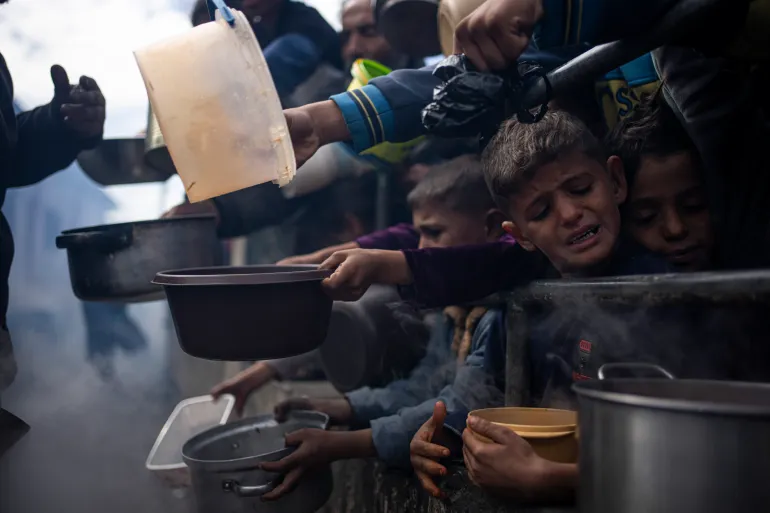
The human toll of this enforced scarcity is visible outside every functioning bakery across the territory, where long lines of residents wait for hours under harsh conditions, fearing flour supplies will run out before they reach the counter. With high unemployment, eroded purchasing power, and skyrocketing living costs, bread remains the primary caloric staple for the vast majority of displaced and impoverished families. Deprived of humanitarian parcels and priced out of scarce market alternatives, Gaza’s most vulnerable residents bear the brunt of the widening supply gap.
Shortages of Industrial Oils and Spare Parts Threaten Machinery Collapse
The threat to Gaza’s bread supply extends beyond raw flour to encompass critical mechanical and operational supplies blocked under the Israeli siege. Abu Qamar highlighted an acute scarcity of industrial mineral oils needed to lubricate commercial ovens and power generators, compounded by a total lack of spare parts required to repair mechanical breakdowns.
Forced to rely on primitive, improvised repairs due to missing replacement components, bakery operators face escalating maintenance costs, accelerated equipment wear, and frequent production line failures.
Operating generators and industrial mixers continuously under extreme conditions without proper lubrication or servicing threatens to permanently disable vital machinery across the territory. Sustaining bread production requires an integrated supply chain encompassing raw flour, fuel, industrial lubricants, and mechanical parts, all of which remain severely restricted.
Systemic Threat to Gaza’s Food Production Infrastructure
Ultimately, the deepening bread crisis reflects the broader economic and humanitarian suffocation imposed on the Gaza Strip. Without a guaranteed, uninterrupted flow of both humanitarian and commercial flour alongside fuel, mineral oils, and spare parts, Gaza’s remaining bakeries remain on the brink of forced closure. Addressing the emergency requires lifting Israeli obstacles on essential commodities and restoring full humanitarian funding before localized flour deficits escalate into a territory-wide collapse of basic food production.