
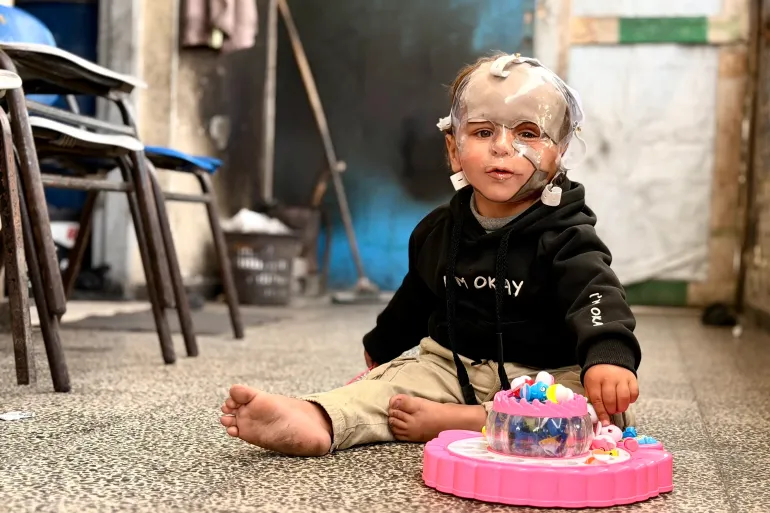
Gaza Herald — For tens of thousands of Palestinian children in Gaza, childhood has been utterly transformed by an absence no explanation can repair. The mother or father who once offered comfort, held their hand through danger, or promised safety will never return. Across an enclave devastated by deliberate bombardment, forced displacement, and economic destruction, an entire generation of Palestinian children is being forced to navigate survival without the parents who once shielded them from danger.
According to data from the Palestinian Central Bureau of Statistics cited in official reporting, more than 39,000 Palestinian children in Gaza had lost one or both parents by March 2026, including approximately 17,000 children who have been left completely orphaned of both parents. Beyond these staggering statistics are young lives facing not only profound grief, but the total annihilation of the family units that once provided emotional stability and security. For a child, losing a parent under Israeli bombardment means losing far more than a primary caregiver; it means the total erasure of daily routines, financial security, and the essential belief that someone will protect them when violence strikes.
Forced into Adulthood: Survival Replaces Childhood
The consequences of parental loss manifest in severe physical and psychological distress across displacement camps. Younger children, separated from surviving relatives, frequently exhibit intense separation anxiety, insomnia, regression in motor skills, and mutism as they struggle to process overwhelming trauma. In overcrowded tent cities, where surviving adults are themselves paralyzed by grief and starvation, children cling desperately to whichever relative remains, even as those caregivers lack the basic material resources to offer sustained comfort.
Older children face an even heavier burden: the immediate expectation to take on adult survival roles long before they are ready. When a parent is killed or maimed by Israeli attacks, eldest sons and daughters are forced to abandon their education to secure food and care for younger siblings. In one account from Gaza, an 11-year-old girl whose father was killed in an airstrike began preparing basic baked goods over an open wood fire alongside her mother. Navigating bombed-out ruins and military insecurity, the young girl spent her days hawking their products through crowded displacement shelters to feed her family, prioritizing daily survival over grief.
Trauma, Separation, and the Fear of an Uncertain Future
For children who survive the loss of a parent, the constant threat of further military strikes turns daily life into a cycle of terror. A seven-year-old Palestinian boy whose father was killed in an Israeli airstrike became entirely inseparable from his mother, exhibiting severe panic and refusal to play whenever she left his sight. When evaluated by a field mental health worker, the young boy sat in silence, continuously verifying that his mother was beside him before offering a single request: “I want my father back.” His response highlighted a profound trauma that psychological reassurance alone cannot heal.
In another instance at a regional field hospital, a 14-year-old Palestinian girl, the sole survivor of her entire family, refused physical rehabilitation out of sheer terror of being discharged. She explained to medical staff that the hospital represented her final physical sanctuary, and that leaving its walls meant returning to a devastated world where she possessed no surviving family, no home, and no safe harbor. Her case underscores how psychological recovery remains completely impossible while Israeli military operations continue to deny Palestinian children safe living environments.
Manufactured Hunger Drives Mass-Orphaned Youth into Fire
For children who have lost their entire support network, extreme hunger forced by Israel’s blockade transforms daily survival into a life-threatening ordeal. A 12-year-old boy who lost both parents and his older brother routinely disappeared from his family’s tent for hours, eventually revealed to be risking his life at chaotic aid distribution sites operated by the Gaza Humanitarian Foundation. Despite enduring sniper fire, stampedes, and artillery shelling at these distribution points, the boy continued to return because his younger siblings had gone days without food while his elderly grandfather remained unable to provide.
When asked about the severe danger of visiting aid points, the 12-year-old boy offered a stark reality: “I know it’s dangerous, but what choice do I have?” His question captures the impossible choices forced upon Palestinian children who must weigh the risk of violent death against the certainty of slow starvation. Orphanhood in Gaza is not merely the loss of a mother or father; it is the structural destruction of safety, continuity, and basic human dignity. Until Palestinian children are guaranteed total protection from military aggression, secure shelter, and adequate nutrition, survival will remain their primary responsibility.

