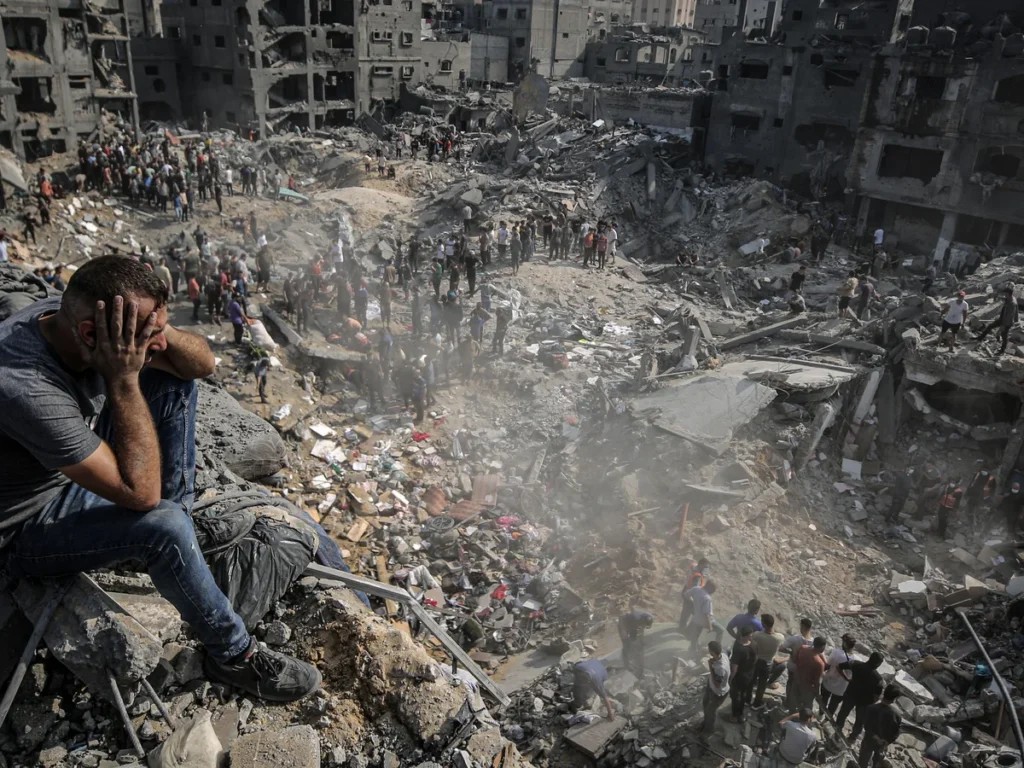
Gaza Herald — The life-threatening dangers facing Palestinians across the Gaza Strip continue to escalate as residential buildings structurally compromised by Israeli bombardment collapse without warning, exposing families to fatal hazards amidst widespread devastation and an engineered housing catastrophe.
Displaced families remain trapped inside severely damaged structures that no longer meet basic safety standards, left with no alternative shelter due to the ongoing siege. In the latest tragedy, 35-year-old Abdul Rabbo Ashraf Al-Ashouh was killed on Sunday following the partial collapse of a home previously shelled during Israel’s war on Gaza, highlighting the lethal threat posed by unstable ruins across the blockaded enclave.
This fatality has renewed urgent warnings regarding thousands of structurally compromised buildings scattered throughout Gaza’s residential districts. The danger to civilian life is no longer confined to direct air strikes and military invasions. Structures that survived heavy shelling now pose a continuous death threat to those forced to seek refuge inside them. With vast structural destruction left unaddressed and essential engineering machinery blocked from entry by Israeli authorities, damaged homes have become a daily hazard for families struggling to survive under siege.
Damaged Structures Become Fatal Traps Under Siege
Gaza City and districts across the Strip face a compounding crisis as thousands of residential units sustained catastrophic structural damage from Israeli strikes. Deprived of alternatives, forcibly displaced families are compelled to shelter in these crumbling ruins, many of which are on the verge of sudden collapse. The peril is magnified by the complete lack of technical equipment required to conduct structural risk assessments, identify hazardous buildings, and execute mandatory emergency evacuations or reinforcements.
Local official estimates confirm that more than 2,000 damaged structures occupied by residents and displaced families remain at risk of immediate collapse. These statistics underscore the depth of Gaza’s structural crisis, where damaged homes are not abandoned ruins, but the sole remaining shelter for Palestinians who have lost everything to the aggression.
For these families, evacuating an unsafe building is impossible. Having already endured repeated forced displacement and the total destruction of their property, and with no alternative shelter materials permitted into Gaza due to the blockade, families face an agonizing choice: remain beneath cracked concrete that threatens to crush them, or face total exposure on the streets.
This reality demonstrates the fatal connection between structural damage and forced displacement. Even when direct bombardment pauses, Palestinians remain at constant risk from the fallout of systematic destruction, with their shelled homes turning into sites of further tragedy.
Systematic Destruction Compounds the Housing Catastrophe
The danger of building collapses is a direct consequence of the massive destruction inflicted by Israeli forces on Gaza’s civilian infrastructure. Official data indicates that the Israeli assault has completely leveled or partially destroyed more than 102,000 buildings and damaged over 330,000 housing units across the Strip.
This widespread devastation has decimated habitable housing, trapping vast numbers of Palestinians in prolonged displacement. With entire neighborhoods rendered uninhabitable, damaged buildings have become a perilous last resort for families denied access to emergency housing materials.
This acute shelter shortage severely hinders efforts to clear dangerous sites. Municipal authorities may mark unstable structures for demolition, but without alternative housing units or caravans available for displaced residents, evacuation orders cannot be implemented. Families cannot abandon their makeshift shelters when doing so leaves them exposed to the weather or forces them into another cycle of displacement.
Resolving this crisis requires heavy excavators, engineering inspection tools, emergency stabilization supplies, and controlled demolitions of unstable facades. Crucially, it requires the immediate provision of dignified temporary housing for affected families.
However, Gaza’s Civil Defense crews and municipal workers face an acute shortage of heavy machinery and specialized rescue equipment, driven directly by Israeli import restrictions. Blockades on essential tools paralyze emergency response teams, leaving hazardous structures standing and residents exposed to preventable collapses.
Approaching Winter Rain Threats Further Collapses
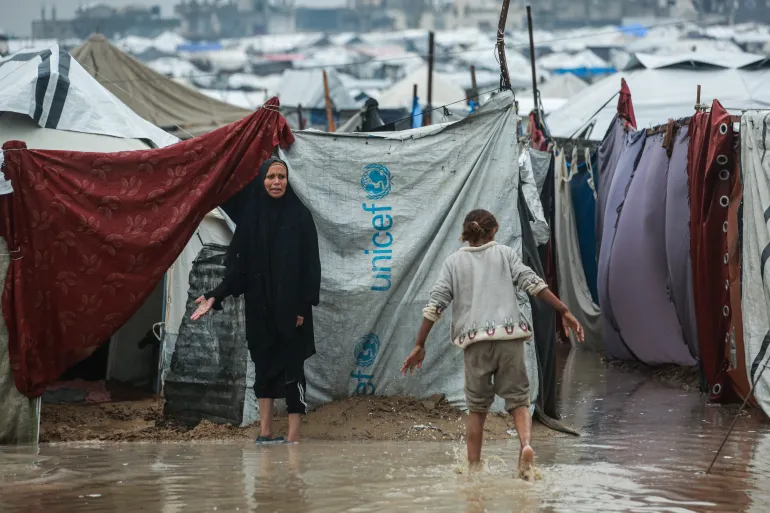
The onset of winter threatens to trigger further structural failures across the enclave. Heavy rain and water saturation penetrate weakened concrete structures, accelerating the degradation of cracked walls, compromised foundations, and exposed roofs. For families sheltering inside these damaged homes, severe winter weather turns pre-existing structural damage into an immediate threat to life.
The danger extends beyond sudden structural collapse. Rainwater leaks through shattered ceilings, flooding living quarters, destroying remaining household items, and rendering compromised shelters completely uninhabitable. For displaced Palestinians living in extreme poverty, even minor weather damage causes severe hardship.
Children, the elderly, and injured or disabled residents face the highest risk, as they are unable to evacuate quickly during a sudden collapse. Overcrowding in partially standing structures leaves families with zero room to move to safer areas during heavy storms.
Without systematic inspections, emergency reinforcement, and the evacuation of high-risk buildings, residents remain exposed to preventable loss of life. The enforced absence of alternative shelter leaves thousands of families with no choice but to endure the coming winter inside structures whose integrity has been shattered by war.
A Humanitarian Emergency Beyond the Loss of Property
The death of Abdul Rabbo Ashraf Al-Ashouh beneath a war-damaged house is not an isolated event; it is a direct consequence of the physical destruction of Gaza’s residential infrastructure. For thousands of Palestinians, losing a home does not end when the shelling stops; those seeking shelter in damaged structures face ongoing risks of injury, displacement, or death beneath crumbling concrete.
Meanwhile, the strict blockade on heavy machinery, building supplies, engineering tools, and temporary caravans prevents municipal teams from mitigating the danger.
Immediate international intervention is required to compel the entry of heavy machinery, structural testing equipment, and construction materials into Gaza, enabling emergency crews to stabilize compromised buildings and clear hazardous ruins. Furthermore, displaced families occupying unsafe structures must be provided with dignified alternative shelter ahead of severe winter storms.
In Gaza, the lethal impacts of war persist long after direct strikes. A fractured wall or a compromised roof remains a constant threat to civilians who have already survived immense trauma. Preventing further fatalities requires lifting the blockade, granting access to essential equipment, and delivering a coordinated emergency response to protect human life.
As winter approaches, leaving families trapped inside collapsing ruins is an unsustainable human disaster. The constant threat of collapse is a direct result of the devastation surrounding them, exacerbated by the enforced absence of safe shelter. Without urgent action, Palestinians who survived the destruction of their homes remain at risk of losing their lives beneath the debris left behind.