
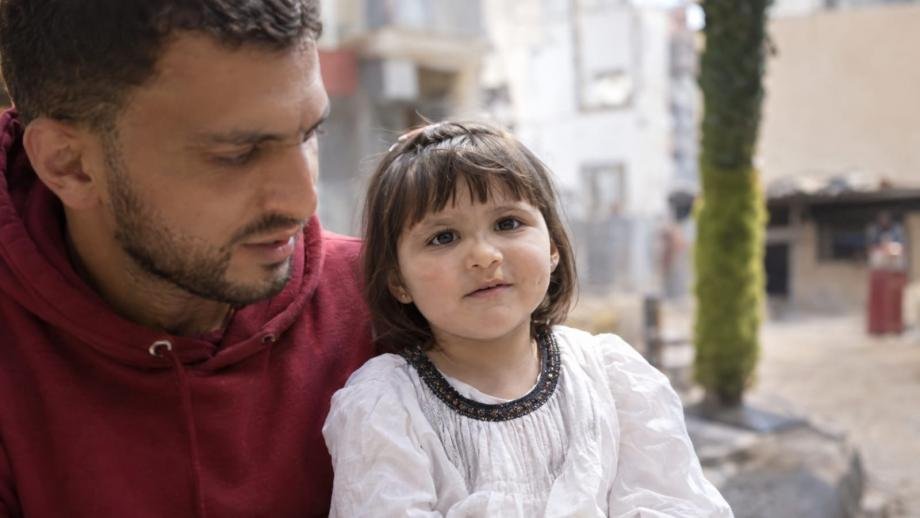
Gaza Herald — Mohannad asks his young niece for her name, and she replies confidently, “Rivan.” When he asks about her father, she responds softly, “Papa Ahmed.” These simple words encapsulate all that remains in the memory of a child pulled from the rubble after losing her entire immediate family: names she holds onto, faces she recognizes in photographs, and a void whose true magnitude she is still too young to comprehend fully.
Rivan was just 18 months old when an Israeli artillery strike struck her family’s shelter in Jabalia al-Balad, northern Gaza, on December 22, 2023. The bombardment killed her father, Ahmed, her mother, Hayat, and all of her siblings. Pulled alive from beneath the shattered concrete, covered in dust and injuries, Rivan emerged as the sole survivor of her nuclear family, embarking on a turbulent childhood defined by loss and continuous displacement.
Today, nearly two years and ten months later, Rivan lives with her uncle, Mohannad, alongside her grandmother, aunts, and extended relatives. As her family strives to nurture her through early childhood, the little girl keeps the memory of her immediate family alive by looking at their photographs and repeating their names, frequently saying that she loves them and that they are now in heaven.
A Tragic Night in Jabalia and Days of Forced Displacement
Recalling the moment of the strike, Mohannad explained to local journalists that two heavy artillery shells slammed into their shelter at approximately 5:00 PM, instantly killing his brother Ahmed, his sister-in-law, and their young children.
In the immediate chaos that followed, forced displacement scattered the surviving extended family members across different shelters, schools, and temporary refuges. Mohannad initially had no idea where his family members were or whether the little girl had survived.
“We were separated during the frantic displacement, but by the grace of God, we managed to reunite the next day at a university building in Gaza City,” Mohannad recounted. “Those first few days were exceptionally difficult. We fled our home with nothing but the clothes on our backs, unable to carry basic essentials Rivan needed, such as milk, diapers, or warm clothes.”
Overcoming initial supply shortages by sourcing items from local market stalls surrounding the displacement camps, the family faced deeper emotional hurdles. At an age when a child is inextricably attached to her mother, Rivan suddenly found herself without one. It took time for the toddler to adjust to her new caregivers, though she gradually bonded with her grandmother and aunts. The presence of her maternal aunt, who closely resembles her late mother, helped build a deep bond that brought the young girl comfort.
Preserving Memory Amidst an Ongoing Humanitarian Crisis
As Rivan grows older, her relatives actively preserve her connection to her parents and siblings. She points to family pictures, stating, “This is Baba Ahmed,” and frequently asks her uncle to write down their names. Her family speaks of them openly in her presence, encouraging her to pray for them while ensuring her daily needs are met.
However, Mohannad stresses that Rivan’s story is not an isolated one, but a reflection of thousands of orphaned Palestinian children across the northern, central, and southern districts of the Gaza Strip who have been left without immediate family support amidst relentless warfare and displacement.
He appeals to humanitarian organizations and generous donors worldwide to extend urgent assistance and comprehensive care to Gaza’s surviving orphaned children, who require specialized psychological support, nutrition, and basic living supplies.
For Rivan, who emerged from the rubble with only her life, she continues to grow up surrounded by relatives determined to restore a sense of familial warmth. She remembers the names of Ahmed and Hayat, keeping the story of her family alive through every photograph she touches.

