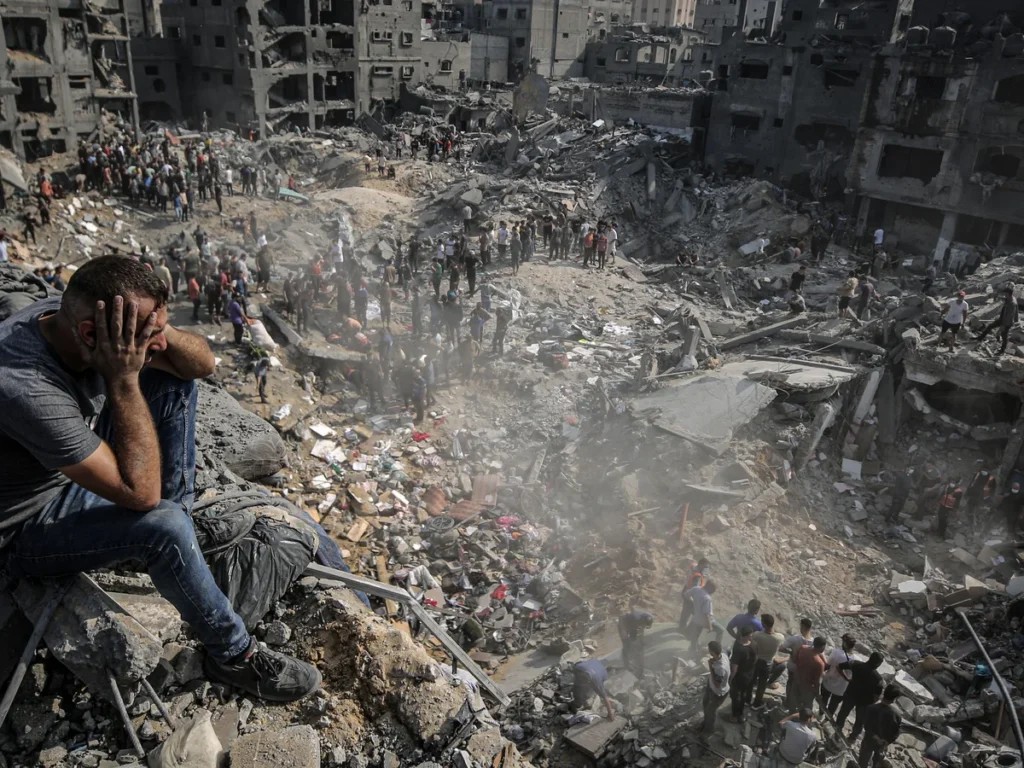
Gaza Herald — Gaza’s economic recovery remains severely constrained by a deepening energy crisis engineered by Israel’s systematic destruction of power infrastructure and the prolonged blockade on fuel imports, forcing remaining businesses and production facilities to rely on exorbitant private alternatives to survive.
The Gaza Governorate Chamber of Commerce, Industry and Agriculture warned on Sunday that manufactured power blackouts have become a primary barrier to reviving commercial life, demanding urgent action to lift restrictions on grid rehabilitation supplies and restore reliable electricity across the besieged Strip.
In a comprehensive report titled “Reviving Gaza’s Energy and Electricity Sector: From System Collapse to Economic Recovery,” the chamber detailed the catastrophic economic fallout of the grid’s destruction. The report warned that targeting power plants and enforcing an energy blockade have severely undermined commercial operations, crippled public utilities, and driven up the cost of basic survival.
The energy blockade leaves local manufacturers struggling to cover baseline operating expenses in an economy already devastated by widespread structural destruction, severe supply chain blockades, and a total freeze on raw materials. Without a functioning power grid, factories, agricultural cold storage units, and local service providers face monumental barriers to resuming work, paralyzing local food production, trade, and employment.
Enforced Energy Blackout Deepens Gaza’s Economic Paralysis
According to the chamber’s report, pre-war electricity supplies available in Gaza stood at approximately 240 megawatts against a peak demand of 450 megawatts. This structural deficit, long maintained by occupation controls on fuel and import lines, was turned into a complete system collapse after Israeli forces systematically targeted power stations, solar arrays, and distribution networks.
The destruction of physical energy infrastructure and the deliberate denial of grid repair parts have left Palestinian businesses with zero access to municipal power. This total outage impacts every sector of the local economy, which relies on consistent power to run production lines, preserve food stocks, maintain telecommunications, and pump clean water.
Electricity is the lifeblood of industrial production and basic commerce. When power is weaponized or made prohibitively expensive through blockades, local enterprises are forced to drastically cut output, absorb unsustainable losses, or permanently shut down.
For Gaza’s devastated private sector, the total absence of grid electricity represents an insurmountable barrier to rebuilding livelihoods. Even enterprises that survived physical bombardment find that the astronomical cost of generating private power makes local manufacturing financially impossible.
Dependence on Commercial Generators Drives Operating Costs to Crisis Levels
With public power lines severed and municipal generators deprived of fuel, commercial establishments are forced to rely on private neighborhood generator operators. However, this emergency alternative operates at predatory price points due to extreme fuel scarcity under the blockade.
The chamber’s report reveals that commercial generator power in Gaza currently costs between 25 and 35 shekels ($6.70–$9.40) per kilowatt-hour, a staggering tariff that drastically inflates production costs and renders local products completely uncompetitive against imported goods.
This financial drain impacts critical sectors requiring uninterrupted power, including medical equipment manufacturing, commercial bakeries, food processing plants, and water desalination facilities. For small businesses operating on depleted capital, purchasing generator power consumes virtually all operational revenue, leaving no funds for worker wages, structural repairs, or raw materials.
The chamber estimates that the monthly financial expenditure required just to maintain minimal private electricity in Gaza stands at approximately 225 million shekels ($60 million). Furthermore, direct and indirect losses inflicted on the energy sector have surpassed $1.4 billion, illustrating the massive scale of destruction engineered throughout the assault.
These figures demonstrate how the deliberate destruction of energy infrastructure acts as an economic weapon. The exorbitant cost of alternative fuel cripples local production, deepens market dependency on outside aid, and prevents the Palestinian private sector from recovering.
Rebuilding the Power Grid Demands an Immediate End to the Blockade
To prevent total economic death, the chamber demanded the immediate lifting of Israeli restrictions on electrical supply lines and the entry of heavy maintenance equipment. It called for the urgent entry of spare parts, transformers, high-voltage cables, and technical supplies required to repair pulverized distribution networks.
The report emphasized that true economic stabilization requires restarting Gaza’s central power plant, rebuilding destroyed regional transformer stations, and repairing municipal distribution grids. These measures are essential to deliver affordable electricity to commercial centers, medical facilities, and residential neighborhoods.
The chamber also pointed to solar energy as a vital pillar for long-term energy independence, noting that widespread solar installations could decentralize power and bypass grid vulnerabilities. However, expanding solar capacity remains blocked by occupation prohibitions on importing photovoltaic panels, lithium batteries, and inverter units under the pretext of “dual-use” restrictions.
The report stressed that allowing the unhindered entry of industrial fuel and technical equipment is a prerequisite for any physical recovery. Without these supplies, municipal technicians remain incapable of restoring basic power, locking Palestinian businesses into permanent dependency on scarce, high-cost generator fuel.
Restoring power generation must be paired with immediate field access for electrical engineering crews. The chamber’s findings highlight that economic survival is impossible without lifting the siege on energy infrastructure.
Economic Survival and Reconstruction Depend on Restoring Power
The Chamber of Commerce affirmed that rebuilding Gaza’s energy sector is directly linked to the survival of the Palestinian population. Reliable, affordable electricity is the fundamental prerequisite for reopening factories, restoring local agricultural markets, creating jobs, and operating basic civil services.
Without a functioning power grid, physical reconstruction remains paralyzed. Heavy machinery, water treatment facilities, and construction material processors cannot operate without continuous energy. This creates a destructive loop: targeted infrastructure damage inflates operational costs, high expenses shut down local businesses, and reduced domestic production deepens poverty and reliance on aid.
This crisis directly devastates household livelihoods. When local factories cannot afford fuel, employment opportunities vanish, family incomes collapse, and access to locally produced goods disappears. The restoration of power is therefore not merely a technical issue, but an urgent humanitarian requirement to prevent the total liquidation of Gaza’s domestic economy.
Gaza’s electricity catastrophe illustrates the broader policy of dismantling the Strip’s productive capacity and civil infrastructure. Rebuilding the electrical grid, supplying industrial fuel, permitting repair equipment, and expanding renewable solar installations are immediate prerequisites to ending economic paralysis.
Ultimately, economic recovery cannot be separated from lifting the blockade that holds Gaza’s infrastructure hostage. As the Chamber of Commerce report confirms, unless restrictions on energy supplies and repair equipment are lifted immediately, Gaza’s productive sector will remain paralyzed by artificial operating costs, leaving two million Palestinians trapped in engineered economic devastation.