
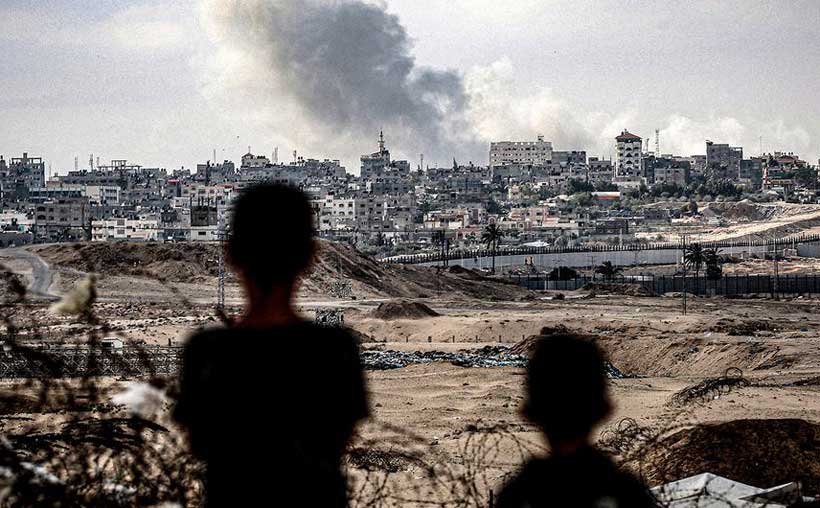
Gaza Herald — Continued obstruction of Gaza’s reconstruction, escalating Israeli military attacks, and expanding territorial control threaten to render the Strip uninhabitable, opening the door to forced displacement and destroying prospects for a political settlement, according to an analysis published by the U.S. magazine Foreign Affairs.
Writing in Foreign Affairs, Khaled Elgindy, senior fellow and author of Blind Spot: America and the Palestinians from Balfour to Trump, warned that the stalling of the U.S. peace plan risks losing Gaza permanently amid unchecked Israeli violations and a lack of effective U.S. pressure on Benjamin Netanyahu’s government.
Elgindy emphasized that the ceasefire agreement, which entered into force in October 2025, has failed to implement core commitments regarding aid entry and basic services. Over a year later, no meaningful reconstruction of homes, hospitals, water networks, or power grids has begun, despite promises by Jared Kushner, U.S. President Donald Trump’s envoy assigned to the dossier, that infrastructure repairs would commence within 100 days.
A Systemic Humanitarian Disaster
With recovery efforts completely stalled, most of Gaza’s population continues to survive in overcrowded makeshift tents lacking clean water, healthcare, and sanitation. Severe shortages of food and medicine, compounded by spreading disease, have intensified the humanitarian disaster.
Paralleling this social collapse, Israeli occupation forces have maintained active operations despite the truce, killing more than 1,400 Palestinians over the past year. Furthermore, Israeli military control has expanded to encompass approximately 65% of the Gaza Strip’s total land area.
Elgindy warned that what is unfolding extends far beyond an ordinary humanitarian failure. The current trajectory serves a strategic Israeli objective: rendering Gaza completely unlivable to pressure its Palestinian population into leaving.
Political Paralysis and Washington’s Complicity
Under the framework outlined in the U.S. plan, reconstruction was meant to begin alongside:
The establishment of a Palestinian technocratic administration.
The deployment of an international stability force.
The phased disarmament of Hamas alongside a full Israeli military withdrawal.
However, Netanyahu has refused any military withdrawal before total disarmament, while Hamas maintains that disarmament must be linked directly to an Israeli withdrawal. Although Hamas, under pressure from regional mediators, agreed to a compromised disarmament framework, the Israeli government rejected the roadmap announced in July 2026, further crippling implementation.
Elgindy sharply criticized Washington’s diplomacy, arguing that the U.S. publicly adopts Israeli positions while offering contradictory assurances to other parties. This imbalance allows the stronger party to dictate terms and perpetuate the status quo.
Netanyahu continues to exploit this political paralysis, using the demand for complete disarmament to justify the permanent presence of occupation forces inside the Strip and maintain the support of his far-right coalition partners.
The Danger of Permanent Displacement
The U.S. analyst warned that continued political and military stagnation risks provoking a new wave of violence, accelerating the forced expulsion of Palestinians, and worsening regional instability.
Prolonging the occupation will not guarantee security for Israel; rather, it deepens its international isolation and undermines regional normalization efforts.
Despite the structural flaws in the Trump administration’s plan, Elgindy noted that saving the framework remains possible if Washington and regional mediators exert genuine pressure to enforce synchronized implementation. This requires:
Imposing real consequences on parties obstructing the process.
Permitting the entry of a Palestinian administration and police force.
Unlocking aid flows and restoring essential services without political preconditions.
Ultimately, Gaza’s future hinges on whether the U.S. administration is willing to confront the Netanyahu government instead of granting it more time to complete the destruction. Without decisive intervention, the current phase will not mark the beginning of recovery, but rather the foundation for generations of continued violence, displacement, and regional chaos.

