
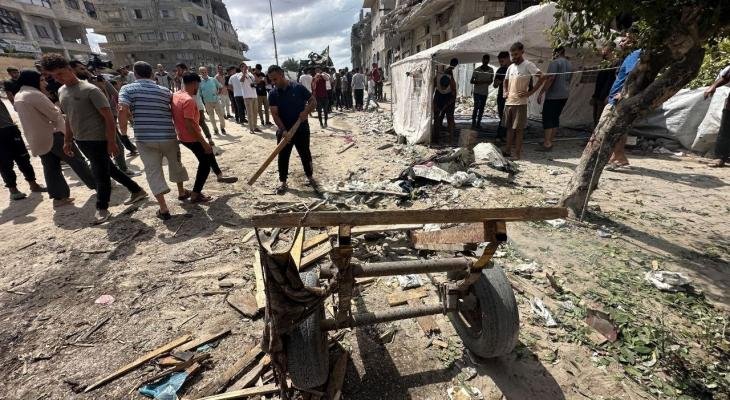
Gaza Herald — Across the Gaza Strip, simply moving from one place to another has become a daily struggle. Widespread destruction, severe fuel shortages and the collapse of much of Gaza’s conventional transportation system have pushed residents to rely on improvised vehicles to reach hospitals, search for food and travel between devastated neighborhoods.
On Wednesday, that fragile lifeline was itself struck.
An Israeli airstrike hit a public transport vehicle towing a makeshift passenger trailer in Gaza City’s Tal al-Hawa neighborhood, killing five Palestinians and injuring at least 13 others. The attack underscored the dangers facing civilians even while using the rudimentary forms of transportation that have emerged amid Gaza’s devastated infrastructure.
A Deadly Strike on Makeshift Public Transport
The Israeli airstrike targeted the vehicle in the Council of Ministers area of Tal al-Hawa, southwest of Gaza City.
Local reporting identified it as a public transport vehicle towing an improvised passenger trailer known locally as an “aqala.” One report said the vehicle was carrying passengers when it was struck and that some of the wounded were in critical condition.
The Palestinian Red Crescent Society said its ambulance crews transported five Palestinians killed in the strike to Al-Shifa Hospital and 13 wounded people to the PRCS-run Al-Quds Hospital. Some local reports put the number of wounded at 15.
For Palestinians in Gaza, such vehicles are no longer an unusual sight. They have become part of a makeshift transportation network born out of destruction and necessity.
From Transport Collapse to Makeshift Alternatives
The widespread use of the “aqala” emerged as destruction, fuel shortages and disruption to Gaza’s transportation system left residents with increasingly limited ways to travel.
The vehicle typically consists of a trailer adapted to carry passengers and pulled by another vehicle. With conventional transportation increasingly difficult to access, these makeshift trailers have become a common way for Palestinians to travel through Gaza.
They offer little comfort or protection. Passengers often travel in exposed trailers over damaged roads, enduring difficult conditions simply to reach workplaces, markets, hospitals or other parts of the Strip.
Yet for many families, the alternative is walking long distances through a territory where roads, neighborhoods and basic infrastructure have been heavily damaged.
When Basic Movement Becomes a Risk
Wednesday’s attack highlights a broader reality facing Palestinians in Gaza: the destruction of conventional infrastructure has forced civilians to depend on increasingly fragile alternatives for the most basic aspects of daily life.
Transportation is not simply about convenience. For a patient trying to reach a hospital, a family searching for food or a worker attempting to cross Gaza City, access to a functioning vehicle can determine whether essential services remain within reach.
The improvised transport network helps bridge some of the gaps left by the destruction of Gaza’s conventional transportation system. But its passengers remain exposed, and Wednesday’s strike demonstrated how quickly an ordinary journey can become deadly.
Gaza’s Fragile Lifelines
As Gaza’s infrastructure has deteriorated, Palestinians have repeatedly adapted to keep daily life functioning — using improvised transportation, temporary shelters and other makeshift systems to replace services that have been destroyed or severely disrupted.
The “aqala” has become one visible symbol of that adaptation: a rudimentary passenger trailer serving communities where ordinary transportation has become increasingly scarce.
The strike in Tal al-Hawa exposed the vulnerability of even these basic alternatives.
For Palestinians already navigating destroyed roads, fuel shortages and limited transportation, the attack adds another layer of fear to something as ordinary as getting from one neighborhood to another.
In Gaza, even the makeshift systems created to keep civilian life moving now operate under the shadow of military attack.

