
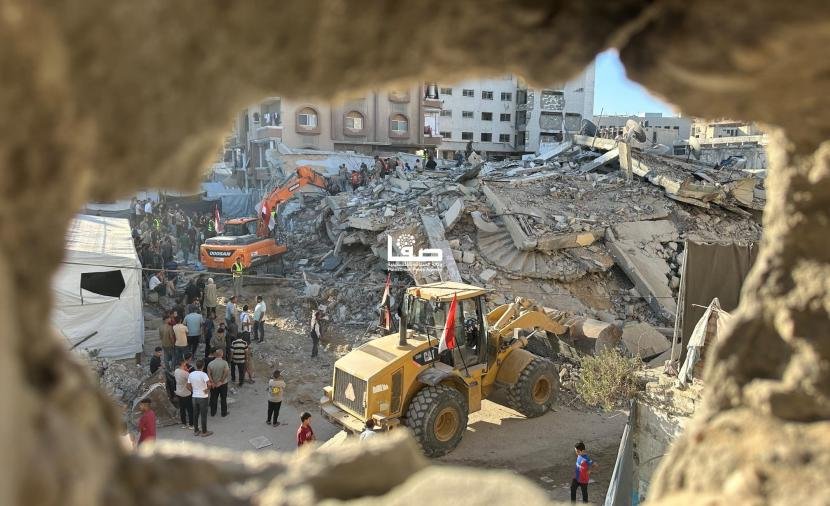
Gaza Herald — On Beirut Street in Gaza City’s Tel al-Hawa neighborhood, UN engineer Ahmed Alyan works under a scorching sun to clear wreckage from a thoroughfare once vibrant with shops and homes. Despite a day of grueling labor, the surrounding mountains of debris barely seem to diminish, prompting Alyan to remark that he feels as if his team is holding a spoon and trying to empty the sea.
His struggle reflects what international experts describe as one of the largest and most complex rubble-clearance operations in modern history, as Gaza remains buried under an estimated 61 million tonnes of war debris, a volume approximately 20 times greater than all rubble generated by global conflicts combined over the past 18 years.
A Sea of Ruins: The Monumental Scale of the Debris Crisis
According to Jaco Cilliers, the UN Development Programme’s (UNDP) special representative in Palestine, removing Gaza’s war debris could take 7 to 10 years and require billions of dollars in international funding. Over two years into clearance efforts, workers have removed approximately 907,000 tonnes and recycled 300,000 tonnes, representing a mere 1.5 percent of the total volume.
The physical operation is severely constrained by strict import restrictions imposed by Israeli authorities, who prohibit essential heavy machinery, spare parts, engine oil, and construction equipment under “dual-use” classifications.
Furthermore, as military control lines shift, less than 30 percent of the Gaza Strip remains accessible to civilians and aid workers, leaving little space to transport or store collected debris, while local crews are forced to rely on heavily worn equipment, including just seven crushing machines across the enclave, two of which were makeshift units built from spare parts by local engineers.
The Human Reality Buried Beneath the Rubble
Removing debris is not merely an engineering challenge; it is a deeply sensitive humanitarian operation. Official estimates cited by the UNDP indicate that between 8,000 and 10,000 bodies remain unrecovered beneath the ruins, making the clearance process emotionally delicate for surviving families.
Teams must navigate severe hazards including unexploded ordnance, compromised building foundations at risk of sudden collapse, and toxic airborne materials such as asbestos fibers.
To handle these risks, UNDP teams coordinate closely with the International Committee of the Red Cross (ICRC) to prioritize search-and-recovery sites, institute forensic identification procedures, and issue formal death certificates so grieving families can perform proper religious burials.
Recycling War Debris as a Survival Strategy
With natural construction materials completely blocked from entry, aid agencies like the World Food Programme (WFP) and UNDP have resorted to processing crushed concrete to maintain basic civilian infrastructure. Crews manually sort collected rubble from destroyed buildings to separate concrete from structural steel rods and metals, before transferring it to five specialized yards where crushing plants process the concrete down to small stones roughly the size of marbles.
The resulting aggregate is then deployed to fill road potholes for emergency vehicles and layered beneath temporary shelters to elevate displaced families above standing sewage and rainwater, serving as an imperfect but necessary substitute for standard building supplies.
Modest Signs of Life Amid the Destruction
Despite the overwhelming volume of debris, clearing even small stretches of road brings immediate relief to localized communities across the enclave. In areas like Tel al-Hawa, clearing wreckage reduces pest infestations, widens access for relief trucks, and creates safer spaces for children living in adjacent tent encampments.
Furthermore, removing wreckage from destroyed storefronts has provided a spark for local economic resilience, with UN estimates showing that when debris is cleared from commercial properties, many shop owners manage to reopen small trade operations within 20 days, providing essential goods to more than 2.1 million displaced residents surviving in temporary shelters.

