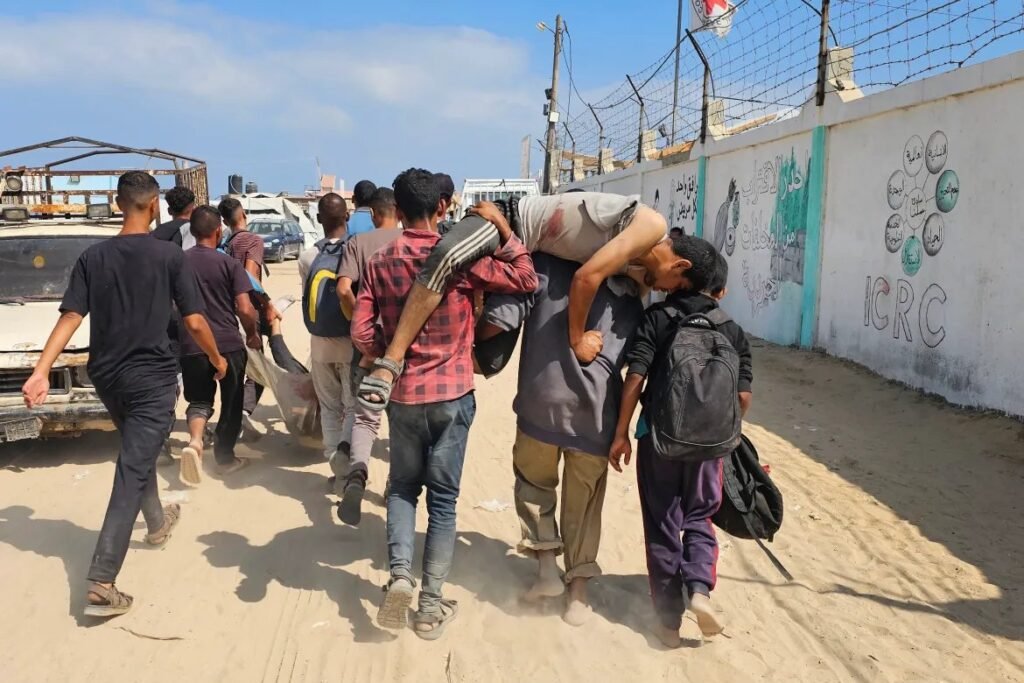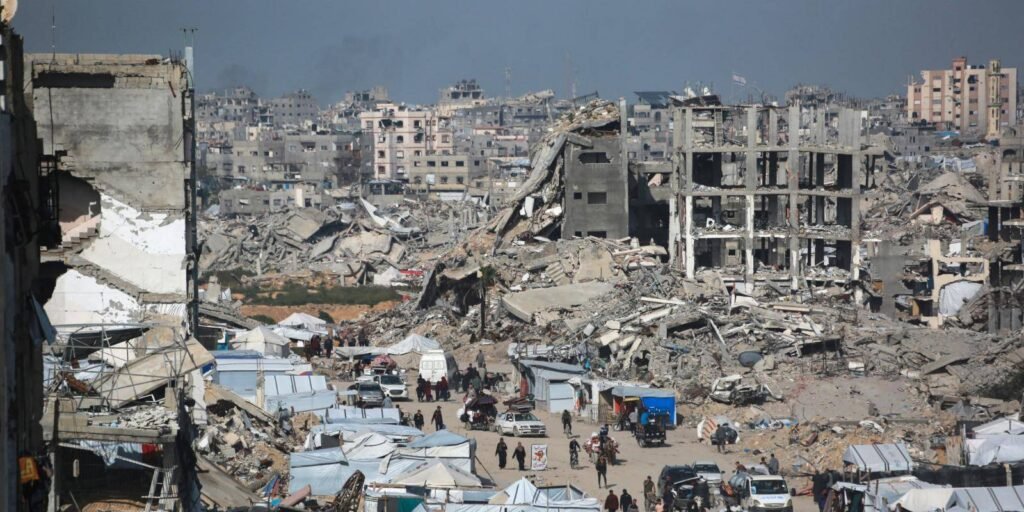
Gaza Herald — More than a year after Israel’s total war flattened Gaza’s civil infrastructure, institutions, and community life, a newly formed Palestinian technocratic body claims it stands fully prepared to assume civil administration. Yet behind its administrative declarations lies a stark reality: the committee’s deployment remains indefinitely stalled, subordinated to foreign vetoes and verification mechanisms rather than bound by a sovereign timeline.
On September 23, Nickolay Mladenov, Senior Envoy and High Representative for Gaza under the US-backed Board of Peace, confirmed that the National Committee for the Administration of Gaza (NCAG) has finalized its operational framework. However, Mladenov’s announcement contained a critical caveat: no start date has been authorized.
Instead of establishing a firm transition, the framework locks Palestinian civil life behind a multi-stage international verification regime. This design leaves millions of Palestinians waiting to see whether external overseers will grant a local committee permission to enter Gaza and address an overwhelming humanitarian catastrophe.
Formed in January 2026 under UN Security Council Resolution 2803, the NCAG is framed as an apolitical, Palestinian technocratic body tasked with managing essential public services, urgent recovery, and internal security. In practice, however, its design ensures it functions strictly under the direct supervision of the international Board of Peace, explicitly stripped of any mandate to represent Palestinians politically or diplomatically abroad.
A Technocratic Shield for Political Paralysis
The NCAG is headed by Chief Commissioner Dr. Ali Shaath, who holds acting responsibility for energy, transport, and religious affairs. Its executive council comprises 13 Gaza-based Palestinian technocrats overseeing specialized portfolios, including Abdel Karim Ahmed Ashour for Agriculture, Omar Shamali for Communications and Digital Affairs, Hanaa Hanna Nicola Tarazi for Social Protection, and Ayed Awni Abu-Ramadan for Economy, Industry, and Trade.
Education is overseen by Dr. Jabr Ibrahim El-Daour, Finance and Treasury by Dr. Bashir Rayyes, Health by Dr. Aed Mahmoud Yaghi, Interior by Sami Nasman, Justice by Adnan Salem Abu Warda, Housing by Osama Al-Saadawi, Water and Local Authorities by Dr. Ali Shehda Barhoum, and Civil Peace by Hossni Al-Mghani.
While presented as an administrative mechanism formed through consensus among Palestinian factions under Resolution 2803, this structure reveals a core institutional weakness: it separates public administration from political self-determination. By framing governance purely as a technical exercise to maintain basic services until Palestinian Authority reforms satisfy international criteria, the arrangement treats Palestinian statehood not as a right, but as a distant reward conditional on external approval.
Sovereignty Outsourced: Foreign Frameworks and External Control
The NCAG operates without independent political sovereignty. Its mandate functions strictly within the post-war framework advanced by the Trump administration and authorized under UN Resolution 2803. Primary supervisory authority belongs to the Board of Peace, executed on the ground through High Representative Mladenov.
This creates an unprecedented structural paradox: while the committee is staffed entirely by Palestinian technocrats, their operational authority, implementation timeline, and day-to-day capacity are controlled by foreign oversight bodies.
Furthermore, the committee’s temporary charter makes its interim status conditional on the Palestinian Authority completing required institutional reforms. By tying civil administration in Gaza to external prerequisites, the framework establishes a structure where Palestinian governance remains perpetually subject to foreign evaluation and leverage.
High Responsibilities, Constrained Authority
The operational burdens assigned to the committee are vast, yet its autonomy to address them remains severely restricted. Its mandated responsibilities include managing basic public infrastructure, auditing financial institutions, securing public assets, protecting consumer rights, and coordinating healthcare, education, municipal water, and agricultural networks.
Under the Board of Peace’s July 2026 Gaza Roadmap, the NCAG is also expected to conduct comprehensive financial audits, manage contractor obligations, oversee local police units, and coordinate a phased transfer of civil weapons custody. However, key levers of recovery, including reconstruction blueprints, donor allocations, and resource flows, remain subject to joint approval and control by the Board of Peace.
Chief Commissioner Dr. Ali Shaath noted that the committee has developed 71 operational programs spanning infrastructure, health, security, and economic recovery, with a phased rollout planned from Rafah northward through Khan Younis, the central camps, Gaza City, and Northern Gaza. Yet, executing these plans depends entirely on whether foreign authorities grant the necessary operational clearances and funding access.
The Reality of Deployment: Conditional Access and Endless Delay
The core contradiction of Mladenov’s announcement lies in the gap between technical readiness and physical deployment. While the July roadmap outlined 14-day implementation windows following approval, real-world progress remains bound to requirement mechanisms administered by the International Verification Committee.
Under this system, the NCAG cannot operate inside Gaza until foreign inspectors verify that complex preconditions have been satisfied. These conditions tie humanitarian relief and civil administration directly to the deployment of a multilateral International Stabilization Force, the verification of weapons decommissioning protocols, and the phased withdrawal of Israeli forces from populated zones.
By linking basic civilian administration to these complex diplomatic and military checkpoints, the international framework effectively turns essential governance into a leverage point. As long as Israeli military movements, political preconditions, and international verification procedures take precedence over immediate deployment, the technocratic committee remains confined to paper preparations, while millions of Palestinians in Gaza endure extreme deprivation without functioning public institutions.