Gaza Herald _ A photograph documenting young Palestinians playing football among the ruins of Gaza has become the center of a growing political and cultural controversy in France after it was unexpectedly removed from an exhibition at the Deauville Sports Photography Festival.
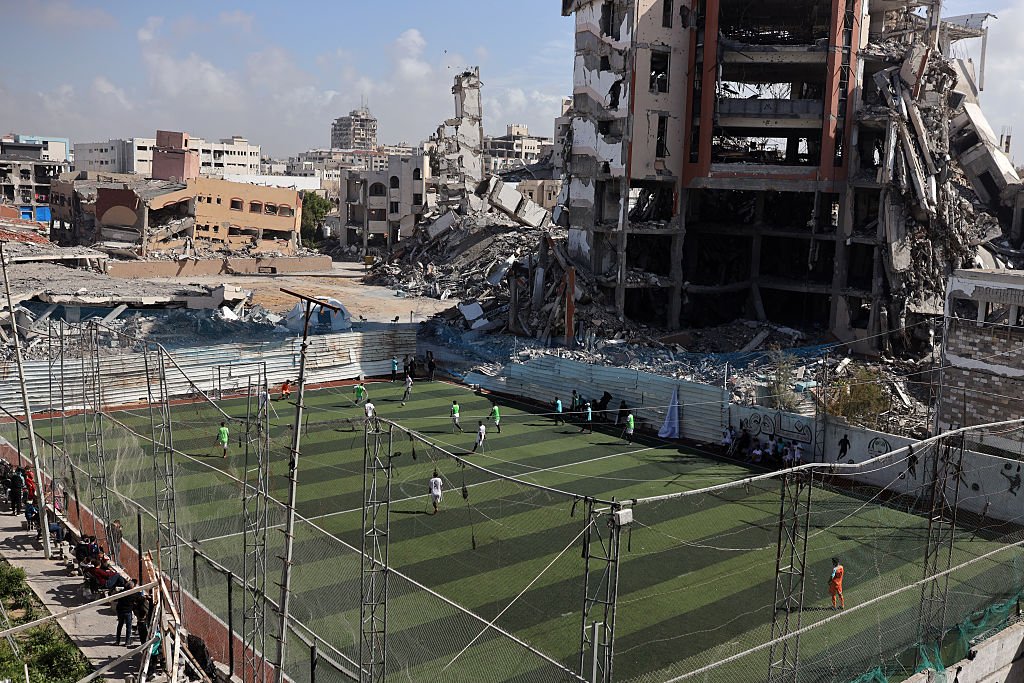
The photograph, taken by Palestinian photographer and Associated Press journalist Jihad Al-Sharafi, shows young Palestinians playing football on a rehabilitated field in Gaza City, surrounded by buildings destroyed during the war.
The image had been scheduled to remain on display at the festival until September 6 as part of an exhibition exploring the relationship between sport and everyday life. It was suddenly taken down and replaced with a photograph of cyclists, without an immediate clear explanation for the change.
According to the French newspaper L’Humanité, the removal followed pressure from pro-Israel supporters. Deauville’s municipal authorities said the decision was intended to prevent controversy and avoid offending any side. The municipality acknowledged receiving requests concerning the photograph but did not clearly identify those who had submitted them.
A photograph of life, not combat
What made the controversy particularly striking was the content of the image itself.
The photograph does not show an airstrike, armed fighters or a battlefield. Instead, it captures young Palestinians playing football.
Yet the destruction surrounding the field gives the scene a deeper meaning. The players appear to be attempting to reclaim a small piece of normal life in a city transformed by war.
The image therefore became more than a sports photograph. It captured an attempt by young Palestinians to preserve recreation, community and everyday life despite the devastation around them.
How the photograph disappeared
Sylvain Larcher, a local Socialist Party official, noticed that the photograph had disappeared while visiting the exhibition and questioned why an image showing nothing more than a football match surrounded by destruction had been removed.
The controversy grew after reports emerged that pro-Israel activists had campaigned against the photograph, describing its display as favorable to the Palestinian narrative.
Activist Mike Kreif was among those who publicly opposed the image and later celebrated its removal, presenting the decision as a result of the campaign against it. He also described himself as a “very extreme Zionist.”
His statements added to the criticism surrounding the decision, particularly because they came as the photograph disappeared from the exhibition.
There has been no official confirmation that Israeli pressure directly determined the removal. However, the timing of the campaign, the disappearance of the photograph and the public celebration by some of its critics have intensified questions in France and beyond.
Political and rights groups respond
The controversy quickly moved beyond the festival and into political circles.
European Parliament member Emma Fourreau sent a letter to the festival organizers and Deauville authorities, criticizing what she viewed as an attempt to suppress Palestinian representation in cultural and artistic spaces.
Former European Parliament member Mick Wallace also criticised the decision, saying it reflected growing restrictions on the ability to present Palestinian perspectives in Europe.
Meanwhile, journalists, bloggers and activists began sharing the photograph widely across social media, turning it into a symbol of the wider debate over Gaza, censorship and freedom of expression.
Removing the photograph made it more visible
Ironically, taking the image off the exhibition wall appears to have given it a far larger audience.
Instead of remaining one photograph among many at a sports photography festival, it became the subject of widespread discussion about Gaza, censorship and the role of journalism in documenting war.
Journalist Leila Hamed said the removal reflected growing sensitivity toward images documenting Palestinian life in Gaza, while academic Zachary Foster criticised what he described as an unequal approach to photographs depicting Palestinian suffering.
Some activists also warned that the visibility of the football field could potentially expose the location to danger, reflecting broader concerns among Palestinians about the safety of remaining civilian spaces across Gaza.
Sport has also paid a heavy price
The photograph cannot be separated from the devastating impact of the war on Palestinian sport.
Since the outbreak of the war in October 2023, sports facilities across Gaza have suffered extensive destruction, while Palestinian athletes have also faced enormous human losses.
According to estimates from the Palestinian Olympic Committee cited in the report, around 400 Palestinian athletes have been killed in the war in Gaza and the West Bank, while numerous sports facilities have been destroyed and organised sporting activity in Gaza has largely come to a halt.
Against this backdrop, Al-Sharafi’s photograph represents far more than a football match.
It captures young people attempting to reclaim a sense of normality in a landscape of destruction. The ruined buildings surrounding the pitch form part of the image, but so does the decision of the players to keep playing.
A photograph that could not be erased
Deauville authorities said they sought to avoid controversy by removing the image. Instead, the decision created an even larger controversy.
The photograph that was removed from a festival wall moved into the wider public sphere, where it became part of a debate over Gaza, freedom of the press, censorship and the right to document Palestinian life.
What began as a photograph of young people playing football amid the ruins ultimately became a question about who gets to tell Gaza’s story and whether even an image of young Palestinians trying to play a simple game can escape the political pressures surrounding the war.