
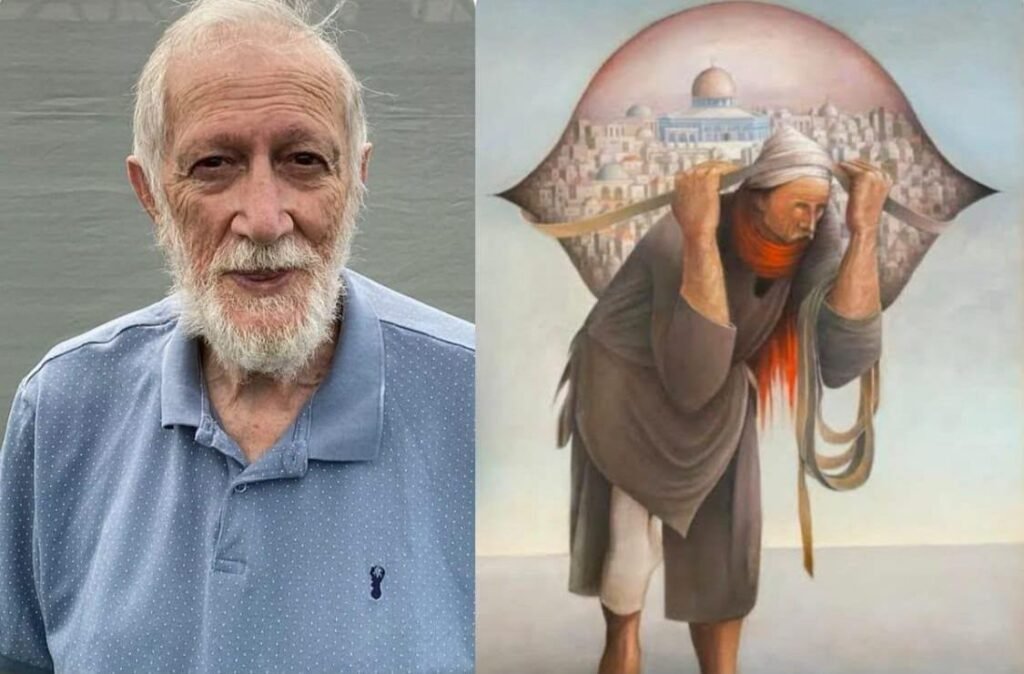
Gaza Herald – Palestinian artist Suleiman Mansour, one of the most influential figures in modern Palestinian art, has died at the age of 84, leaving behind nearly five decades of work devoted to preserving Palestine’s history, identity, land and collective memory.
Mansour did far more than paint Palestine. Through hundreds of works, he turned art into a form of cultural resistance, documenting a people’s connection to their homeland through images of Jerusalem, Palestinian villages, olive trees, orange groves, traditional clothing and generations of Palestinian women and farmers.
His most iconic work, Camel of Burdens, first painted in 1973, became one of the most recognizable images of Palestinian identity. It depicts an elderly Palestinian man, bent beneath the weight of Jerusalem carried on his back, a powerful symbol of Palestinians carrying their homeland, history and displacement with them wherever they go.
Across his career, Mansour repeatedly returned to the land as a central subject. His paintings portrayed Palestinian women as mothers, farmers, intellectuals and figures of steadfastness, while traditional Palestinian dress became a visual expression of cultural identity and belonging.
His work also challenged the erasure and reshaping of Palestinian history. Trees, crops, cities and everyday rural life became recurring symbols of roots and continuity, transforming his paintings into visual records of a homeland whose physical landscape and cultural heritage have been repeatedly threatened by occupation, displacement and destruction.
Mansour also brought Palestinian identity into religious imagery. In one of the most striking aspects of his work, he depicted Jesus with Palestinian and Arab features and, in some works, with the keffiyeh, reclaiming the figure within the historical and cultural landscape of Palestine rather than the predominantly European imagery through which he has often been portrayed in Western art.
For generations of Palestinians, Mansour’s paintings became more than works of art. They became vessels of memory, carrying the image of a homeland across generations, preserving places, traditions and symbols that Palestinians have fought to keep alive.
With his death, Palestine loses one of its most important cultural voices. But the world he spent decades painting remains alive in his work: a Palestine rooted in land, memory, identity and an enduring refusal to be erased.

