
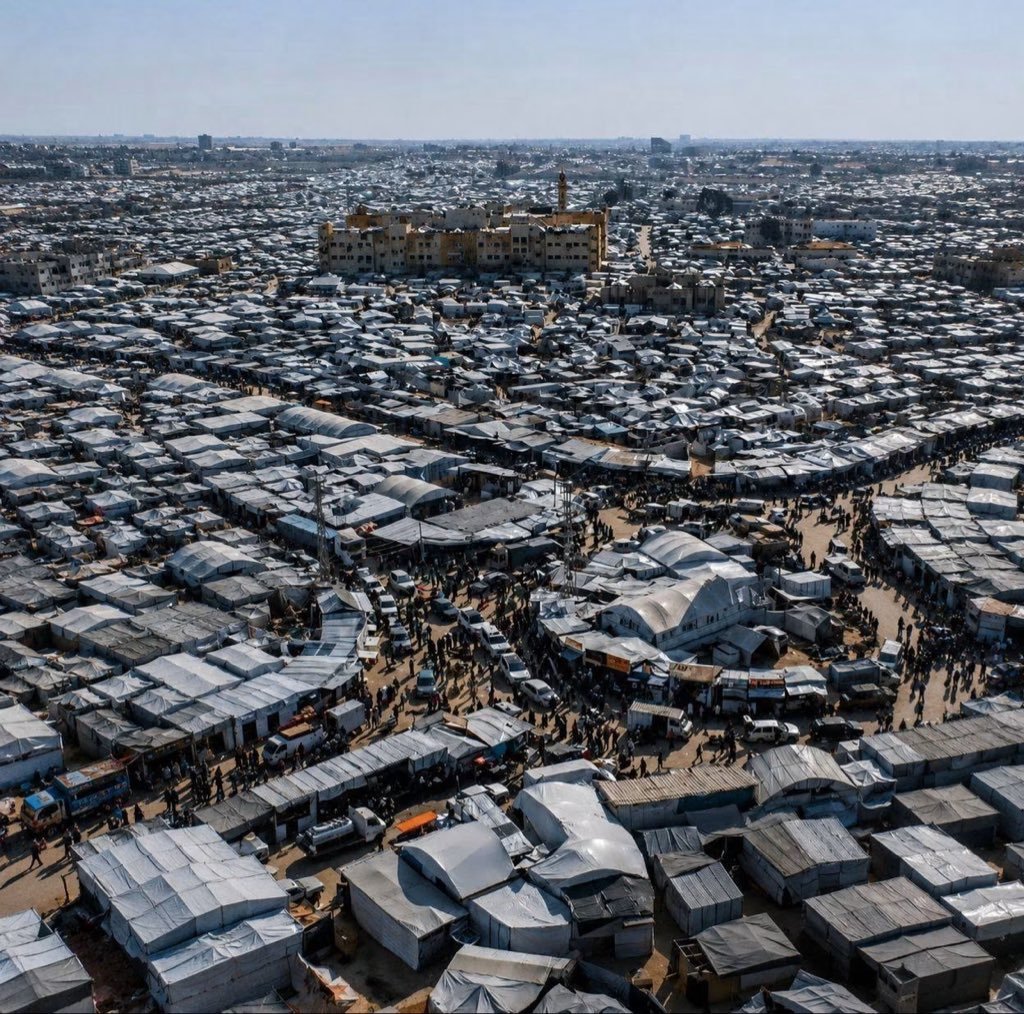
Gaza Herald — On the rooftop of her destroyed home in Gaza City’s Beach refugee camp, Umm Mohammed al-Bayad lives with her children inside a small tent, trying to endure another scorching summer with almost nothing to protect them from the heat.
Holding a piece of cardboard and waving it over her children’s faces, she tries to create a little relief from the suffocating heat and humidity. Her children, who live with autism spectrum disorder, struggle particularly hard to cope with the extreme conditions.
There is no electricity to power a fan.
In Gaza, an electric fan, once an ordinary household appliance, has become a costly luxury for displaced families. The restrictions on goods entering the besieged Strip, widespread destruction, electricity shortages and the soaring cost of generator power have pushed basic cooling far beyond the reach of many families.
For families living in tents, even several hours of relief from the heat can carry a price they simply cannot afford.
Heat, illness and a family’s daily struggle
For Umm Mohammed, the crisis is compounded by her children’s health needs and her family’s financial hardship.
She says a fan that cost around $30 before the war can now cost as much as $300.
Even finding the money to buy one does not solve the problem. Running it requires electricity from commercial generators, where the price of a kilowatt-hour has risen to more than $11, compared with around $1 before the war.
Her husband is unemployed, leaving the family with little income to meet even the most basic needs.
She hopes the suffering will end and that families in Gaza will once again have access to the basic necessities of life.
Cardboard replaces the electric fan
Inside another worn-out displacement tent, the August sun pours through the fabric as Hadi al-Absi tries to cool his children with whatever is available.
He sprays water over their bodies and uses a piece of cardboard as a makeshift fan.
The routine repeats every day until sunset.
Al-Absi describes the inside of the tent as resembling an incubator because of the intense heat and humidity. For his family, an electric fan has become almost impossible to obtain.
Even if he could buy one, he says, the cost of operating it would be beyond the means of a family without steady work or income.
The family relies on spraying water, moving outdoors in search of a breeze and using cardboard to fan the children as they try to sleep at night.
Prices soar as supplies disappear
Mohammed Abu Hasira, who runs an electrical appliance store, says the dramatic increase in fan prices is linked to restrictions on the entry of goods and the destruction of large numbers of homes and businesses across Gaza.
Fan prices have risen by more than 700%, he says.
With new appliances difficult to obtain, repair workers increasingly salvage spare parts from several damaged fans to restore a single working unit.
Families are also turning toward models that consume less electricity, even when their cooling performance is limited.
Repairs become another obstacle
Repair technician Taha Haboush says finding spare parts has become increasingly difficult, often requiring searches across different parts of Gaza.
That scarcity has driven up repair costs and made it harder for displaced families to maintain whatever appliances they still possess.
He says it is particularly difficult when families arriving from displacement camps cannot afford repairs or new appliances, especially when the price of a fan itself approaches $200.
As a result, more residents are choosing less efficient fans simply because they consume less electricity.
When cooling down becomes a luxury
Gaza’s summer crisis is no longer simply about enduring high temperatures.
For families living in displacement tents, staying cool depends on electricity they cannot afford, appliances they struggle to find and supplies that remain severely limited.
A fan that once provided a simple moment of comfort has become a symbol of how war and displacement have transformed even the most basic necessities into unattainable luxuries.
For Gaza’s displaced families, sometimes survival means little more than a piece of cardboard, a splash of water and the hope of finding a breeze.

