
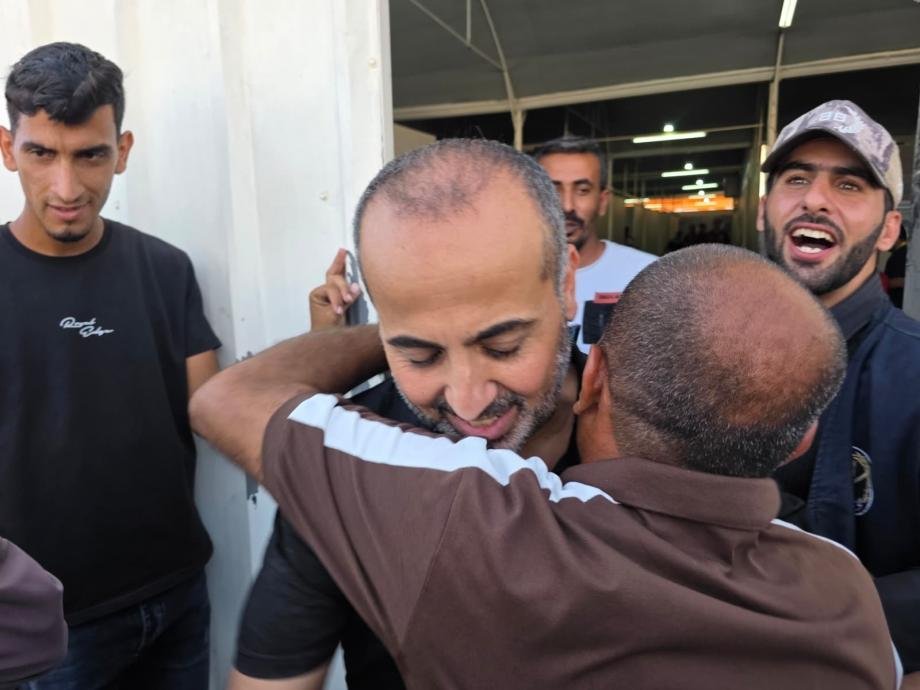
Gaza Herald — Tears overcame Ahmed Abdul Karim al-Siqli as the bus carrying newly released Palestinian detainees crossed back into the Gaza Strip. It was the first time he had seen his hometown in years. The long-awaited return brought overwhelming relief, but also unimaginable grief. The family he had left behind no longer existed as he remembered it.
Al-Siqli, who had been working inside Israel before his detention, said his ordeal began shortly after the war erupted in October 2023.
“I was working there, and after the war started, we moved to the occupied West Bank,” he told Filastin newspaper. “A few weeks later, at around two o’clock in the morning, Israeli soldiers raided the place where we were staying in Qalqilya. They stormed in violently, shouting, beating us, and searching the building before taking us to a military site for interrogation.”
He said he was later transferred to Ofer Prison after being moved through several detention facilities.
“The first days were the hardest,” he recalled. “The conditions were extremely harsh. What we lived through cannot be described in words.”
Throughout his detention, al-Siqli had almost no information about what was happening to his family in Gaza as Israeli attacks devastated the enclave and destroyed entire neighborhoods.
Then came the news that shattered him.
His six children had been killed when an Israeli airstrike struck the residential building where his family had been sheltering.
“It was an enormous shock,” he said, his voice breaking. “When they told me what had happened, I completely collapsed. I was taken to the prison hospital and given intravenous fluids because I couldn’t bear the shock.”
His eldest child was 17 years old. His youngest was a baby girl just two months old.
“They were all killed,” he said quietly. “Among them were my eight-year-old twins and my baby daughter, whom I had only seen once before leaving for work.”
His wife and one of his daughters survived the attack despite suffering shrapnel wounds.
“The building was sheltering around 120 people,” he said. “Only five survived—my wife, my daughter, and three people from other families. Everyone else was killed.”
The residential building was reduced to rubble within moments, turning it into a mass grave for those trapped inside.
Despite the devastating loss, al-Siqli repeatedly whispered, “Alhamdulillah”, “Praise be to God”—each time he spoke about his children or the months he spent in detention, clinging to faith in the face of unimaginable grief.
Describing the moment he finally crossed back into Gaza, he said his emotions were impossible to separate.
“Returning home is beyond words,” he said. “It was an incredible feeling to see Gaza, its people, and my homeland again.”
But what awaited him was nothing like the Gaza he remembered.
“What I saw was heartbreaking,” he said as he looked across the destruction. “The devastation is beyond imagination.”
Al-Siqli was released two nights earlier as part of a group of Palestinian detainees who returned to Gaza after months in Israeli detention. Like many others, he came home to find entire neighborhoods erased, homes destroyed, and families forever changed by the war.
For him, freedom did not mark the end of his suffering. Instead, it became the beginning of life without the voices of the six children who had once waited for him to return.
Still, he holds tightly to his faith.
“Praise be to God in every circumstance,” he repeats, a phrase that now captures a journey stretching from a prison cell to the ruins of his home, from waiting for freedom to confronting the greatest loss a father can endure.
Al-Siqli’s story reflects the broader experience of hundreds of Palestinian workers from Gaza who were inside Israel or the occupied West Bank when the war began on October 7, 2023. Many were detained, interrogated, and held for months without contact with their families. When some were finally released, they returned to find their homes destroyed, loved ones killed, or entire families displaced, turning the long-awaited moment of freedom into the beginning of another painful chapter.

