
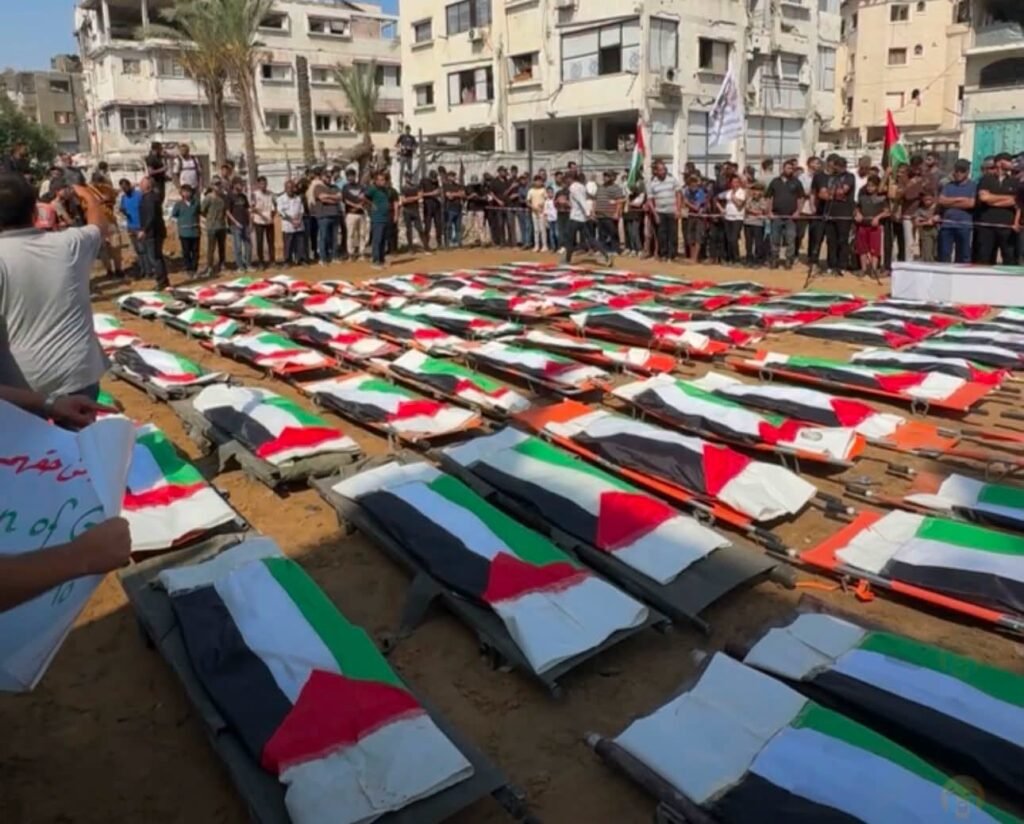
Gaza Herald – The sight of hundreds of mourners walking behind 112 coffins through the streets of Gaza City was far more than a mass funeral. It stood as a delayed testament to one of the most horrific crimes committed during Israel’s genocide in the Gaza Strip.
Nearly 1,000 days after Israeli airstrikes reduced an entire residential block in Gaza City’s Sabra neighborhood to rubble, the remains of dozens of victims were finally recovered, bringing renewed attention to a massacre that the debris had concealed for years but that Palestinians have never forgotten. For many, it remains one of the clearest examples of a crime against humanity that cannot be erased by time.
A Massacre Unearthed
Palestinians across Gaza on Tuesday buried the remains of 112 members of the Abu Sharia and al-Hasayna families after civil defense crews recovered them from beneath the ruins of a residential block completely destroyed by Israeli bombardment in the Sabra neighborhood, south of Gaza City.
The bodies remained trapped beneath the rubble for nearly 1,000 days after rescue teams were prevented from reaching the site because of the scale of the destruction and the inability to conduct search-and-recovery operations in the aftermath of the attack.
The massacre dates back to November 22, 2023, when Israeli forces carried out a series of intense airstrikes that flattened the entire residential block.
According to Palestinian sources, 308 members of the two families were killed, including 44 children under the age of 16, 37 women, and more than 10 people with disabilities.
Evidence of Genocide
Palestinian National Council President Rawhi Fattouh said the funeral brought renewed attention to one of the deadliest massacres committed during Israel’s military campaign in Gaza.
He said Israeli forces prevented rescue crews from reaching the area after the attack, leaving victims buried beneath the rubble for months and, in many cases, years.
Fattouh described the massacre as compelling evidence of the brutality of the genocide in Gaza and of grave violations of international humanitarian law and the Fourth Geneva Convention. He called on the international community to hold Israeli leaders accountable, deliver justice for the victims and their families, and end the longstanding policy of impunity.
The Tragedy Is Still Not Over
Palestinian National Initiative Secretary-General Mustafa Barghouti said the funeral may have been “the largest funeral in Palestinian history,” noting that the victims’ remains were recovered more than two and a half years after they disappeared beneath the rubble.
Researcher Dr. Saeed Al-Haj said the tragedy extends far beyond the 112 victims buried this week, pointing out that hundreds of others remain missing or trapped beneath collapsed buildings across Gaza.
Activist Mohammed Haniyeh said the funeral was not only for 112 people but for what remained of the Abu Sharia and al-Hasayna families, explaining that many other victims’ bodies had either decomposed or remain buried beneath the debris.
Euro-Med Human Rights Monitor Chairman Ramy Abdu said approximately 200 members of the two families are still believed to be beneath the rubble, while other bodies may have completely disintegrated because of the force of the explosions. He added that the remains recovered over the past two days represent only a fraction of the massacre’s victims.
A Funeral That Shook the World’s Conscience
Images of the funeral spread rapidly across social media, where journalists, writers, and commentators described it as one of the most painful scenes witnessed during the Palestinian struggle.
Journalist Musab Al-Sharif said the procession was among the largest and most heartbreaking funerals in Palestinian history because it represented not only a mass burial but also the destruction of entire families during Israel’s assault on Gaza.
Broadcaster Sami Barhoum said the funeral reflected the true meaning of genocide, noting that hundreds of victims are still believed to lie beneath the rubble because rescue teams continue to lack the heavy equipment needed to recover them.
Writer Ahmed Abu Artema said the procession reopened wounds that have never healed, adding that burying more than one hundred members of a single extended family laid bare the scale of the humanitarian catastrophe and the devastating price paid by Gaza’s civilians.
The funeral, with its rows of coffins carrying remains recovered after years beneath the rubble, became another enduring symbol of a genocide whose consequences continue long after the bombs have fallen. For countless Palestinian families still waiting to recover their loved ones, the war has not ended. Justice, too, remains buried beneath the rubble as those responsible continue to evade accountability under the protection of international inaction.

