
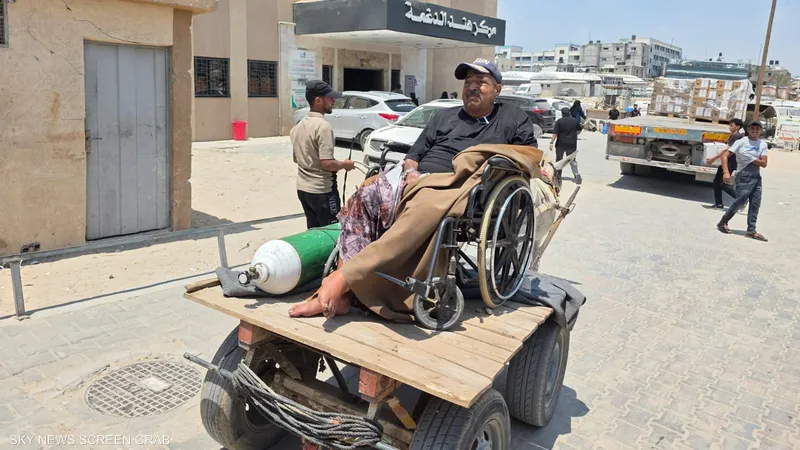
Gaza Herald _ As the first light of dawn spreads across the tents of displaced families in the Mawasi area west of Khan Younis, 77-year-old Palestinian Fathi Haji climbs onto a wooden cart pulled by a donkey. Beside him rests an oxygen cylinder that accompanies him on every journey as the cart slowly makes its way along a dirt road toward Nasser Medical Complex, nearly three kilometers away.
Three times each week, Haji repeats the same exhausting trip. What was once a routine journey to receive medical care has become another struggle for survival amid Gaza’s collapsing healthcare system.
Even after reaching the dialysis center, his ordeal is far from over. Treatment sessions that once lasted four hours have been cut to just two because of severe shortages of essential medical supplies, a measure doctors say leaves patients facing growing health risks.
“I travel nearly three kilometers from my tent to the hospital,” Haji says as he breathes through his oxygen tube. “We are living a slow death.”
“There’s no ambulance or reliable transportation,” he continues. “I have no choice but to ride a donkey cart under the scorching sun just to reach my dialysis appointment.”
Only months ago, kidney failure was not part of Haji’s life. After being displaced from Gaza City’s Zeitoun neighborhood by Israeli attacks, he sought shelter in a tent in Mawasi. Early in 2026, he was diagnosed with kidney failure, making regular dialysis an essential part of staying alive.
But the war has transformed even the journey to the hospital into a life-threatening challenge. Fuel shortages, widespread destruction of vehicles, and the lack of spare parts have left transportation options nearly nonexistent, forcing many patients to rely on whatever means they can find to reach treatment they cannot afford to miss.
Inside the hospital, Haji often waits for a dialysis machine to become available or for equipment to be sterilized before his session can begin.
“I return to my tent completely exhausted,” he says. “I don’t even realize how difficult the journey was until I’ve had a chance to rest.”
Haji’s struggle extends beyond kidney disease. He also lives with diabetes, high blood pressure, gout, and chronic respiratory problems while facing persistent shortages of the medications he depends on.
An oxygen cylinder has become his constant companion, especially as prolonged power outages make it impossible to operate respiratory equipment inside his tent.
His story mirrors the experiences of hundreds of kidney patients across Gaza, many of whom struggle to reach dialysis centers before confronting severe shortages of medicines and essential supplies needed to continue treatment.
Dr. Raed Musleh, a nephrology consultant at Nasser Medical Complex, says the crisis has moved beyond pressure on hospitals and now threatens the foundations of kidney care itself.
He explains that a shortage of sodium bicarbonate, a critical component used during dialysis to regulate blood acidity, has forced the Noura Al Kaabi Dialysis Center to reduce treatment sessions from four hours to just two.
“Shortening dialysis sessions has a direct impact on patients’ health,” Musleh says. “We urgently need supplies of sodium bicarbonate.”
Despite limited equipment and resources, the center continues treating about 250 kidney patients, providing care for an average of 45 people each day.
The shortages extend beyond dialysis materials. Musleh says the center has also run out of erythropoietin, a medication that helps kidney failure patients produce red blood cells, forcing many to rely on repeated blood transfusions instead.
According to Musleh, repeated transfusions have left some patients infected with viral hepatitis while exposing others to additional health complications.
United Nations estimates indicate that nearly 700 dialysis patients across Gaza face increasing danger because of shortages of essential supplies. Limited availability of sodium bicarbonate has already shortened treatment sessions and disrupted dialysis services at other medical centers throughout the territory.
Although small quantities of the chemical and other medications entered Gaza in late July, UN agencies say critical shortages of medicines and lifesaving medical equipment persist, with fewer than half of Gaza’s healthcare service points still functioning compared with pre-war levels.
As Haji prepares for the long journey back to his tent, his request remains painfully simple.
“We ask for nothing more than treatment and a way to reach the hospital,” he says. “Kidney patients cannot wait.”

