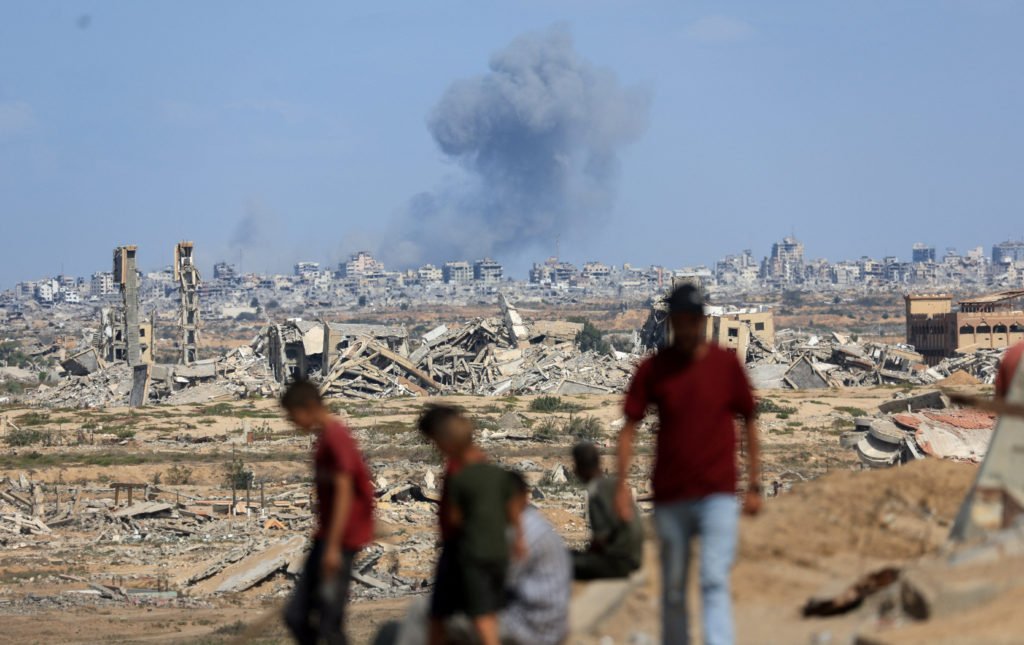
Gaza Herald – Israeli forces carried out controlled demolitions of buildings in areas located beyond the so-called “Yellow Line” after expanding its boundaries, while also targeting displacement zones across the Gaza Strip.
Meanwhile, a new human rights report titled “The Yellow Line: Between Constriction and Displacement” examines the impact of the Israeli-designated security zone east of the Yellow Line, documenting the widespread destruction and losses inflicted on civilians and their property since the beginning of Israel’s war on Gaza.
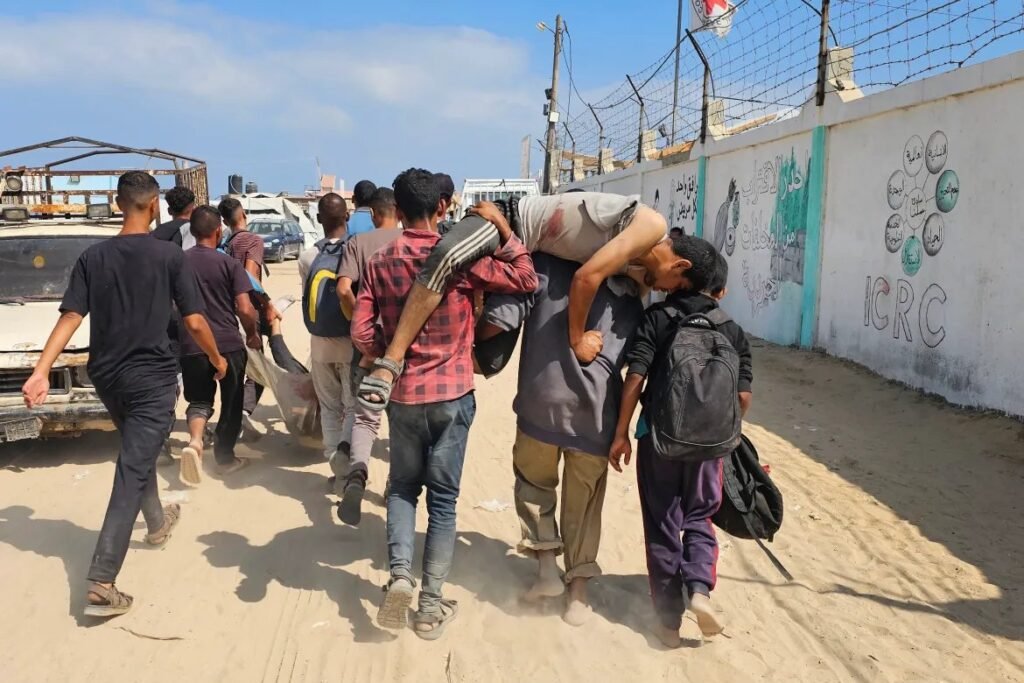
Civilians wounded in displacement areas
The Israeli military announced that it had killed a Palestinian in southern Gaza, claiming he was a military commander affiliated with Hamas.
In a statement, the army said it had targeted and killed Yahya Saeed Mohammad Hamdan, whom it identified as a commander in Hamas’ elite military unit. Israel also alleged that Hamdan participated in the October 7, 2023 attack on the Re’im military base near Gaza.
Local sources, however, reported that a Palestinian woman was wounded by Israeli gunfire in the Al-Faluja area west of Jabalia refugee camp in northern Gaza.
The incident came as Israeli artillery continued shelling areas beyond the Yellow Line in northern Gaza. In Gaza City, Israeli forces demolished several buildings located behind the line, with explosions heard across multiple neighborhoods.
Elsewhere, another Palestinian was injured by Israeli fire east of Al-Bureij refugee camp in central Gaza. In Khan Younis, a civilian was wounded after Israeli military vehicles opened fire near School Street in the Al-Amal neighborhood northwest of the city.
The demolitions coincided with heavy gunfire from Israeli ground forces operating beyond the Yellow Line. Israeli naval vessels also fired heavy machine-gun rounds toward Gaza’s shoreline and coastal waters, while artillery shelled northeastern areas of Rafah.
These attacks took place despite the ceasefire agreement that entered into force on October 10 of last year, which calls for a halt to hostilities. Israel has also continued to impose restrictions on the entry of humanitarian aid, contrary to the terms of the agreement.
Israeli forces have recently expanded the Yellow Line, increasing the area under their control from roughly 53 percent of Gaza at the start of the ceasefire to nearly 70 percent today. As a result, more than two million Palestinians have been squeezed into increasingly overcrowded areas lacking even the most basic services.
The Yellow Line: A policy of displacement
A legal assessment published by Al-Dameer Association for Human Rights in Gaza, titled “The Yellow Line: Between Constriction and Displacement,” examines what Israel defines as the security zone stretching along Gaza’s eastern border fence.
The report outlines the size of the area now under Israeli security control and documents the destruction inflicted on civilians and civilian infrastructure from the start of the war in October 2023 through the period following the October 2025 ceasefire agreement.
It also analyzes statements by Israeli officials regarding settlement expansion and the displacement of Palestinians, assessing their legal and humanitarian implications. According to the report, the Yellow Line has evolved into “an engineered system of evacuation designed to transform vast areas into an Israeli-controlled buffer zone.”
The organization argues that the ongoing forced evacuations across eastern, northern, and southern Gaza reflect “a systematic policy aimed at converting these areas into an Israeli-controlled security buffer,” raising concerns that Israel is laying the groundwork for a prolonged military occupation.
According to the report, Israeli actions inside the buffer zone violate obligations under international humanitarian law and collectively create conditions that compel Palestinians to leave their homes by making life in those areas impossible.
The organization further warned that these policies raise serious concerns about conduct being assessed under international law as part of the crime of genocide allegedly committed by Israel in the Gaza Strip.
The report calls on the international community to fulfill its legal and moral responsibilities by enforcing the rulings of the International Court of Justice, pressuring Israel to uphold the ceasefire, and bringing an end to what it describes as genocide in Gaza.
It also urges immediate investigations into alleged genocide, war crimes, and crimes against humanity committed in the enclave, calling for legal and political action through the United Nations and international judicial bodies to ensure accountability and prevent impunity.
Qatar expands humanitarian assistance
As humanitarian needs continue to grow, the Qatari Committee for the Reconstruction of Gaza has continued distributing mobility aids to hundreds of Palestinians with physical disabilities and special needs across the Strip. The assistance includes wheelchairs, walkers, crutches, and other essential mobility equipment.
UN: Lack of equipment delays recovery and reconstruction
The United Nations has warned that shortages of specialized equipment, fuel, and explosive hazard assessment capabilities continue to obstruct rubble removal and the recovery of human remains.
According to the UN, these shortages are also delaying reconstruction efforts and preventing displaced residents from returning to their devastated neighborhoods.
The organization added that thousands of people remain missing, with many believed to still be trapped beneath collapsed buildings. As time passes, identifying recovered remains becomes increasingly difficult due to natural decomposition, limited forensic capacity, and insufficient DNA testing resources, prolonging the suffering of families still waiting to learn the fate of their loved ones.