Gaza Herald _For nine agonizing days, the family of Palestinian Mohammed Abu Khamash waited for the chance to recover his body after he was killed in eastern Deir al-Balah. Their struggle underscores the growing hardship faced by Palestinian families who are often unable to retrieve or bury their loved ones because of Israeli military restrictions across Gaza.
Abu Khamash was shot and killed by Israeli forces near the area known as the Yellow Line, an Israeli-controlled zone east of Deir al-Balah. Continuous gunfire and the denial of access to ambulance crews prevented anyone from reaching him, leaving his body exposed in the open for more than a week.
Unable to retrieve him, the family repeatedly appealed to international organizations and humanitarian agencies for urgent intervention. Their calls went unanswered until nine days after his death, when they were finally allowed to recover what remained of his body.
A mother’s painful farewell
Throughout the ordeal, Abu Khamash’s mother was denied the opportunity to say goodbye to her son. When his remains were finally returned, she received them in a black body bag after prolonged exposure had left his body badly decomposed. His remains were later transferred to Al-Aqsa Martyrs Hospital before being laid to rest.
The family’s anguish had been documented by Abu Khamash’s father, who wrote on Facebook that his son’s grave had already been prepared while his body remained only a few hundred meters away, unreachable because of Israeli military control over the area.
He also described seeing his wife standing at the edge of the military zone holding a white flag in the hope that soldiers would allow her to retrieve her son’s body. According to the father, Abu Khamash had struggled with mental illness, making the family’s inability to recover him all the more devastating. Similar accounts have emerged from other families whose relatives were killed in areas inaccessible due to ongoing military operations.
Symbol of a wider humanitarian crisis
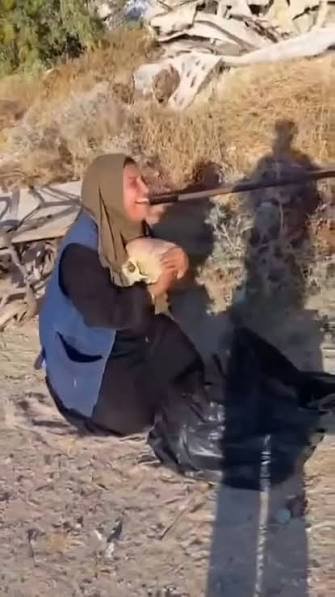
In images documented by journalist Osama Al-Kahlout, Abu Khamash’s mother was seen embracing what remained of her son’s head after receiving his remains. The photographs spread widely across social media, where many Palestinians described them as a heartbreaking symbol of the suffering endured by families whose grief continues long after the loss of their loved ones.
Activists and journalists said the case reflects a recurring reality in Gaza, where rescue teams are frequently prevented from reaching victims in areas under Israeli military control. Many argued that the inability to recover the dead has become one of the conflict’s most painful humanitarian consequences.
The incident is part of a broader pattern in which Palestinian families face repeated delays in recovering the bodies of relatives because of Israeli military deployments and continued gunfire in different parts of the Gaza Strip. Throughout Israel’s ongoing war on Gaza, ambulance and civil defense crews have repeatedly reported being unable to reach casualties, forcing families to wait days before they can bury their loved ones.
Although a ceasefire was announced last October, Israeli airstrikes have continued and restrictions on humanitarian aid remain in place. According to official Palestinian figures, 1,098 Palestinians have been killed and 3,507 others injured since the ceasefire took effect, the majority of them women and children.