
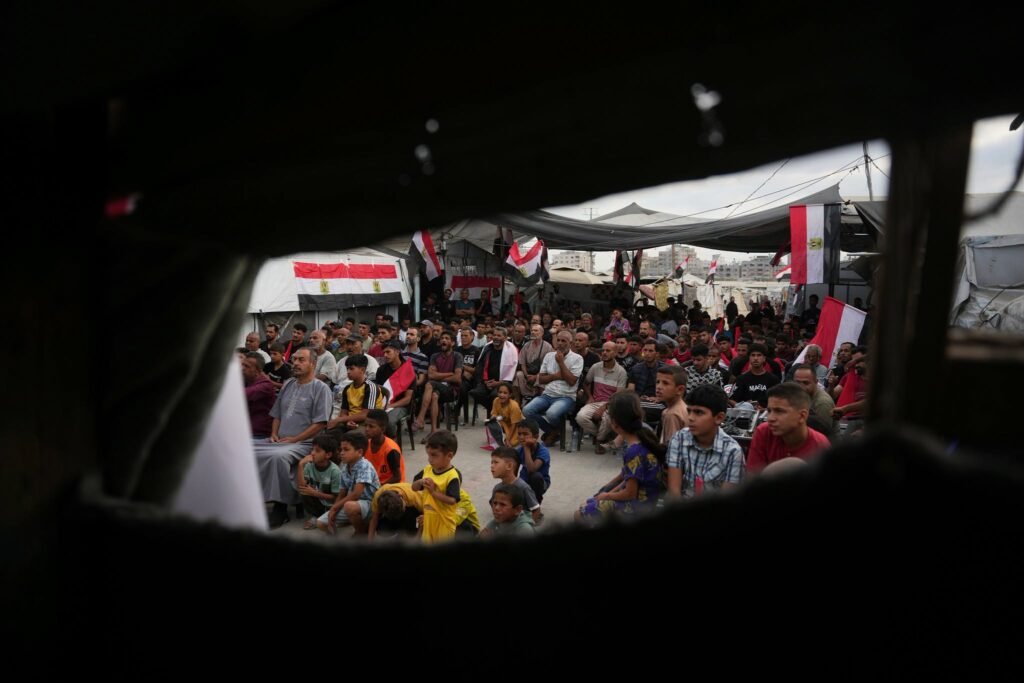
Gaza Herald – As hundreds of millions of fans around the world turn their attention to the 2026 FIFA World Cup, Palestinians in the Gaza Strip are experiencing a completely different version of the tournament, one watched under bombardment, amid constant power outages, and with the fear that leaving home to watch a match could become a one-way journey.
For many, football has become more than a game. It is a fragile connection to normal life in the midst of genocide.
One such story is that of Haitham Al-Saqqa, a footballer with dwarfism, who now finds himself playing the most difficult match of his life, not on the pitch, but in his struggle to hold onto his passion for football after war claimed his dreams and several of his teammates.
Football Under Bombardment
While World Cup matches are celebrated across the globe with packed stadiums and crowded cafés, following the tournament in Gaza has become an entirely different experience.
Years of genocide have devastated the territory’s infrastructure, leaving residents to contend with widespread destruction, repeated electricity cuts, and the daily risk of airstrikes that make something as simple as going out to watch a football match a potentially fatal decision.
For people with disabilities, those challenges are even greater, as mobility restrictions and the lack of accessible facilities make watching the world’s biggest sporting event even more difficult.
A National Team Dream Interrupted
Thirty-eight-year-old Haitham Al-Saqqa, who stands 110 centimeters tall, works in the humanitarian sector with the Medical Aid for Palestinians (MAP).
Before the Israeli genocide on Gaza that erupted in October 2023, he achieved what many considered impossible by establishing Palestine’s first national football team for people with dwarfism, opening the door for athletes who had long been excluded from competitive football.
The genocide, however, brought that dream to a halt.
Plans to compete internationally were suspended, and several members of the team were killed in Israeli airstrikes.
Watching a Match Could Cost Your Life
Haitham says he does not need a ticket to enter a stadium; he needs luck simply to watch a match safely.
His home is located near the so-called “Yellow Line,” an area where many Palestinians have reportedly been killed, making even a short walk outside after dark a life-threatening risk.
“We’re afraid to walk in the streets, especially after 9 p.m., when the matches usually begin,” he says.
Even gathering with friends at a café has become too dangerous.
“I’m afraid to go to cafés or restaurants to watch games with my friends. And if I decide to watch from home, the electricity keeps cutting out.”
Despite the obstacles, Haitham says he has managed to watch around 20 World Cup matches through different means, determined not to let the war completely erase his love for football.
Afraid That Cheering Could Turn Into Farewell
A father of three, Haitham supports Liverpool FC, Real Madrid, and Egypt’s Al Ahly SC.
Yet he no longer shares football the way he once imagined with his four-year-old son.
He refuses to take the child to public viewing areas, fearing they could become targets.
“I’m afraid of losing him outside,” he says. “We could be killed in our home, but I would feel even worse if we left the house together and something happened.”
When Gaza Celebrated Football
Before the genocide, World Cup tournaments were among the most anticipated events in Gaza.
Streets were decorated with national flags, cafés overflowed with supporters, and football brought communities together in moments of celebration and joy.
Those scenes have now been replaced by silence, fear, and destruction, as residents struggle to preserve even brief moments of happiness through the world’s most popular sport.
Mohamed Salah’s Jersey
Amid everything he has lost, Haitham still treasures one possession that offers him comfort.
A friend once gave him a Liverpool jersey signed by Egyptian star Mohamed Salah, a gift whose value extends far beyond football.
“It reminded me that our friends outside Gaza still see us as human beings,” he says. “People who have passions, dreams, and moments of happiness, not just victims of war.”

