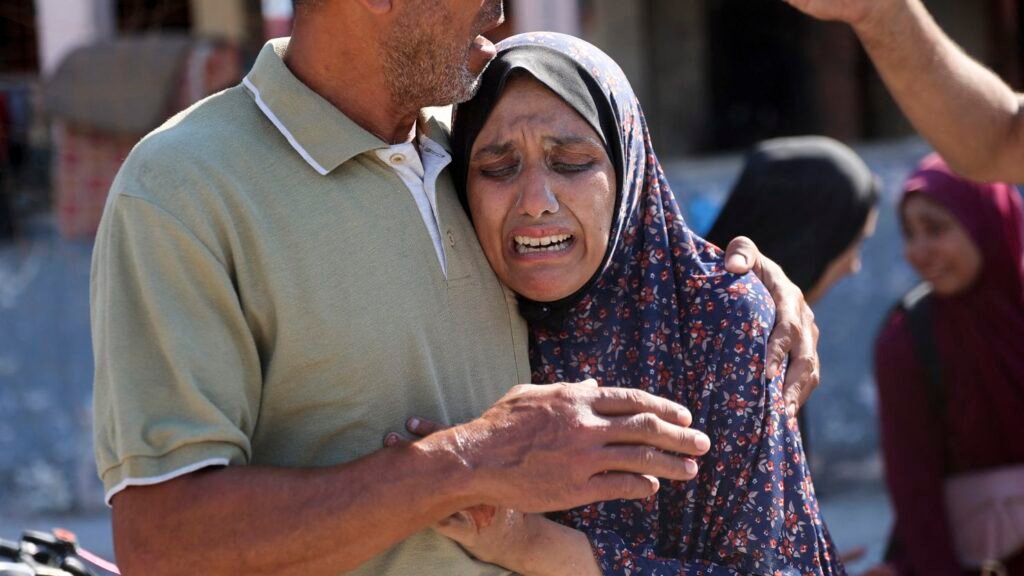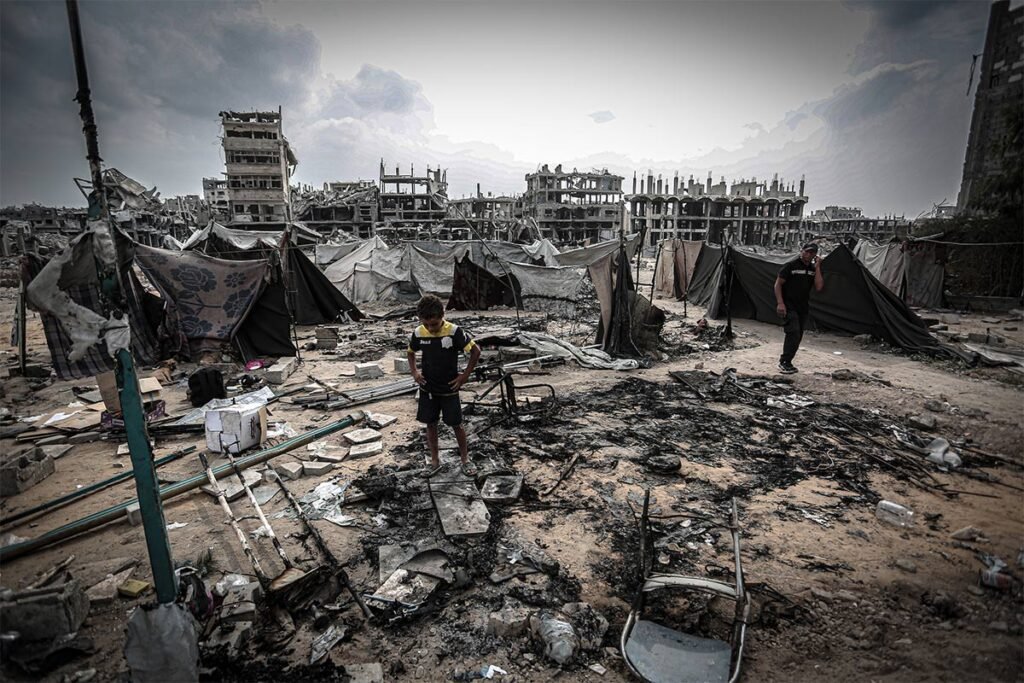
Gaza Herald — As winter tightens its grip on the besieged Gaza Strip, hundreds of thousands of displaced Palestinians remain trapped in worsening living conditions, confronting damaged tents, ruined homes, and severe shortages of materials needed to withstand cold temperatures and heavy rain. More than three years into Israel’s genocidal war, sweeping destruction, blockade restrictions on essential supplies, and stalled political arrangements continue to deny families even basic means of survival.
The humanitarian emergency is unfolding across a heavily restricted geographic reality. Military deployment by Israeli occupation forces beyond the so-called Yellow Line has barred Palestinians from large parts of Gaza, forcing displaced families into overcrowded sites with shattered infrastructure and dwindling prospects of returning home.
The Yellow Line and Shrinking Space for Palestinians
Military control and deployment by Israeli occupation forces across roughly 70 percent of the Gaza Strip have sharply narrowed where Palestinians can live and move. In an October 30 warning, the United Nations Human Rights Office underscored the severe impact of these restrictions, noting that displaced families face severely constrained prospects of returning to areas beyond the Yellow Line.
Ajith Sunghay, head of the Office of the High Commissioner for Human Rights in the occupied Palestinian territory, stated that prevailing conditions leave displaced Palestinians with increasingly limited chances of returning to their homes.
Repeated displacement has compounded that confinement. A strike by Israeli occupation forces in Shuja’iyya in late October forced roughly 200 families, around 800 people, to flee their homes and seek refuge elsewhere, adding further pressure onto already packed displacement sites. With vast areas off-limits and large sections of residential neighborhoods leveled, families confront ongoing uncertainty over where they can find safety, lacking adequate housing, essential services, or firm assurances of return.
Winter Storms Expose Shelter Collapse and Deadly Hazards
Winter weather has intensified the ordeal of displaced households, laying bare the fragility of available shelters across the Strip. Storms striking Gaza between November 6 and 8 affected roughly 46,000 families, around 226,000 people, damaging some 40,000 shelters and rendering more than 9,000 completely unusable.
Floodwaters swept into makeshift shelters and disrupted access to healthcare, sanitation, and other vital services. Families sheltering inside worn tents struggled to protect children and scarce belongings from driving rain, strong winds, and collapsing sand, while reports of deaths and injuries from sand falling onto tents, alongside an infant suffering from hypothermia, highlighted the lethal toll of inadequate shelter in winter.
On November 13, United Nations humanitarian teams warned that roughly 150,000 tents were still needed inside Gaza, alongside acute shortages of heating materials, water pumps, generators, fuel, and heavy machinery required to clear rubble and begin reconstruction. Without sufficient shelter supplies and equipment to repair damaged networks, even moderate rainfall turns displacement camps into hazardous living spaces as temperatures drop.
Healthcare and Municipal Lifelines Under Mounting Strain
The crisis extends far beyond shelter into Gaza’s healthcare system and municipal services, which remain weighed down by mass destruction, supply shortages, and damage to critical infrastructure. According to a November 18 World Health Organization update, 1,056 attacks on healthcare facilities and services had been documented since October 2023, resulting in 1,010 deaths and 1,725 injuries and further eroding a medical system strained by prolonged war and displacement.
Hospitals and medical crews struggle to sustain core care as damaged facilities, equipment gaps, and restricted supplies limit treatment capacity. Municipalities and Civil Defense teams face parallel constraints, with shortages of fuel, operational vehicles, machinery, and spare parts impeding debris removal, flood pumping, infrastructure repairs, and aid to families whose shelters were destroyed. Deteriorating water and sewage systems, power grids, schools, and public facilities mean displacement strips families not only of housing but also of the basic services required for safety and human dignity.
Stalled Commitments and Ongoing Casualties Defy Recovery
Despite repeated international discussions over Gaza’s future, a wide gap persists between political pledges and ground realities. A November 17 report submitted to the United Nations Security Council indicated that implementation of proposed arrangements for Gaza remained limited, with the transitional administration and planned international stabilization force not yet operational, leaving core questions of governance, security, and reconstruction unresolved.
Meanwhile, restrictions on shelter materials and winter supplies, together with approval delays for essential items, continue to block relief operations. Shortages of tents, heating supplies, construction machinery, and basic necessities show how far current measures fall short of survival needs as winter advances and reconstruction remains frozen.
With Israeli occupation forces maintaining military deployment across large swaths of the Strip, Palestinians are concentrated into a limited area estimated at roughly 110 square kilometers. The ceasefire that began on October 10, 2025, has not ended the crisis: attacks by Israeli occupation forces since the ceasefire took effect have killed 1,679 Palestinians and wounded 6,100 others, bringing the cumulative toll since October 2023 to 74,746 deaths and 176,234 injuries.
For displaced families, the toll shapes every facet of daily life, homes beyond reach, tents unable to withstand winter storms, overburdened hospitals, and scarce supplies. As winter deepens, Gaza’s emergency reflects not only wartime devastation but ongoing restrictions that block recovery, shelter, healthcare, and basic services, leaving thousands exposed to life-threatening conditions without lifted restrictions, sustained relief, and a credible path to return and reconstruction.