
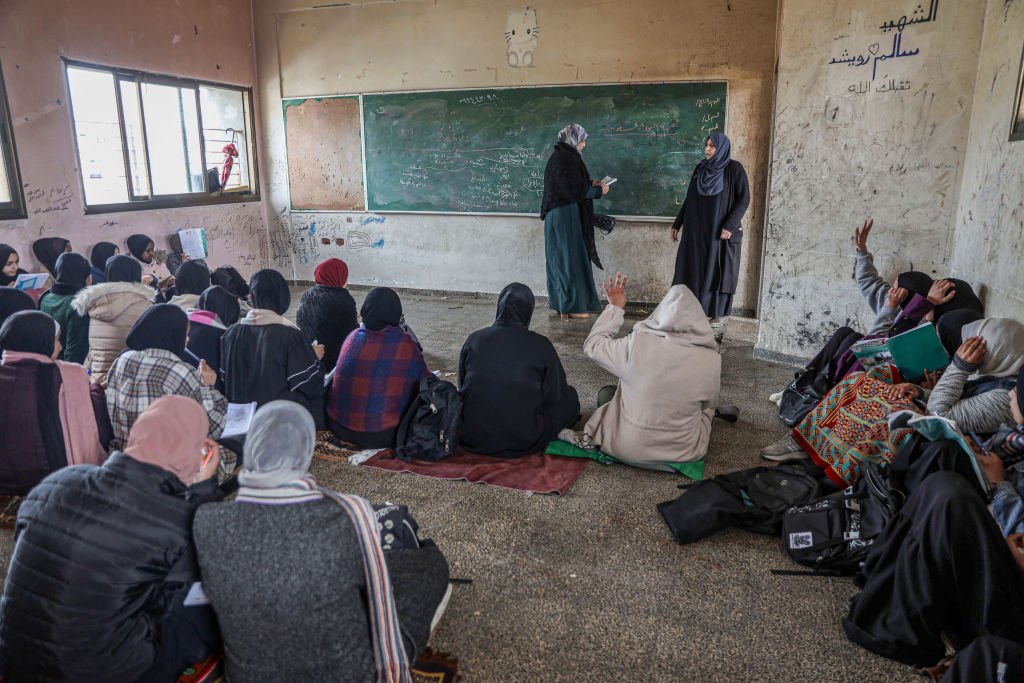
Gaza Herald — Roughly 32,000 Palestinian students in the besieged Gaza Strip sat for their high school examinations online over the past year while Israeli bombs fell around them, with most managing to pass despite near-total destruction of educational infrastructure, according to United Nations Assistant Secretary-General Abdullah al-Dardari.
Speaking in press remarks on Tuesday, November 24, al-Dardari clarified the distinct roles of United Nations agencies working to sustain schooling across Gaza amid extreme field conditions. While the United Nations Children’s Fund (UNICEF) is leading broader efforts to restore and deliver primary and secondary education to as many school-age children as possible across the territory, the United Nations Development Programme (UNDP) specifically spearheaded the technical operation enabling roughly 32,000 high school students to complete their final exams online from inside Gaza.
Al-Dardari explained that teams of technical specialists worked continuously under bombardment to secure the internet connectivity students needed to sit for their exams. Several staff members were killed during those efforts, he noted, affirming that educational support will persist and that the United Nations will not abandon Gaza’s students.
More Than 20,000 Students and 1,300 Educators Killed
Official figures document the staggering human toll inflicted on Gaza’s education sector over nearly three years of genocidal war waged by Israeli occupation forces. According to a May 2026 report by the Palestinian Ministry of Education and Higher Education, citing Gaza Ministry of Health records, more than 20,051 school-age students have been killed, while over 19,886 students have been forced to leave the Strip during the war, according to Government Data Center figures.
The assault has also decimated Gaza’s teaching and administrative workforce. Ministry of Health records cited in the report confirmed the killing of more than 769 Ministry of Education employees alongside 532 teachers working across government schools, UNRWA schools, and private institutions.
Systematic Destruction of Gaza’s School Infrastructure
Prior to October 2023, Gaza operated 584 school buildings, comprising 309 government schools, 182 UNRWA schools, 70 private schools, and 23 special education facilities. Bombardment by Israeli occupation forces has damaged or destroyed the vast majority of these buildings and rendered others inaccessible, according to the ministry’s General Directorate of Educational Buildings.
Across Gaza’s school network, 55 government schools, 30 private schools, and 11 special education schools were destroyed, while 12 government schools, 26 private schools, and six special education facilities suffered partial destruction. Severe damage struck eight government schools, 11 private schools, and two special education schools; moderate damage hit 50 government schools and two private schools; and minor damage affected 59 government schools, one private school, and four special education schools. The destruction extended equally to educational administration and learning resource centers, with 42 out of 46 administrative buildings completely leveled.
Yet even amid shattered classrooms, severed networks, and the loss of tens of thousands of students and teachers, the determination of Gaza’s youth to sit for their exams under fire underscores that education remains a vital act of survival and resilience, requiring urgent international protection and reconstruction so an entire generation is not robbed of its future.

