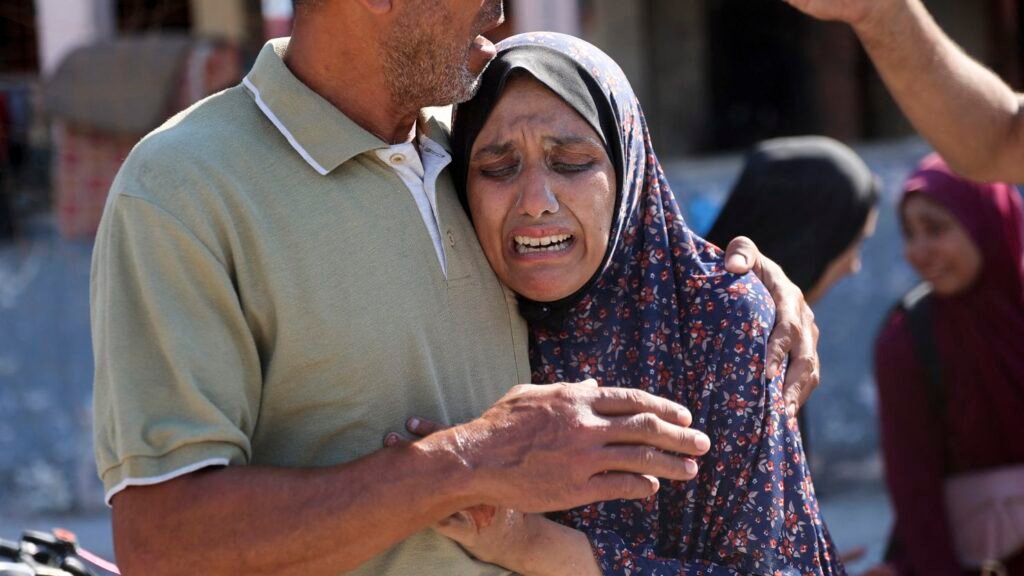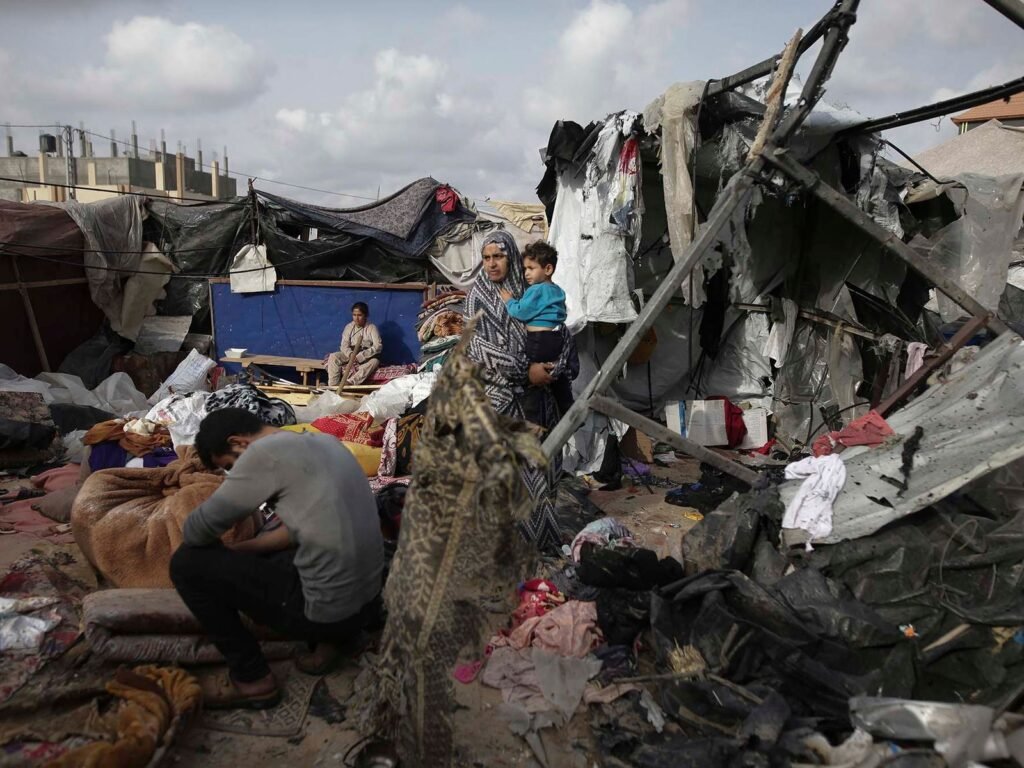
Gaza Herald — As the rainy season draws near, hundreds of thousands of forcibly displaced Palestinians across the Gaza Strip are not awaiting winter as a passing season. Instead, they are bracing for a catastrophic threat that creeps into their tents from saturated ground, tears away canvas coverings with gale-force winds, and submerges children’s bedding in freezing water, all while families face severe blockades and zero safe shelter alternatives.
In a scene capturing the extreme irony of survival under siege, displaced families fill empty flour sacks with sand to erect primitive makeshift dykes around their tents.
What was once a bag used to hold basic food aid has been converted into a desperate barrier against rising floodwaters, as impoverished households remain unable to secure intact tents or structural reinforcement materials. On October 17, the United Nations documented these individual survival efforts, highlighting the vast abyss between the immediate physical needs of displaced Palestinians and the blocked humanitarian response.
These severe fears unfold as the majority of Gaza’s population lives through harsh forced displacement following the systematic destruction of entire residential districts and municipal infrastructure during Israel’s ongoing war. Families remain crammed inside rotting tents, temporary encampments, or cracked, structurally compromised ruins.
As these makeshift shelters degrade, preparing for winter has turned into a desperate race against time. The crisis extends far beyond distributing thermal blankets or winter clothing: it requires preventing low-lying displacement sites from total submergence, securing structural shelter, clearing blocked drainage and sewage networks, stabilizing cracked buildings, and delivering aid before weather conditions spark an all-out humanitarian disaster.
Hundreds of Thousands Face High Risk of Winter Flooding
The United Nations has issued severe warnings regarding widespread flood hazards across the enclave as seasonal storms approach.
According to a report published on October 2 by the UN Office for the Coordination of Humanitarian Affairs (OCHA), emergency relief teams evaluated over 400 displacement sites, identifying 217 encampments categorized as moderate- to high-risk zones. These vulnerable sites currently hold approximately 235,000 displaced Palestinians.
Concurrently, preliminary estimates by the Shelter Cluster reveal that over 4,000 structurally unsafe buildings require complete or partial demolition. Alarmingly, more than 2,300 of these ruined buildings remain inhabited, sheltering nearly 44,000 civilians who have nowhere else to go.
This confirms that the winter threat extends beyond canvas tents to thousands of families forced to reside inside unstable concrete structures that cannot withstand heavy rainfall or strong winds.
Flood risks are exceptionally severe in low-lying coastal areas, zones adjacent to coastal lagoons, and overcrowded camps where municipal drainage pipes are smashed or clogged with rubble and solid waste. In these locations, heavy downpours turn surrounding grounds into mud pits, weaken tent anchors, and completely submerge access paths leading to medical posts, water distribution points, and charity kitchens.
The crisis is compounded by the environment’s total loss of absorption capacity. Rainfall that would normally pass through functional municipal drainage systems turns into a life-threatening flood inside densely packed tent encampments built on uneven, debris-strewn ground lacking drainage pumps or runoff channels.
Fragile Shelters Incapable of Withstanding Wind and Water
Vast numbers of displaced families reside in tents that have severely degraded after months of exposure to sun, wind, and rain.
These makeshift structures provide zero insulation against freezing temperatures or driving rain, while other households remain trapped in bombed-out buildings due to the total prohibition on shelter imports.
In an October 9 report published by Reuters, the International Organization for Migration (IOM) confirmed that nearly two million Palestinians in Gaza urgently require shelter assistance ahead of winter. However, global procurement for winterization supplies has covered barely 17% of total estimated needs. The UN agency further revealed that over half of all temporary tents and makeshift shelters across the enclave require immediate replacement due to severe physical decay, with 1.8 million people living in high-risk flood zones.
These statistics underscore a critical truth: a canvas tent, while essential as an immediate emergency response, is not a permanent housing solution and cannot withstand consecutive seasons of cold and heavy rainfall.
As forced displacement drags on, temporary materials disintegrate entirely. Impoverished families who have exhausted their savings and lost all personal property cannot purchase replacement materials on the open market.
Left with no alternatives, families attempt to patch rotting canvas with plastic sheets, raise floor mattresses onto wooden pallets, or pile sandbags at tent entrances. However, these individual measures cannot fix fundamental structural defects or prevent tent collapses during heavy gale-force winds.
The dilemma deepens as families remain unable to relocate to safer ground. Damaged concrete buildings carry high risks of sudden collapse, available land is severely overcrowded, and relocation options remain strictly limited by the lack of serviced land and heavy transport tools.
Freezing Temperatures Threaten Infants and Medical Patients
The impact of winter in Gaza extends beyond dampness and cold; it presents direct medical threats compounded by widespread malnutrition, overcrowding, collapsed sanitation systems, and crippled healthcare facilities. Children living in damp tents on wet bedding without warm clothing face acute hypothermia, upper respiratory infections, and waterborne diseases.
In its 2026–2027 Winterization Preparedness Plan, UNICEF reported that nearly 84% of Gaza’s population, more than 1.76 million people, live in overcrowded displacement sites or structurally compromised shelters that offer zero defense against freezing weather and flash floods. The agency warned that these severe conditions exponentially increase cases of hypothermia, severe respiratory infections, and waterborne pathogens, especially among infants, young children, and chronic disease patients.
According to the same UNICEF report, at least 11 children, including newborn infants, died directly from hypothermia during the previous winter in Gaza. This underscores that winter exposure under blockade is a lethal threat, particularly when severe cold converges with an acute lack of dry clothing, thermal blankets, and functional pediatric care.
The danger extends to elderly residents, disabled individuals, war-injured amputees, and chronic medical patients. Navigating flooded camps with muddy, blocked pathways severely hinders their ability to reach emergency medical posts or ambulances.
Furthermore, soaked bedding and clothing drain family resources. Households require dry storage space, replacement garments for children, and heating fuel, resources that are virtually non-existent under the ongoing energy blockade and total lack of electricity.
Infrastructure Collapse and Uncleared Rubble Double Flood Hazards
Winter preparations face a massive barrier due to pulverized municipal sewage lines, ruined stormwater channels, and an acute lack of heavy maintenance machinery. When heavy rain mixes with raw sewage or flows over uncleared waste and rubble, floodwaters contaminate encampments and trigger rapid disease outbreaks.
OCHA noted in its October 2 report that ongoing humanitarian interventions include clearing drainage channels, reinforcing tent structures, repairing basic water and sanitation lines, and identifying safer voluntary relocation sites. However, these field operations remain severely constrained by international funding deficits, security hazards, and strict Israeli import blockades on maintenance machinery and construction supplies.
Distributing tents and blankets alone cannot resolve the crisis. A displacement site without functional drainage will submerge regardless of how many new blankets a family receives, just as repairing a tent cannot protect children from raw sewage or a collapsing concrete wall next door.
High-risk zones require comprehensive engineering interventions: land leveling, drainage channel excavation, debris removal, mobile water pumps, sanitation grid maintenance, elevated walkways, and emergency night lighting.
Meanwhile, structurally compromised buildings require formal engineering inspections, clear hazard warnings for occupants, and the immediate provision of dignified alternative housing before evacuation orders, preventing families from being forced to choose between a collapsing ceiling and total homelessness on the streets.
Blockade and Aid Deficits Paralyze Emergency Response
Despite initial winter preparations, a massive gap remains between survival needs and available humanitarian aid. On September 17, UNICEF announced an urgent appeal for $97.5 million to protect 540,000 children and their families in Gaza and the West Bank from cold, rain, flooding, and service collapses between October 2026 and March 2027.
On October 9, Reuters reported that approximately 8,600 emergency shelter kits, containing timber beams, plastic sheeting, and structural hardware, were blocked from entering Gaza after Israeli authorities classified them as “dual-use” items. While occupation authorities cite security rationales for import bans, international humanitarian agencies emphasize that these arbitrary restrictions completely paralyze winter preparedness.
This crisis reveals that emergency preparedness depends not only on funding, but on the physical ability of aid agencies to import, store, transport, and distribute shelter supplies. Even when donor funds are secured, severe delays in bringing in tents, timber, tarpaulins, and sewage pumps destroy the window to act before winter storms strike.
Furthermore, physical supplies require field technicians, fuel to operate water pumps and excavators, and safe transit routes. Winterization must be addressed as an interconnected chain that succeeds only when families are physically protected from floodwaters and freezing temperatures.
Who Is Responsible for Protecting the Displaced?
The crisis poses a fundamental question: Who guarantees that displaced Palestinians will not face another brutal winter trapped in uninhabitable tents, flooded encampments, and lethal building ruins?
Humanitarian agencies have a duty to coordinate emergency responses within available means, map high-risk zones, and direct resources to the most vulnerable. However, executing these plans requires unhindered entry of heavy machinery, full access to affected populations, lifting import bans on shelter supplies, and securing land for safe temporary housing.
Priority must be granted to overcrowded encampments facing high flood risks and collapsed sanitation, rather than relying solely on generic distribution quotas. A family living in a low-lying zone inside a torn tent next to a broken sewer line requires an intensive engineering intervention compared to a household on higher ground.
Additionally, displaced communities, including women, elderly residents, and individuals with disabilities, must be actively consulted in mapping localized flood risks and natural water runoff channels to ensure aid reaches critical choke points.
Crucially, relocating families from high-risk zones cannot be a temporary eviction. It must be paired with dignified alternative shelter, continuous access to clean water, operational sanitation, healthcare, and education, while respecting family units and social structures.
Winter as a Litmus Test for International Humanitarian Action
Winter in Gaza is not merely a test of Palestinian endurance; it is an absolute test of whether the international humanitarian response can shift from reactive damage control to proactive disaster prevention. Clearing drainage canals before heavy downpours, reinforcing shelters against winter gales, safely evacuating compromised ruins, and delivering dry thermal supplies can prevent mass casualties if executed immediately.
However, UN data demonstrates that the gap between urgent human needs and permitted resources leaves hundreds of thousands facing catastrophic cold, flooding, and preventable disease.
Under continuous siege and physical destruction, impoverished families cannot bear the burden of protecting their children from winter storms without construction tools, financial resources, or safe land.
The true benchmark of winter preparedness is not the number of tents logged or hazard assessments conducted; it is the number of Palestinian families able to sleep through a severe winter storm without floodwaters submerging their children’s beds, soaking their dry clothes, or forcing them into another desperate cycle of displacement.
After years of war, siege, and total loss, the people of Gaza require far more than temporary palliatives. They require immediate protection from the elements, the lifting of import blockades on shelter machinery, and dignified housing that restores basic human security.
As winter arrives, the urgent question remains not how displaced families will endure the coming storms, but whether life-saving aid will reach them before rain turns into another preventable human tragedy.