
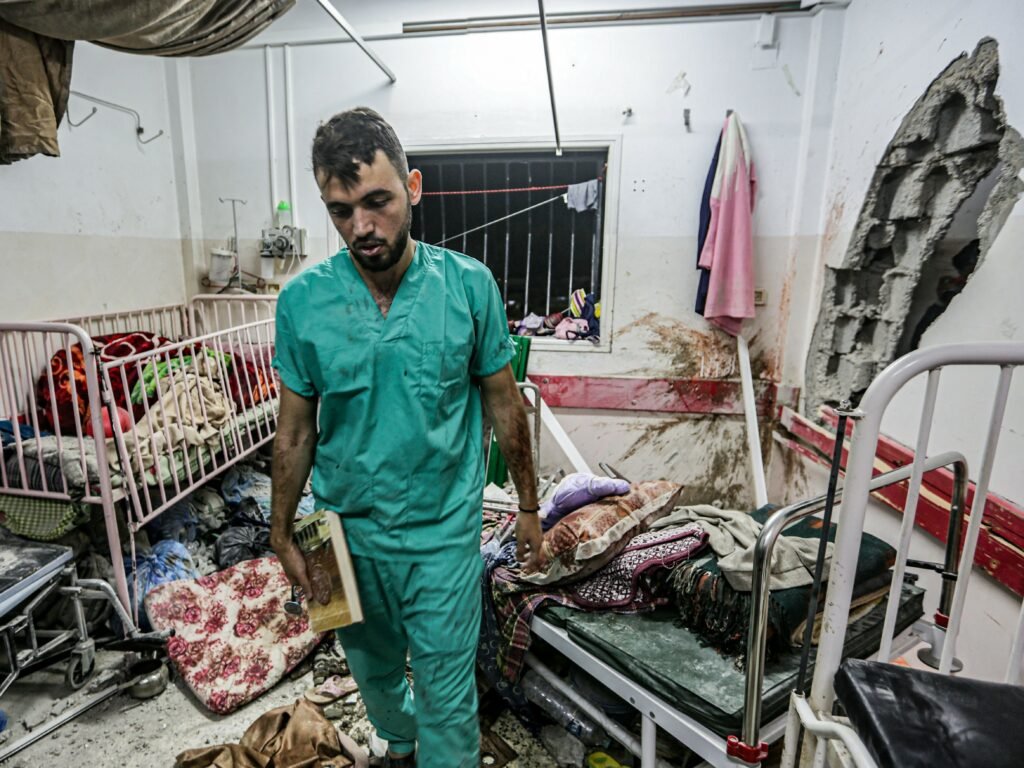
Gaza Herald _At Al-Aqsa Martyrs Hospital in central Gaza, Bassem Hassan, director of the laboratory department, faces a harrowing reality every single day: deciding whose life-saving medical tests get prioritized when the equipment to save everyone no longer exists. Under a relentless Israeli siege and military campaign that has intentionally gutted Palestinian healthcare, basic diagnostic tools, the foundation of modern medicine, have been virtually wiped out.
For Gaza’s healthcare workers, every missing test is a life hanging in the balance. Crucial blood gas analyses for cardiac and ICU patients have been completely halted. Basic blood-collection tubes, automated chemistry analyzers, sterilization equipment, and blood-bank refrigeration have all broken down or run out due to blocked supplies and targeted infrastructure destruction.
Given these severely limited resources, laboratory tests are strictly prioritized according to the severity of each case, with immediate access granted primarily to kidney, cancer, and heart patients, as well as those in intensive care. Without these critical test results, doctors are forced to estimate medication dosages, blindly monitor patient responses, and make life-or-death choices completely in the dark.
Nearly three years into the assault on Gaza, Israel’s blockade has left the medical system in a state of deliberate starvation.
Approximately eighty-seven percent of laboratory testing materials are completely exhausted, while seventy-four percent of essential lab consumables are entirely unavailable. Across the enclave, more than three-quarters of medical imaging equipment is out of service, leaving medical teams without basic diagnostic capabilities.
The physical destruction of medical infrastructure has eliminated advanced diagnostic care entirely. Zero MRI machines remain functional in Gaza after all nine were destroyed in Israeli attacks, and only five of eighteen CT scanners are still running, operating far beyond their safe mechanical capacity. Gaza’s Ministry of Health warns that blood banks and laboratories are on the verge of total shutdown, representing a direct death sentence for thousands suffering from severe electrolyte imbalances, high potassium levels, kidney failure, and heart disease.
At public hospitals, this crisis leaves physicians with impossible choices. Dr. Marwan Al-Azaiza, head of cardiology at Al-Aqsa, notes that physicians are often forced to send patients to private laboratories, an option few impoverished families can afford, or rely solely on basic physical examinations and electrocardiograms that cannot properly confirm or rule out critical conditions.
Dr. Mohammed Abu Salmiya, director of Gaza City’s Al-Shifa Hospital, describes the brutal daily routine of medical triage forced upon healthcare staff. Medical teams are compelled to restrict laboratory tests, X-rays, and CT scans exclusively to the most urgent cases, forcing doctors to choose between patients to determine whose test is immediate and whose must be delayed.
While necessary under extreme shortages, this approach leaves countless patients on long waiting lists with delayed diagnostic tests, even when those tests are desperately needed to guide active treatment.
For Palestinians living with chronic illnesses, the siege turns manageable conditions into rapid death sentences. Yousef al-Athamneh, a fifty-seven-year-old kidney failure patient from Deir el-Balah, depends on dialysis three times a week just to survive. He faces constant anxiety over the vanishing supplies of bicarbonate, bloodlines, intravenous fluids, and operational dialysis machines required to sustain his life, fearing the day equipment breaks down without replacement parts available.
The crisis is equally grim for Gaza’s cancer patients following the destruction of the Turkish-Palestinian Friendship Hospital, the region’s only specialized cancer facility, by Israeli forces. Khalil Al-Daqran, spokesperson for Al-Aqsa Martyrs Hospital, highlights that severe chemotherapy shortages, paired with Israel’s tightened blockade that makes traveling abroad for care virtually impossible, have left cancer patients abandoned without treatment options.
Across the Gaza Strip, an estimated three hundred and fifty thousand patients living with chronic conditions such as diabetes and hypertension are currently cut off from consistent medication. Cancer patients, individuals with chronic illnesses, and those suffering from heart and kidney disease require regular medical interventions that cannot be postponed, yet doctors are left to operate with virtually no supplies. Without immediate, guaranteed access to medicines, medical supplies, and basic equipment, preventable supply shortages will continue to act as an additional, deliberate cause of death for thousands.

