
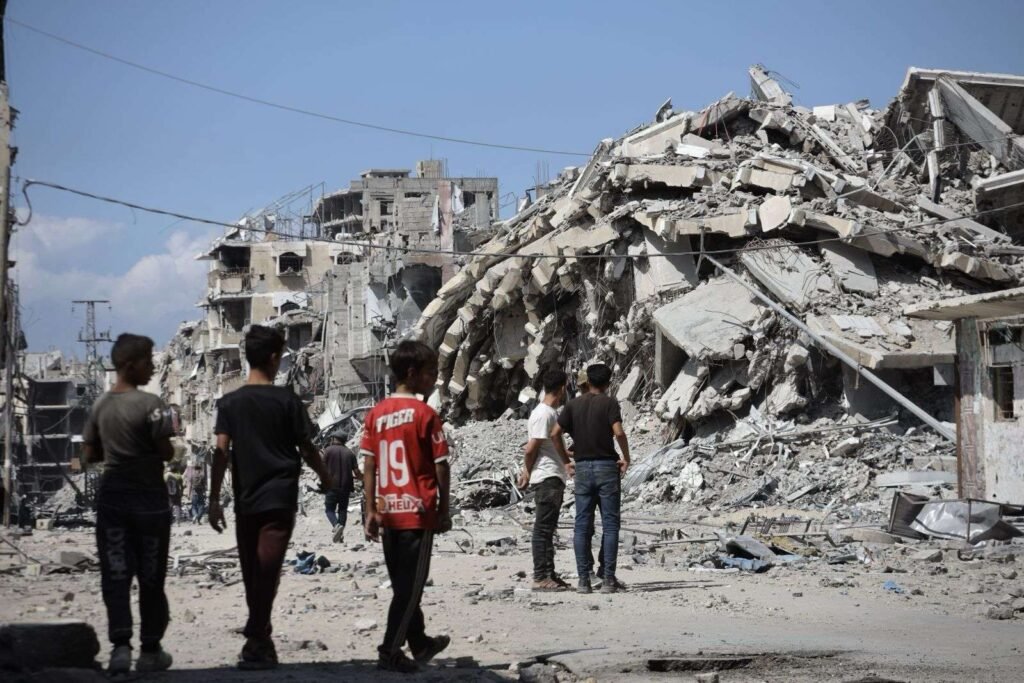
Gaza Herald — For millions of displaced Palestinians crammed into makeshift encampments across southern Gaza, the threat to human life is no longer confined to active battlefields. It permeates the spaces where families attempt to construct the barest semblance of daily life, striking inside family tents, along dusty residential streets, and where young children gather to play.
The tragic deaths of two children in separate shooting incidents this week have starkly illuminated the lethal reality facing civilians living near Israeli military positions, where routine gunfire routinely breaches designated non-combat zones and exposes the dangerous fallacy of unilaterally proclaimed “safe zones.”
The Fatal Illusion of the “Yellow Line” Boundary
Seventeen-year-old Tareq Kamel al-Masri was simply walking near his family home in central Khan Younis on Sunday morning when, according to eyewitness accounts and family members, he was struck in the head by Israeli sniper fire. Hours later and several miles away, eight-year-old Mohammed Saif al-Din al-Shukhrit was playing outside his family’s tent in the Fish Fresh area north of al-Mawasi in Rafah when gunfire suddenly erupted from nearby military positions. Both fatal shootings occurred well outside what the Israeli occupation military classifies as the “Yellow Line”, a shifting perimeter meant to delineate high-risk zones near army posts.
Yet for displaced families, these arbitrary lines offer zero practical protection, functioning instead as fluid boundaries where lethal force is applied without warning.
Tents Offer No Shield Against Live Ammunition
For families like the Shukhrit household, who had already been uprooted from Rafah and pushed toward the coastal sandbanks of al-Mawasi, displacement has provided no respite from trauma. When the shooting began, eight-year-old Mohammed ran toward his family shelter attempting to reach his mother, only to scream and collapse in the center of the tent. Relatives rushed the boy to a Palestinian Red Crescent facility, where medical staff discovered a bullet entry wound in his back and severe internal hemorrhaging before transferring him to Nasser Medical Complex, where he was pronounced dead.
Fabric tents and thin plastic sheeting offer no physical defense against military fire, turning basic survival tasks, such as fetching drinking water, foraging for food, or allowing children to step outside, into life-threatening gambles.
Systemic Deprivation and Forced Proximity to Danger
The ongoing displacement crisis leaves Gaza’s civilian population with virtually no geographic alternative. With over 80 percent of residential buildings across the enclave damaged or completely destroyed and Israeli forces constantly shifting military barriers, families are systematically trapped between advancing control lines and overcrowded coastal strips.
As local residents note, constant automatic fire, artillery echoes, and hovering reconnaissance drones maintain an environment of perpetual psychological stress. Families are forced to remain in areas immediately adjacent to military watchtowers simply because every other square inch of the Gaza Strip is already packed with displaced populations or rendered structurally uninhabitable.
The Stark Disconnect Between Rhetoric and Reality
These fatal shootings highlight a glaring contradiction between international diplomatic discussions regarding “de-escalation” or “ceasefire arrangements” and the reality enforced on the ground. While public statements frame the conflict through the lens of reduced airstrikes or managed truces, the daily experience of Palestinians along military perimeters remains defined by persistent, low-visibility violence.
For the families preparing funeral shrouds for Tareq and Mohammed, the technical distinctions of military disengagement hold no meaning. As displaced encampments continue to saturate Gaza’s remaining open spaces, the ongoing targetings demonstrate that no designated zone, civilian shelter, or truce agreement guarantees safety for Palestinian children.

