
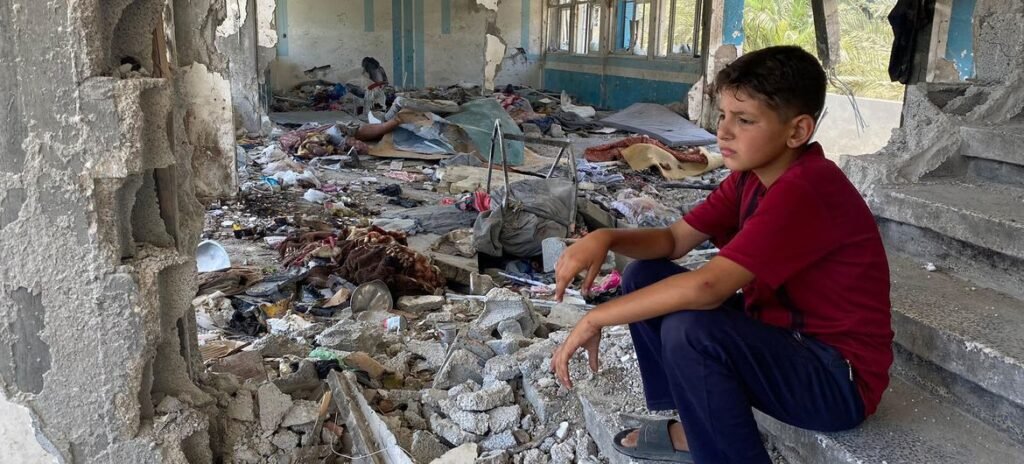
Gaza Herald- At 12 years old, Ramadan Yacoub Ghaban should be carrying a schoolbag, sitting beside his classmates and arguing over whose turn it is to play during recess. Instead, the war has pushed him into a completely different life.
Ramadan begins his day before 7 a.m. searching for pieces of wood and plastic to start a fire at his family’s tent. He then spends up to 12 hours working at a café on the seafront, carrying tables, arranging chairs, cleaning the area, leveling the sand and collecting trash before returning at night to a damaged tent, knowing that another day of work awaits him.
His days are no longer divided between school, home and play. They revolve around what his family needs and what a 12-year-old can provide. Displaced from Beit Lahia and having lost his father during the war, Ramadan has become part of the family’s daily struggle to secure food and water. While he watches neighborhood children play with their fathers, he works so his younger sisters will not have to go hungry.
A Childhood That Begins With Firewood
Ramadan’s family wakes inside a tent erected on a platform among the dunes of the Al-Nuwairi coastal area in Nuseirat. The shelter offers little protection from the elements. Rats have torn through its sides, leaving holes in the fabric, while sand blows inside through the gaps.
The family has no cooking gas, so one of Ramadan’s first tasks each morning is finding anything that can burn.
He moves between tents and dunes searching for scraps of wood and plastic. Sometimes he collects debris washed ashore by the sea or cuts branches from nearby thorny bushes. On one morning, he gathered pieces of plastic, a piece of wood, and several branches before lighting a fire with his brother, Uday, to make tea.
For a child his age, it is a morning chore that should never have become part of everyday life.
After that, Ramadan does not head to school. He walks to the café near his tent, roughly 300 meters away, where another long day begins.
Twelve Hours Instead of a School Day
At the café, Ramadan carries tables and chairs onto the beach, brings them back at night, cleans the area, collects garbage, and smooths the sand around customers’ seating areas.
His shift usually begins around 7 a.m. and can continue until 10 p.m., depending on how long customers remain.
The sea beside the café is both his workplace and one of the few places where Ramadan can briefly reconnect with the childhood he has lost. He loves swimming and says he taught himself how to swim. When he gets a short break, he sometimes runs into the water to cool himself down.
But even those brief moments of play are overshadowed by fear.
The café once offered him a different kind of memory. One day, he watched customers grilling food as the smell spread through the area. He thought about the home his family had lost and imagined that, had it still been standing, they might have been eating grilled food together.
When the customers left, they had abandoned a bag of potato chips. Ramadan was hungry, so he took it and ate it.
The Loss That Changed His Family
Ramadan would not have been carrying this responsibility had the war not transformed his family’s life.
Before the war, his father worked picking strawberries in Beit Lahia and collected recyclable materials. Then, one day, he went to the home of his uncle and aunt to help them evacuate after the family learned that a nearby area had been bombed.
The family was sheltering in a school when a woman arrived and told them that Ramadan’s father had been killed.
At first, they could not believe it.
When they eventually reached the house, they found it destroyed. Ramadan and his family tried to search through the rubble for his father, but shelling and gunfire prevented them from reaching him and forced them to flee.
His father remained beneath the rubble for four months.
When the family was eventually able to return to Beit Lahia, they recovered his remains and buried him.
For Ramadan, the loss did not simply mean growing up without his father. It meant entering a life in which contributing to the family’s survival became part of his responsibilities.
He says the work is exhausting, but he has no choice. When there is no money to buy food, his younger sisters cry, and he feels compelled to help.
Water Is Another Job
Ramadan’s responsibilities do not end at the café.
Around 1:30 p.m., when a water tanker arrives in the area, he temporarily leaves work and rushes with his sisters to fill their containers. They manage to collect around 15 containers for drinking and washing.
They then load them onto a makeshift cart made from a plastic crate, uneven wheels, and a crude wooden axle, pulling it back through the sand toward their tent.
Even getting water is unpredictable. Tankers may arrive as early as 6 a.m. or not appear until the afternoon.
Inside the tent, the family’s water containers are also vulnerable to rats. The rodents have damaged much of what the family owns, including the containers used to store water.
Most of the remaining containers leak, forcing the family to rely on plastic bottles.
A task that should take minutes has become another daily challenge for a child already working a full shift.
From a Family Home to a Tent on the Sand
Before the war, Ramadan lived with his family in a home with two bedrooms, a living room, a kitchen, and a bathroom.
He went to school in the morning, sat with his classmates, ate breakfast, and played with them during recess.
Now, his home is a tent on the sand.
Rats have eaten through parts of the shelter, while its damaged fabric offers little protection from the weather. As winter approaches, Ramadan worries about strong winds, heavy rain and flooding.
He knows that when the sea rises and storms intensify, cafés along the coast may close. But for his family, there is no alternative shelter waiting for them.
Even childhood games have become associated with danger.
Ramadan says children stopped making kites after children flying them were caught in an attack. A simple game that once filled the sky with color has become something they are afraid to repeat.
He Fears the War and the Hunger Returning
Ramadan’s fears extend beyond losing shelter or remaining poor. He lives with the possibility that the war could return at any moment.
He worries that the café where he works could be hit, that he could be attacked while walking, or that a nearby building could be targeted.
He is also afraid of hunger returning.
Ramadan remembers periods when his family went three or four days without food. He recalls going to an aid distribution point in Zikim to search for bread and watching people push and fight over a single kilogram of flour.
He says he saw people killed there and remembers gunfire erupting nearby.
People were forced to lie flat on the ground, he recalls, because bullets were coming from above and anyone who raised his head risked being shot.
He hopes those days never return.
Ten Shekels for a Day of Work
After spending between 12 and 15 hours at the café, Ramadan receives just 10 shekels.
He says the amount would have bought many things before the war. Today, it barely covers some cheese and a loaf of bread.
Still, he has found one thing he likes about his job: the café is next to the sea.
He loves the sea air and swimming whenever he gets the chance. For a few minutes, the water allows him to step away from the tables, the garbage, the hunger, and the responsibilities waiting for him onshore.
But the break never lasts.
Soon, he has to return to work.
A Child Still Holding On to His Dreams
Despite everything the war has taken from him, Ramadan still has dreams that extend beyond the tent, the café, and the daily struggle for food.
He wants to become a lifeguard so he can rescue people from drowning.
He also dreams of becoming a doctor or a lawyer.
But his most important wish is much simpler: he wants the war to end, homes to be rebuilt, and life to return to something resembling what it was before.
Then, Ramadan says, he would no longer have to work. He could return to school.
He has not entered a classroom since the beginning of the war, despite loving to read and considering Arabic his favorite subject.
At the end of his day, Ramadan walks back along the beach to his family’s tent. He washes, changes his clothes, prays, eats dinner and goes to sleep.
The next morning, he will wake at 6:30 and do it all over again.
Ramadan’s story is not simply about a child working 12 hours a day for 10 shekels. It is about what happens when war rearranges every part of childhood. In Gaza, for children like Ramadan, the questions that once belonged to adults have become part of everyday life: Who will bring the water? Who will buy the food? Who will work? Where will we sleep when winter comes?
Ramadan is not asking for an extraordinary life. He wants what should have been ordinary: to end the workday, return to a real home, sit in a classroom with a book in his hands, meet his friends in the schoolyard, and have enough time to simply be a child.

