
Gaza Herald — In Gaza, schools are being asked to do something they were never built to do: educate children while providing shelter to families who have nowhere else to go.
For years, classrooms have been transformed into living spaces for Palestinians whose homes were destroyed or who were forced to flee their neighbourhoods. Families have hung blankets between walls, stored their belongings beside blackboards and turned school courtyards into temporary homes.
Now, as Gaza begins a new academic year and more than half a million students return to education, those same buildings are being asked to become schools again.
But many displaced families have nowhere else to go.
The result is one of Gaza’s most painful dilemmas: children desperately need classrooms after years of disrupted education, while displaced families desperately need the same buildings for shelter. With nearly all of Gaza’s school infrastructure damaged and much of it requiring major reconstruction, there are simply too few safe spaces for either.
When a School Becomes the Last Home
For displaced families, leaving a school is not as simple as opening a classroom door and walking away.
Asaad Al-Awja, 40, had been living with his wife and children inside Suleiman Sultan School after their home in Gaza City’s Shuja’iyya neighbourhood was destroyed. The classroom gradually became their home, a place where they slept, stored their belongings and tried to create some form of normality amid repeated displacement.
Then the school year approached, and the family had to leave.
Eventually, a tent was provided for them in Gaza City’s Yarmouk area. The move freed classroom space for students, but left the family confronting another form of insecurity, with a tent offering little protection or stability.
In Nuseirat, other displaced families face the same dilemma. For them, the question is not whether Gaza’s children deserve education. Their own children need schools too. The problem is that many families whose homes have been destroyed still have no safe alternative shelter.
Too Few Schools for Too Many Children
Around 541,000 students are expected to participate in Gaza’s new academic year, including approximately 100,000 enrolled in UNRWA schools.
Yet they are returning to an education system devastated by nearly three years of war.
Recent UNICEF figures indicate that nearly 98% of Gaza’s school buildings have been damaged, while more than 93% require major rehabilitation or complete reconstruction. Around 700,000 children aged 4 to 17 have also missed formal, face-to-face schooling for almost three consecutive academic years.
The result is an education system trying to bring an entire generation back to learning with only a fraction of the infrastructure it once had.
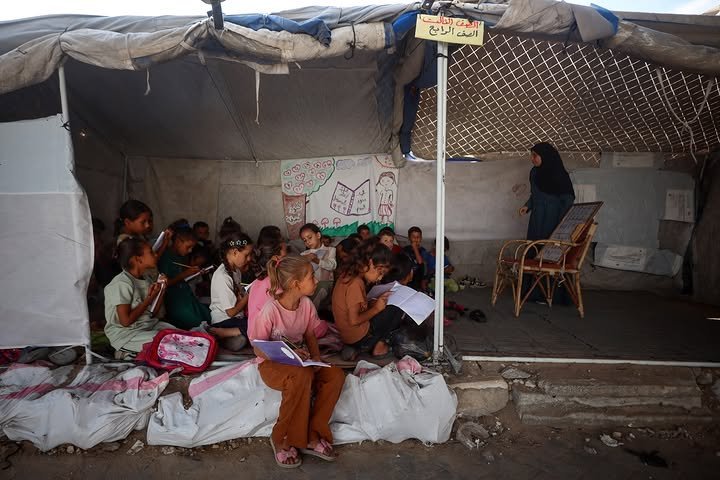
The Palestinian Ministry of Education says it is seeking to expand face-to-face education through around 700 learning points across Gaza, with another 25 temporary schools expected to become available. Virtual education will continue for students who cannot physically reach learning spaces.
But none of these alternatives can fully replace a functioning school.
Tents cannot provide the stability, protection or facilities of proper classrooms. Online education depends on electricity, internet connections and devices that many families lack. Temporary learning spaces may provide lessons, but they cannot compensate for the destruction of an education system.
Schools also need desks, stationery, teaching materials, sanitation facilities, electricity and enough teachers to serve hundreds of thousands of children.
A School Cannot Carry Two Futures at Once
Education authorities face an almost impossible balance. Schools must be restored to children without simply pushing displaced families into the streets.
The emerging response therefore relies on reopening available schools, establishing temporary learning points and expanding face-to-face education where conditions permit, while recognising that displaced families need alternative shelter before schools can fully return to their original purpose.
This leaves Gaza caught between two urgent needs.
Children need classrooms because years without regular schooling have already caused enormous educational losses. Families need shelter because many of the homes they would normally return to have been destroyed or rendered uninhabitable.
Neither need can simply be postponed.
As the school bell rings again in Gaza, it therefore does not signal a return to normality. In some places, children are studying in tents because their schools have been destroyed. In others, families are being asked to leave classrooms that became their last remaining shelter.
A Palestinian child should never have to compete with a displaced family for a classroom, and a displaced family should never have to choose between keeping a roof over its head and allowing children to return to school.
Yet that is the reality confronting Gaza as another academic year begins.
The challenge is no longer simply how to reopen schools. It is how to rebuild enough schools and homes so that education does not come at the cost of shelter, and shelter does not come at the cost of a child’s future.
Until then, Gaza’s surviving schools will remain trapped between two roles they were never meant to carry at once: places where children are supposed to build their futures and places where displaced families are struggling to survive the present.

