
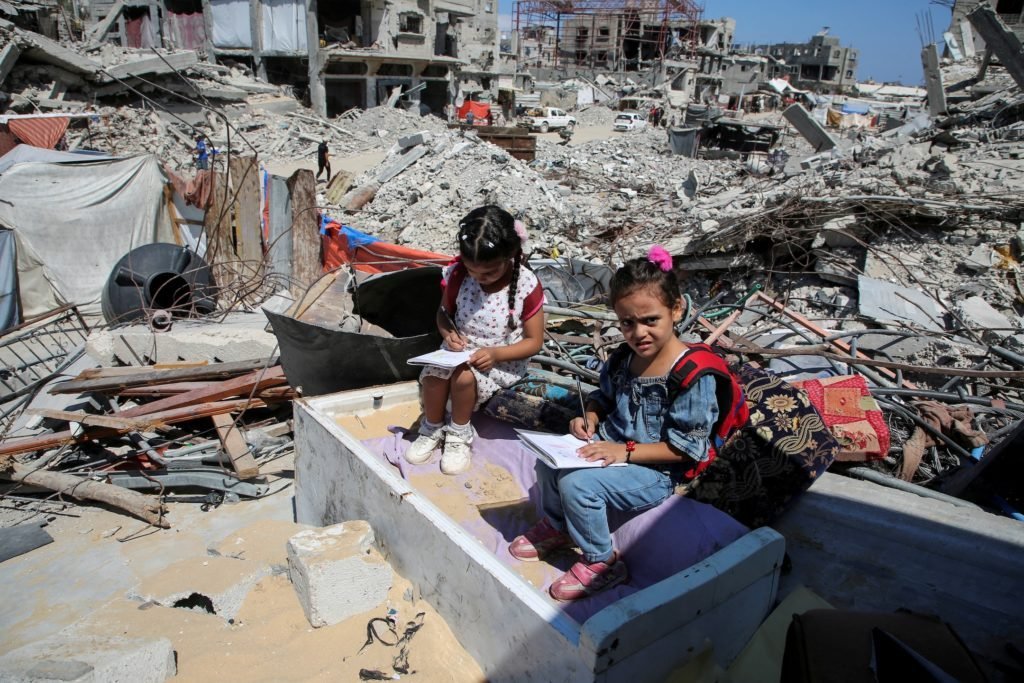
Gaza Herald — More than half a million students in Gaza are beginning a new school year, but for many of them, returning to education does not mean returning to a classroom.
Across the Strip, children are returning to an education system transformed by nearly three years of war. School buildings have been destroyed or severely damaged, thousands of students and hundreds of teachers have been killed, and many of those who remain are studying in tents, temporary learning spaces and overcrowded facilities never designed to function as schools.
For Gaza’s children, the beginning of the 2026/27 school year therefore carries two very different meanings. It marks a return to learning, but also serves as a reminder of everything the war has taken away.
According to the Palestinian Ministry of Education and Higher Education, around 541,000 students are beginning the academic year across Gaza, including approximately 100,000 enrolled in UNRWA schools. Education is being provided through hundreds of in-person learning points alongside virtual education for students unable to attend physically.
Yet Gaza has only a fraction of the functioning educational infrastructure needed to accommodate them.
A School System Running on Survival
Education authorities have been forced to improvise almost every part of the school system. Surviving schools and temporary learning centres are operating multiple shifts, while some students attend entirely online and others combine virtual and in-person education.
The Ministry of Education says around 700 in-person learning facilities are operating across Gaza, with another 25 temporary schools expected to become available. Virtual schools are also serving tens of thousands of students inside Gaza and abroad.
The numbers reveal both the scale of the effort and the scale of what has been lost. Education is resuming, but the system returning this year bears little resemblance to the one Gaza’s children knew before the war.
For thousands of students, the path back remains uncertain. Years of interrupted education have left enormous learning gaps, forcing education authorities and humanitarian organisations to rely heavily on remedial programmes to help children recover lost schooling.
When a Tent Becomes a Classroom
In Gaza City, returning to school often means returning to a tent.
Temporary classrooms have been erected in school courtyards and other available spaces, while some surviving school buildings remain partly occupied by displaced families. Students can be seen sitting on mats or directly on the ground as teachers attempt to recreate classrooms with whatever materials remain available.
Basic stationery and educational materials remain scarce, while damaged infrastructure has left many learning spaces without adequate sanitation, electricity or other essential facilities.
The image is far removed from what a school is supposed to be, yet teachers continue to stand before their students.
Education authorities are also establishing temporary learning spaces closer to displaced communities, reducing the distance children must travel. But even finding suitable space has become difficult in a territory where repeated displacement and widespread destruction have compressed large numbers of Palestinians into increasingly crowded areas.
Weather presents another challenge. Temporary tents offer limited protection from rain and winter conditions, meaning that something as basic as staying dry can determine whether a child is able to attend a lesson.
The Children Who Never Returned
The destruction of Gaza’s education system cannot be measured only in damaged buildings.
Palestinian education authorities have reported that more than 20,000 school-age students have been killed since October 2023, alongside hundreds of teachers and education workers.
For surviving children, returning to education therefore also means returning without classmates who once sat beside them and without teachers who once stood at the front of their classrooms.
The physical destruction is similarly profound. UNICEF has reported extensive damage across Gaza’s school infrastructure, leaving most school buildings requiring major rehabilitation or reconstruction.
The destruction of electricity, telecommunications and internet infrastructure has also complicated alternative forms of education, while shortages of stationery, books and other materials continue to affect both students and teachers.
Humanitarian organisations have supplied learning materials and supported temporary education centres, but the scale of assistance remains far below what would be required to rebuild a functioning education system.
An Education System Refusing to Disappear
That creates the defining paradox of Gaza’s new school year: an education system devastated by war is nevertheless trying to bring more than half a million children back into learning.
The challenge is much greater than simply reopening schools. Gaza needs classrooms, teachers, books, electricity, internet access, sanitation, safe transportation and ultimately the reconstruction of an educational infrastructure that has been shattered.
For Gaza’s children, a classroom is more than four walls and a blackboard. It is a place where a child can sit safely, listen to a teacher, open a notebook and imagine a future beyond survival.
This year, many will have to imagine that future beneath a tent, sitting on the ground while teachers work with whatever materials they can find.
Yet they are returning.
That may be the most powerful image of Gaza’s new school year: children walking back towards education despite the destruction around them, sharing whatever space remains and refusing to allow the destruction of their schools to become the destruction of their right to learn.
Gaza begins this school year without enough classrooms, desks or supplies. But its children are still showing up, and after nearly three years in which so much has been taken from them, returning to learn has itself become an act of survival.

