
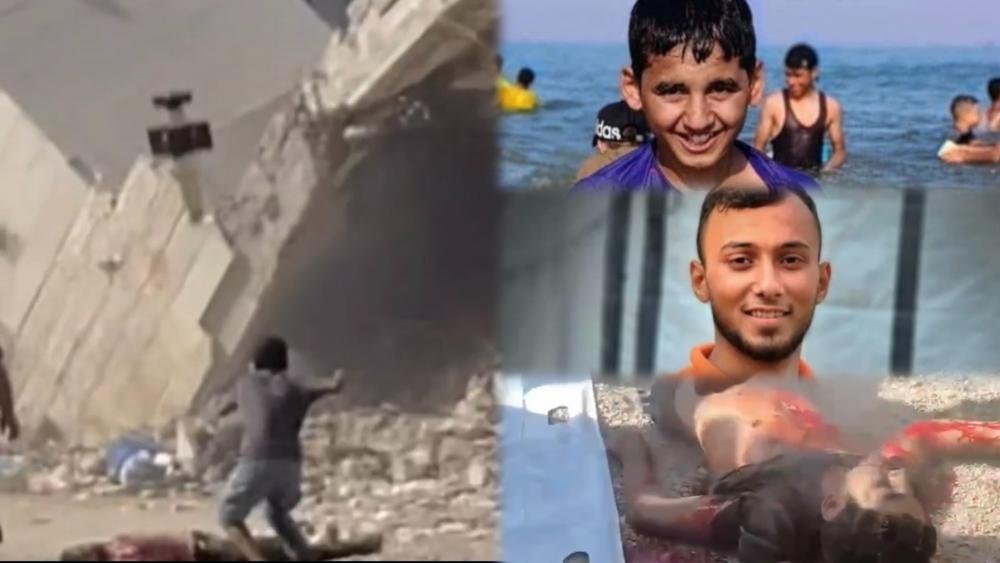
Gaza Herald — Minutes before his life was stolen, 18-year-old Muhammad al-Zeinati was doing what any teenager should be doing: laughing with friends, clinging to a fleeting moment of ordinary life in a place where ordinary life has been methodically dismantled.
Then came the deafening roar of an Israeli airstrike in Sheikh Radwan, northwest of Gaza City.
When the dust settled, civil defense worker Sharif Labad lay critically wounded on the ground. Muhammad saw him. He wasn’t a trained paramedic; he had no protective gear, and he carried no equipment. He had only his own humanity.
Barefoot, Muhammad sprinted toward the bleeding man.
Moments later, a second strike hit the same spot. The follow-up strike ended two lives in an instant, leaving Muhammad lying dead beside the man he tried to save.
Choosing the Danger Zone
After the first missile struck, anyone in Gaza knew the deadly pattern: staying exposed meant risking a second attack. Most would run for cover. Muhammad ran toward the blast.
Unedited footage and testimonies from the scene show the teenager charging barefoot through the rubble as onlookers hesitated amidst the smoke. According to his friend, Muhammad al-Balawi, there was no calculation, no pause for self-preservation.
“We were playing together minutes ago, and suddenly he was in a shroud,” al-Balawi recalled in disbelief. “He ran to protect someone else and never returned.”
Muhammad reached Labad, but the second missile gave him no time to pull the rescuer to safety, and no time to turn back.
A Father’s Farewell at al-Shifa
At al-Shifa Hospital, the reality of the loss collapsed onto Muhammad’s father.
Standing over the white shroud holding his 18-year-old boy, the grieving father was stripped of the future he had envisioned, watching his son mature, build a life, and grow old.
Leaning over his son’s body, he wept: “May God have mercy on you, my beloved. My hero. I never got to enjoy seeing him grow into his youth. Allah is sufficient for us.”
The Price of Humanity
Sharif Labad went into the danger zone because it was his duty as a civil defense responder. Muhammad went simply because he refused to let a human being die alone.
In a landscape dominated by destruction, Muhammad’s final act was defined by absolute selflessness. He didn’t run away to save himself; he ran forward to save another, becoming part of a generation of young Palestinians whose lives are cut short not while fleeing the violence, but while trying to defy it.

