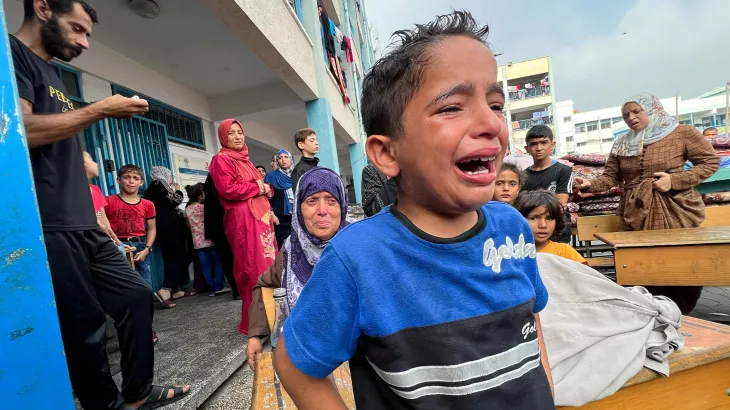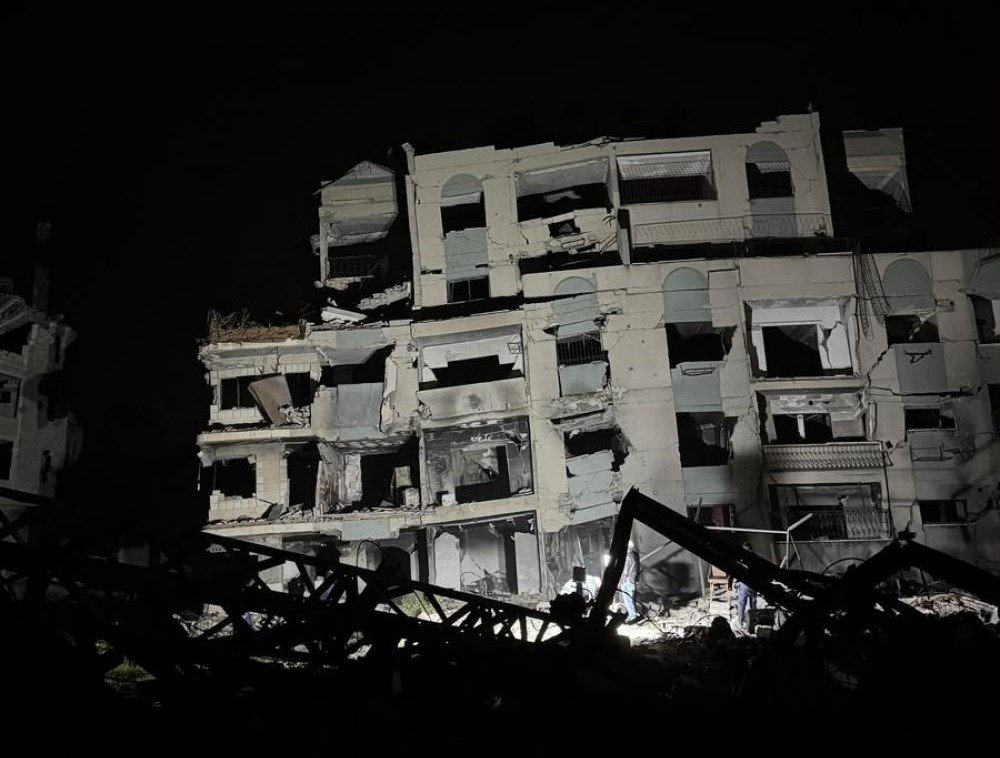
Gaza Herald — When Al-Saada residential building collapsed in western Gaza City before dawn on Wednesday, the families sheltering inside were not simply victims of a sudden structural accident. They were living inside a building already badly damaged by Israeli bombardment because, like thousands of Palestinians across Gaza, they had few safer places left to go.
At least 16 Palestinians, including children, were reported killed as rescue operations continued, while dozens were injured and around 100 people were initially feared trapped or missing beneath the enormous slabs of concrete. The six-storey building was sheltering displaced families when it gave way, collapsing not only onto those inside but also onto tents erected nearby.
The tragedy exposes a danger that has remained largely hidden behind Gaza’s staggering statistics of destroyed homes: thousands of buildings that survived Israeli attacks are still standing, but many are no longer structurally safe. For the families living inside them, the bombardment may have ended months or years ago, yet the threat embedded in damaged foundations, cracked columns and weakened concrete remains.
A Disaster Years in the Making
Al-Saada had previously been damaged by Israeli strikes. Families nevertheless continued to shelter there amid Gaza’s severe housing crisis, where widespread destruction has left displaced Palestinians choosing between damaged buildings, overcrowded shelters and tents offering little protection.
Gaza Civil Defence says around 2,000 damaged buildings remain inhabited despite being at risk of collapse, while hundreds are considered in particularly dangerous condition. The warning is especially urgent as winter approaches, when rain, moisture and strong winds could further weaken structures already damaged by explosions.
This makes Al-Saada more than an isolated tragedy. It is a warning about what could happen across Gaza if structurally compromised buildings are not urgently assessed, reinforced, evacuated or safely demolished.
Yet telling families to leave is not a solution when there is nowhere safe for them to go. Palestinians have returned to damaged homes not because they believe the structures are safe, but because the destruction of Gaza has stripped them of alternatives.
The Race Beneath the Rubble
After Al-Saada collapsed, Palestinian Civil Defence crews, ambulance workers and residents began searching for survivors beneath massive concrete slabs. Some rescuers and residents were forced to dig through debris with basic tools and their hands while cries could still be heard from underneath the wreckage.
Civil Defence officials appealed urgently for heavy machinery and specialised rescue equipment, warning that the scale of the rubble exceeded the capabilities available to crews on the ground.
This shortage can determine who lives and who dies. In the first hours after a building collapse, every delay matters. Excavators, lifting equipment, cutting tools, search technology and specialised rescue teams can mean the difference between reaching a trapped survivor and recovering a body days later.
The United Nations estimates that Gaza is covered by roughly 61 million tonnes of rubble, while thousands of people are still believed buried beneath debris from the war. Yet restrictions affecting the entry of heavy machinery and other equipment continue to obstruct recovery and rescue operations.
Al-Saada therefore raises a question extending far beyond one collapsed building: how many lives could be saved if Gaza had the machinery necessary to reach people quickly?
When the Bombing Ends but the Danger Remains
The physical consequences of an airstrike do not disappear when the explosion ends. A building can remain standing while suffering serious damage to foundations, columns and load-bearing walls. That deterioration can worsen with time, particularly under overcrowding and exposure to rain and moisture.
This is one of the war’s continuing dangers. Israeli bombardment has not only reduced buildings to rubble; it has left behind structures whose damage can turn them into delayed death traps.
The absence of large-scale reconstruction has compounded that danger. Nearly a year into the ceasefire, Palestinians continue living among damaged structures because rebuilding has barely begun and restrictions remain on materials and equipment needed for reconstruction. Reuters reports that tens of thousands of Palestinians are living in approximately 2,000 compromised buildings across Gaza.
For them, “shelter” can mean sleeping beneath concrete that may no longer be capable of remaining upright.
Gaza Needs Rescue Equipment Now
Responsibility for preventing another Al-Saada tragedy cannot stop with warnings from Gaza Civil Defence.
Israel bears responsibility for the enormous physical destruction created by its military campaign and for restrictions that humanitarian organisations say have impeded the entry of machinery and essential equipment. But the international actors involved in administering Gaza’s post-ceasefire reality also face a basic humanitarian question: why, nearly a year after the ceasefire, do Palestinian rescue workers still lack sufficient equipment to reach civilians buried beneath collapsing buildings?
The United States, mediators and international bodies involved in the ceasefire and Gaza’s humanitarian arrangements cannot treat this as an unfortunate technical problem. If heavy machinery, rescue equipment, temporary housing and engineering teams are known to be urgently needed, failing to secure them leaves civilians exposed to foreseeable danger.
Managing Gaza’s humanitarian catastrophe is not the same as ending it. Nor is announcing aid sufficient when rescuers are still digging through concrete with inadequate equipment.
Al-Saada should therefore be treated as an urgent warning. Gaza needs structural engineering teams to identify buildings at immediate risk, heavy machinery to remove unstable concrete and rubble, specialised search-and-rescue equipment, and safe temporary housing so families can actually leave dangerous buildings.
Around 100 people were initially feared beneath the rubble of one building. Across Gaza, thousands of damaged structures remain standing over families who have nowhere else to live.
The bombs may have fallen years ago, but for Palestinians sleeping inside those buildings, the destruction has not ended.
Al-Saada collapsed in a single night. The conditions that made the tragedy possible were created over years — and without urgent intervention, other buildings could follow.