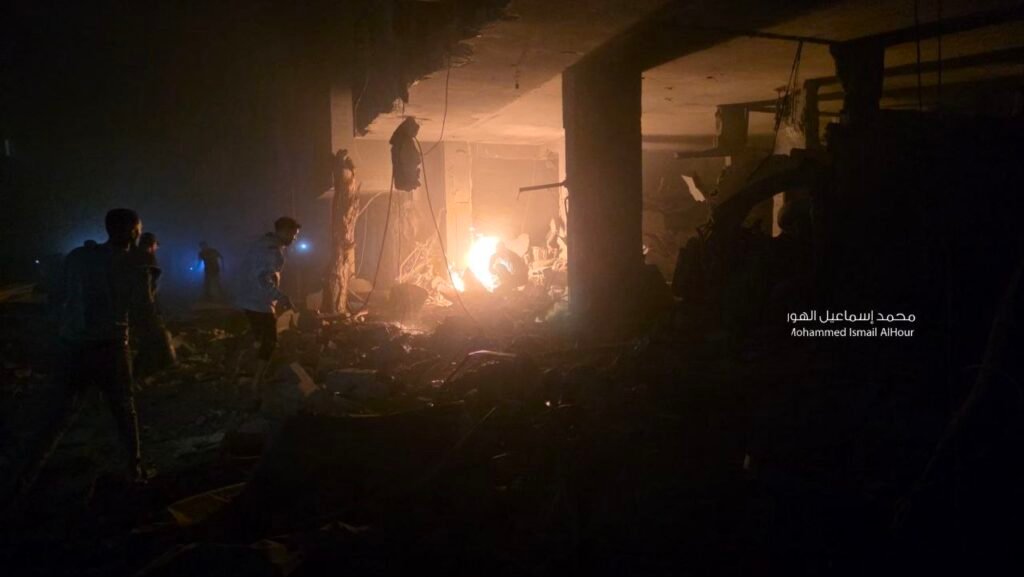
Gaza Herald — Gaza’s electricity distribution system has been devastated by Israeli attacks, with preliminary losses approaching $1 billion and more than 85% of the enclave’s distribution networks destroyed, leaving most Palestinians with little or no reliable access to power.
Mohammed Thabet, public relations director of the Gaza Electricity Distribution Company, estimated losses to the sector at $977 million, covering damage to electricity networks, facilities, warehouses, vehicles and other operational infrastructure.
The true cost could be considerably higher. Thabet said technical crews remain unable to reach all damaged areas, particularly locations still under Israeli military control, preventing engineers from completing a comprehensive assessment.
According to the company, more than 85% of Gaza’s electricity distribution networks have been destroyed, alongside approximately 90% of its warehouses and storage facilities. More than 70% of company buildings and facilities have been completely destroyed, while around 85% of its vehicle fleet has been lost.
The destruction has deprived Gaza of an estimated 2.3 billion kilowatt-hours of electricity, according to the company, turning an already severe energy shortage into a crisis affecting virtually every aspect of civilian life.
A Crisis Far Beyond Darkness
Electricity in Gaza is not simply about keeping lights on. Hospitals require power for operating rooms, intensive care units, medical equipment and refrigeration. Water wells and desalination facilities need electricity to function, while sewage treatment, telecommunications and other essential services depend on a stable power supply.
The collapse of the electricity network therefore compounds almost every other humanitarian crisis in Gaza. A hospital without power cannot provide normal medical care, water cannot be reliably pumped to families, sewage systems cannot operate effectively, and communications become increasingly difficult.
For ordinary Palestinians, alternative electricity has also become prohibitively expensive. Thabet said a kilowatt-hour can cost around 30 shekels, or approximately $8, putting privately generated electricity beyond the reach of the overwhelming majority of families.
According to the company, only around 15% to 20% of Gaza’s population currently has access to any electricity, while Israeli restrictions on fuel, equipment and spare parts have severely constrained the operation of generators and efforts to repair damaged infrastructure.
Destruction That Will Outlast the War
Restoring Gaza’s electricity system would require far more than reconnecting cables. Reconstruction depends on the entry of transformers, spare parts, fuel, heavy machinery and vehicles, as well as safe access for engineers to devastated areas across the Strip.
The scale of the damage also means that electricity will be central to any meaningful reconstruction of Gaza. Homes cannot be sustainably rebuilt without functioning water and sanitation networks, hospitals cannot recover without reliable energy, and businesses, schools and communications infrastructure cannot return to normal operation while most of the population remains without power.
The destruction of Gaza’s electricity infrastructure has therefore created damage that extends far beyond the immediate consequences of Israeli attacks. Even where buildings can eventually be reconstructed, restoring the systems required to make civilian life possible could take years.
For Gaza’s Palestinians, the result is a territory where the destruction of electricity has become intertwined with the destruction of everyday life. With 85% of distribution networks destroyed and preliminary losses already reaching $977 million, rebuilding Gaza will require not only reconstructing what Israel destroyed, but restoring the basic infrastructure that allows an entire society to function.