
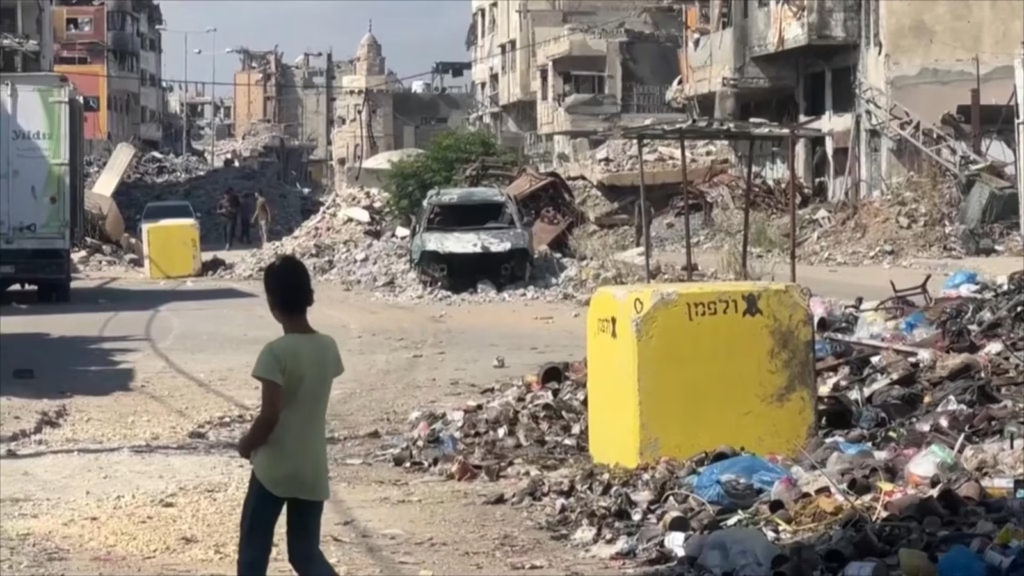
Gaza Herald — When a Palestinian home in Gaza is reduced to rubble, the loss can extend far beyond its walls. Buried beneath collapsed concrete are title deeds, purchase contracts, tax records and utility bills, documents that may one day determine whether a family can prove its right to the land beneath the ruins.
Across Gaza, Palestinians are confronting this less visible consequence of Israel’s destruction: how to preserve property rights when homes, government offices, legal practices and archives containing the evidence of ownership have been destroyed.
As Palestinians look towards eventual return and reconstruction, lawyers and families are racing to recover whatever evidence remains. An electricity bill, an old photograph, a municipal record or testimony from a neighbor can suddenly become crucial proof that a family lived on a particular piece of land.
Ownership Buried Beneath the Rubble
From his rented room, Mohammad al-Agha can see the ruins of what was once his family home. Somewhere beneath the rubble lies the original title deed to the land where he and his brothers built their lives.
Fearing the destruction could leave his family struggling to prove ownership, al-Agha obtained a replacement document from Khan Younis municipality using digital property information preserved from an earlier planning application. It records the plot, neighborhood, and dimensions of the destroyed property.
“The document proves that we have a right to this place,” he said.
His experience reflects a growing challenge across Gaza. Around 1.9 million Palestinians have been displaced during the war, many repeatedly and often with little opportunity to preserve documents. Entire neighborhoods have been transformed beyond recognition, complicating not only return but the identification of individual properties and boundaries.
For families who have lost original documents, lawyers are assembling alternative evidence: electricity and internet bills, property tax records, photographs and videos, municipal documents, court decisions and testimony from neighbors and community leaders.
In Gaza today, even an old electricity bill can become evidence of belonging.
A Race to Preserve the Records
Legal aid lawyer Mohammad al-Saqqa warns that the effort is a race against time. Surviving government records remain vulnerable, while elderly residents and community leaders who possess decades of knowledge about local ownership and boundaries may not always be available to provide testimony.
The challenge is intensified by Gaza’s complicated system of land ownership, shaped by Ottoman, British Mandate, Egyptian and Palestinian legal systems. Not every privately held property was formally registered in the central land registry, meaning many families were already dependent on secondary records to demonstrate ownership.
Legal teams are therefore searching surviving municipal databases, property-tax files, court records and other archives to reconstruct claims. Where formal deeds no longer exist, lawyers may combine several forms of evidence to establish long-term possession and ownership.
The destruction of legal infrastructure has made that work significantly harder. Law offices and government facilities have been destroyed, while parts of Gaza’s Land Authority archives were badly damaged.
Nidal Jarada, a legal adviser at the University College of Applied Sciences, described seeing displaced Palestinians burn old Ottoman-era documents found near a damaged registry because they desperately needed fuel for warmth and cooking — a striking illustration of how humanitarian desperation can also consume pieces of Gaza’s historical record.
One crucial safeguard survived, however. Gaza’s Land Authority had digitised its property records shortly before the war, leaving a backup from which officials and lawyers can retrieve copies of some lost documents.
From Yibna to Jabalia
The struggle is particularly complicated in Gaza’s refugee camps, where families displaced from their original Palestinian towns and villages in 1948 have built lives on land governed by different forms of tenure and local recognition.
Maysara Daniel, a taxi driver from Jabalia refugee camp, lived in a 140-square-metre apartment before it was destroyed. His family had lived in the camp since his grandparents were displaced from Yibna during the Nakba.
For generations, the family preserved the iron key to its original home in Yibna as a symbol of return. That key now lies somewhere beneath the rubble of Daniel’s destroyed home in Jabalia.
His story captures the layers of Palestinian displacement: a family uprooted from one home in 1948 now faces the destruction of another home built in exile.
In refugee camps, proving property claims may depend heavily on utility records, community testimony and documentation maintained by local committees. Such evidence could become increasingly important when residents return to areas where streets, buildings and physical boundaries have disappeared.
Rebuilding More Than Homes
Preserving these records is therefore not simply bureaucratic work. Property documentation will matter when reconstruction begins, when families attempt to identify destroyed plots and when disputes emerge over boundaries in neighbourhoods whose physical geography has been transformed.
It also carries a deeper significance amid Palestinian fears of permanent displacement and Israeli territorial control. A destroyed building can eventually be rebuilt. A family’s legal connection to the land becomes much harder to restore once the documents, archives and people capable of proving that connection disappear.
For Palestinians, this is why recovering a title deed from a municipal database or preserving an old electricity bill can become part of the struggle to remain rooted in Gaza.
The parallel with the Nakba is difficult to escape. Palestinians expelled in 1948 famously preserved keys and deeds to homes they were never allowed to return to. Nearly eight decades later, families in Gaza are again protecting documents, photographs and keys because they understand what displacement can mean when temporary flight becomes permanent dispossession.
Rebuilding Gaza will therefore involve more than reconstructing houses, hospitals and roads. Palestinians will also have to reconstruct the documentary map of their communities, plot by plot, deed by deed and testimony by testimony.
For a family standing before the ruins of its home, those pieces of paper may appear insignificant beside the scale of destruction. Yet they carry something that the rubble cannot show: proof that this was their home, that this land has an owner, and that destruction does not erase the right to return to it.

