
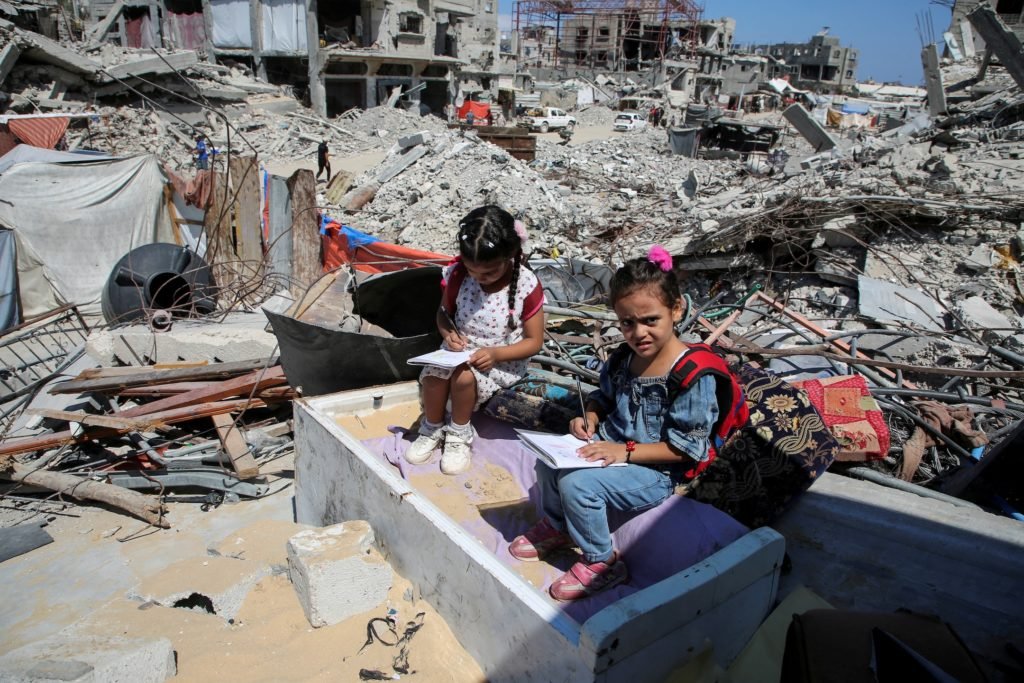
Gaza Herald _As a new school year approaches, Fatima Nasser is no longer thinking about backpacks or school uniforms as she did every year before Israel’s war on Gaza.
Displaced alongside her husband and five children, Fatima now lives inside a damaged mosque in southern Gaza. Her days are consumed by the struggle to secure water and food, while school has become a distant dream postponed beneath the tents.
The Struggle to Learn Under Displacement
The woman in her thirties describes her family’s situation as “very bad.” Her husband lost his job after the war began in October 2023 and, like countless others across Gaza, was left without a stable source of income.
With the new school year approaching in early September, she finds herself unable to meet the long list of needs facing her children, from clothes and backpacks to notebooks and basic stationery.
“How can my children return to school when we cannot afford even the simplest supplies?” she asks painfully.
The worn-out shelter where the family lives is hardly a place for children to study. Fatima tries to teach them on her own, but the constant noise of the displacement camp, the lack of books, and the absence of a smartphone capable of connecting them to online educational platforms make the task nearly impossible.
The Palestinian Ministry of Education and several volunteer initiatives have launched remote learning programs in an effort to compensate for schools that have been destroyed or turned into shelters. But for many displaced families, even access to these alternatives remains out of reach.
Fatima remembers what life was like before the war.
“I used to live happily and comfortably. My husband worked and provided everything we needed as a family. Today, nothing resembles our previous life.”
Her story reflects the reality facing much of Gaza’s devastated population.
School Supplies at War-Time Prices
A few miles away, the impact of the crisis is also visible in Gaza’s small businesses.
Near the Nasser Medical Complex in Khan Younis, Yasmeen Abu Shawish runs a small stationery stand from a sidewalk. Throughout the day, she watches families struggle to afford even the most basic school supplies for their children.
A university graduate who was unable to find work in her field, Yasmeen started the modest business as a way to earn a living. She says Gaza’s education crisis extends far beyond destroyed schools and displaced teachers. Even stationery has become increasingly unaffordable as prices continue to rise.
She points to the dramatic increase in the cost of basic items. A pencil that sold for about half a shekel before the war now costs around two shekels. A 40-page notebook that once cost one shekel now sells for three, while a 60-page notebook can cost as much as seven shekels.
These increases affect nearly every school supply at a time when many families can barely afford food and clean water.
According to Yasmeen, the weak demand for stationery despite the approaching school year is a clear indication that, for many families, returning to education is no longer a normal annual routine. It has become another financial burden they simply cannot afford.
Alternative Schools Built From Tents
Amid this reality, teacher Ahlam Abdel Ati is trying to protect what remains of education for displaced children.
In the Mawasi area west of Khan Younis, she runs one of the early alternative schools established inside tents as part of a free educational initiative.
From the beginning of the war, Ahlam understood the scale of the threat facing Gaza’s students and educational system. Schools were repeatedly bombed and destroyed, while many others were transformed into shelters for displaced families.
That reality inspired her to establish the Ahlam Gaza Model Kindergarten and School, creating a space where children could continue learning despite the destruction around them.
Estimates from Gaza’s Ministry of Education indicate that around 80 percent of schools are currently out of service. Meanwhile, approximately 55 percent of the remaining educational spaces consist of tents and plastic sheeting, while nearly 110,000 students face serious difficulties returning to classrooms.
Ahlam’s own school has been destroyed three times. Each time, she has worked to rebuild it with personal funding and limited donations, continuing to offer free education primarily to displaced children.
Inside her school, a tent has replaced the traditional classroom. A worn piece of wood hanging at the front serves as a blackboard.
Yet despite everything, children continue showing up.
Ahlam says she feels proud when she sees students insisting on attending classes every day and holding onto their right to education despite the devastation surrounding them.
Some children, however, cannot afford even a notebook.
Instead, they write their lessons on pieces of cardboard taken from humanitarian aid boxes.
“Education in Gaza is not a choice. It is a necessity,” Ahlam says.
Some siblings share a single pencil, while other families can afford only one notebook for all subjects.
These harsh details reflect not only the scale of deprivation but also the determination of Palestinian children and educators to continue learning under conditions designed by war, displacement, and siege.
The Mobile Phone: A Traveling Classroom That Not Every Child Can Access
Ahlam also tries to use her mobile phone as a substitute for textbooks during lessons. The phone, she says, has become one of the most important alternative tools for education.
But even this solution is unavailable to many children.
Smartphone prices have risen sharply, while internet access remains unreliable across many areas of Gaza, particularly in displacement camps and overcrowded shelters.
As a result, students face one obstacle after another: schools that have been destroyed or closed, textbooks and stationery that are unavailable or prohibitively expensive, and alternative learning tools that remain beyond the reach of many families.
At the same time, Gaza’s devastating humanitarian conditions have forced many households to depend almost entirely on aid after the war stripped families of their jobs, incomes, and savings.
For many children, the loss extends far beyond the classroom.
Displacement itself has forced some young Palestinians into exhausting daily responsibilities, including searching for water and food for their families.
Ahlam says the collapse of daily life has left thousands of children without either the time or the environment needed to continue their basic education.
As Gaza enters another school year, its classrooms are increasingly shaped not by books, desks, and school bells, but by tents, displacement, shortages, and the continuing consequences of war.
For some children, a piece of cardboard from an aid box has become their notebook.
And while students elsewhere prepare new backpacks and sharpen pencils for the first day of school, many children in Gaza are still searching for something far more basic: a safe place to sit, learn, and imagine a future beyond war.

