
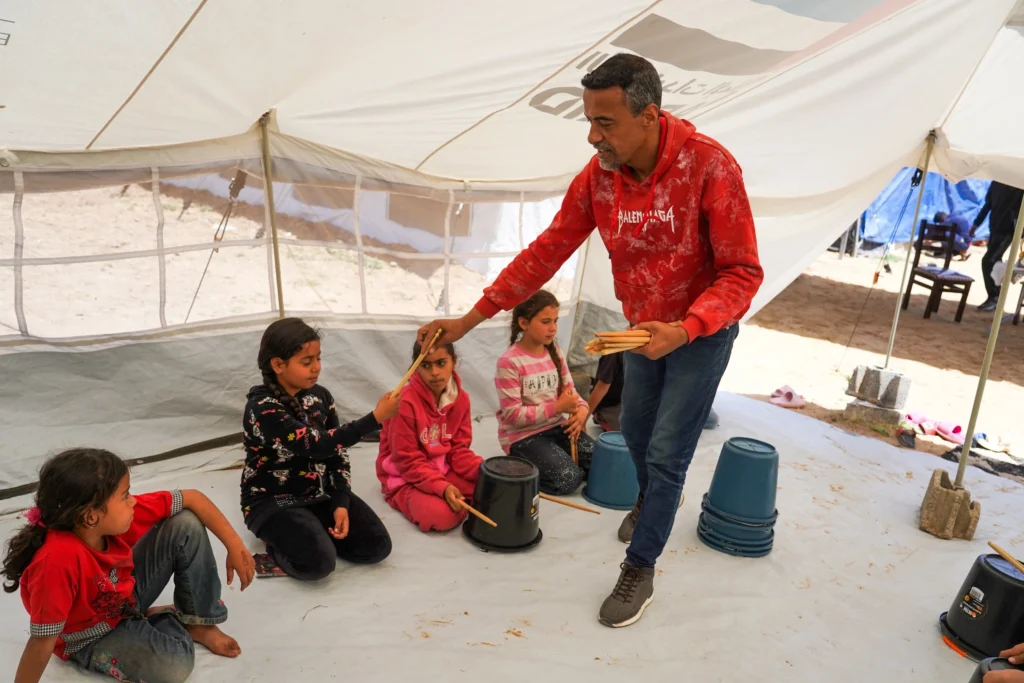
Gaza Herald _ Inside a makeshift classroom in Gaza, the sound of children singing and playing musical instruments offers a rare break from the destruction and uncertainty surrounding their lives.
Every day, young Palestinian children gather for music lessons, practicing their voices and learning to play instruments while trying, even for a short time, to step away from the realities of war, displacement and loss.
For many of them, the classroom is more than a place to learn music. It is one of the few spaces where they can laugh, interact with other children and experience a sense of normalcy that has become increasingly difficult to find.
Despite the devastating conditions across the Gaza Strip, the Edward Said National Conservatory of Music has continued its efforts to provide music education and psychological support to children. Through lessons held in temporary spaces, including tents, instructors are working to create an environment where children can express themselves and reconnect with activities that once formed a normal part of childhood.
“Our first goal is to take these children away from the atmosphere of war and change their surroundings so they can experience joy,” said Fouad Khader, a music instructor leading the sessions.
“Music helps them feel safe and encourages them to play together as a group,” he added.
The sessions come as Gaza’s children continue to face profound disruptions to nearly every aspect of their lives. Months of war and repeated displacement have interrupted formal education, separated families and transformed schools, homes and playgrounds into places associated with fear and uncertainty.
For children who have spent much of their lives surrounded by violence and displacement, opportunities to learn, play and simply spend time with their peers have become increasingly scarce.
Humanitarian organizations have repeatedly warned about the psychological impact of the conflict on Gaza’s children. Alongside the loss of homes and loved ones, children have faced hunger, displacement, insecurity and the prolonged absence of a stable daily routine.
In this environment, music has become an outlet through which some children can express emotions that may be difficult to put into words.
For the young participants, the music tent provides a temporary space where they can focus on something other than the sounds and images of war. Singing, practicing instruments, and performing alongside friends allow them to reclaim small pieces of childhood that have been overshadowed by the conflict.
“I came here to develop myself and improve my singing,” said Sara al-Salmi, a displaced child attending the vocal classes.
“Enough of this war. We want to live like other children around the world, without displacement, suffering or war,” she said.
Her words reflect a desire shared by many children in Gaza: not simply for the opportunity to study music, but for the chance to return to a life in which childhood is defined by school, friendships, hobbies and dreams rather than displacement and fear.
Nearby, Ghazal Abu Jibba draws her bow across a violin alongside other young musicians gathered inside the makeshift tent.
The sounds of the instruments blend with the voices of the children, creating an atmosphere far removed from the devastation outside.
“We really liked the idea of taking part here, and we now come every day because it makes us feel better,” Ghazal said.
“We want the war to end so that we can live in peace and safety,” she added.
For instructors, the value of these sessions extends beyond musical training. The goal is also to give children a safe environment in which they can interact, cooperate and express themselves without being defined by what they have experienced during the war.
Group singing and playing can encourage children to communicate with one another and rebuild a sense of belonging after repeated displacement has disrupted their relationships with schools, neighborhoods and communities.
In Gaza, where many children have been forced to move repeatedly and where familiar places have disappeared beneath the destruction, even a temporary classroom can provide an important sense of stability.
The music program cannot erase the experiences these children have endured, nor can it replace the education, security and normal childhood they deserve. But for the duration of each lesson, the children are able to focus on something different.
A song replaces, for a moment, the sounds of war. A violin becomes a reason to concentrate. A group of children singing together becomes a reminder that they are still capable of joy.
Their participation also reflects a broader effort to preserve cultural and educational life in Gaza despite the destruction surrounding them. Music, like education, has become a way for children to maintain a connection to their identities and aspirations even as the conditions around them continue to change.
For children like Sara and Ghazal, the hope is ultimately much larger than music.
They want an end to displacement. They want safety. They want to return to school, see their friends and grow up without the constant fear of violence.
Until that becomes possible, the music tent offers them a small but meaningful refuge.
For Gaza’s children, music is therefore more than a lesson or a temporary distraction. It has become a form of emotional support, a space for self-expression and a way to reclaim moments of childhood in the middle of a devastating war.
Inside the tent, children sing, play and learn together. Outside, the realities of displacement and destruction remain.
But for a few hours, they are allowed to be what every child should be: children.

