
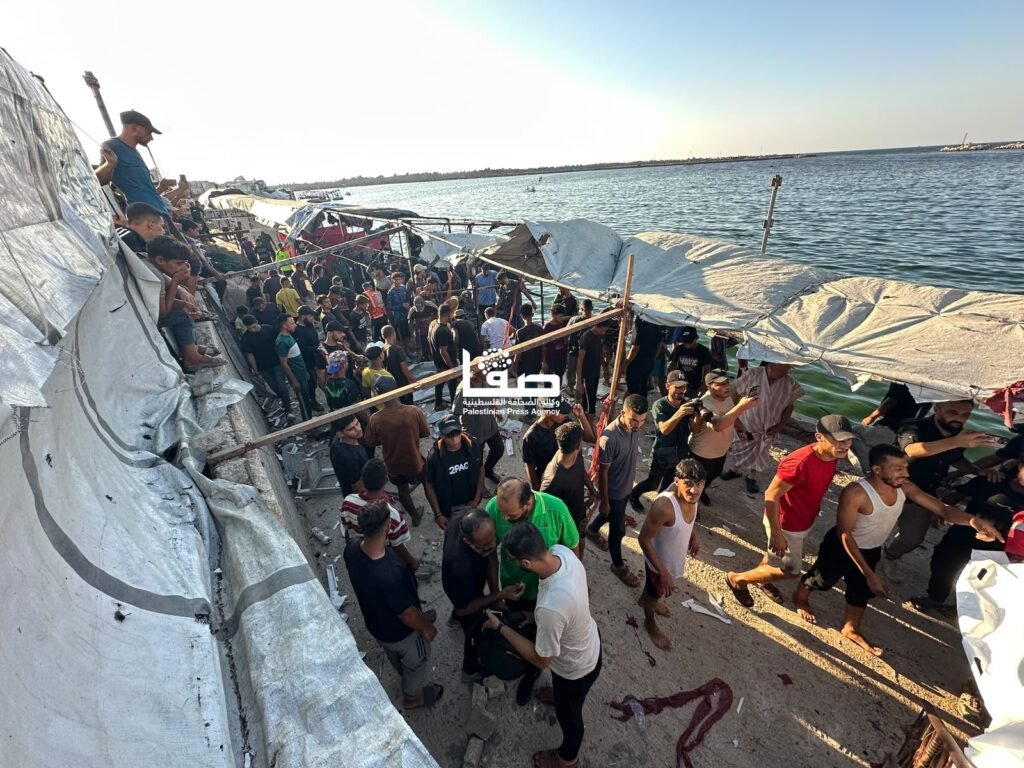
Gaza Herald _ For years, Gaza’s coastline has offered residents a rare escape from the suffocating reality of war, a place to breathe, sit by the water and give children a fleeting sense of normal life. But after an Israeli strike hit civilians at Gaza’s port, even that narrow space of respite was shattered. An image of an elderly woman wounded and covered in blood as she sat near the sea has since come to symbolize a reality in which Palestinians can no longer find safety even in the places they turn to for a moment of peace.
The elderly woman did not go to the sea in search of safety, but in search of a moment of calm, a few minutes to breathe in the fresh air away from the sound of bombardment and the weight of war. Yet the sea, which Gaza residents have long turned to as an escape, was no safer this time than anywhere else.
According to a statement from the Palestinian Ministry of Health, six Palestinians were killed and 14 others injured in an Israeli airstrike targeting civilians in the port area west of Gaza City.
In the photograph, the elderly woman sits wounded, blood covering her face. Her pained expression captures the story of a city where death pursues civilians even in the places they turn to in search of a little life. She went out to catch her breath and returned carrying the pain of war.
Her image was more than a scene of a woman wounded in an airstrike. It appeared as a human testimony to the reality in Gaza, where spaces of safety are shrinking by the day, until the sea,the last remaining refuge, has itself become marked by new memories of fear and blood.
The photograph quickly circulated across Palestinian social media platforms, with journalists and activists seeing it as a visual testimony to a reality in which even the sea, one of Gaza residents’ last remaining outlets for respite, has fallen outside the circle of safety.
An Image That Captures a Greater Pain
The photograph was not simply documentation of a woman’s injury. It appeared to encapsulate a broader tragedy experienced by Gaza’s residents: civilians searching for a moment of life, only to find themselves confronted with yet another moment of death.
The image spread alongside testimonies and posts by Palestinian activists who described the bombing as another extension of the suffering endured by civilians, who have increasingly turned to the sea and the port in search of a place where they can catch their breath away from the atmosphere of war.
Activist Malik Al-Shanbari said the areas still accessible to Gaza residents for reaching the sea have become increasingly limited. He said he took his family to the beach, marking the first time in three years that his two children, Zain and Ayloul, had gone swimming.
The children sat on the sand and built a small castle, in a moment when it seemed that life had found a way to slip through the rubble of war. Then the bombardment returned and shattered that moment.
Al-Shanbari quoted his daughter, Ayloul, as saying: “I don’t want to go to the sea after this, Dad, because even the bombing followed us here.”
Her words capture how the sea, once a refuge for children, has become another place associated with fear.
Activist Aboud Al-Battah said Gaza residents have been turning to the city’s port in search of brief moments of rest and a chance to catch their breath away from the war. Yet the bombardment follows them even to places they seek out to escape the scenes of destruction, as though Gaza has been deprived even of its moments of peace.
Activist Al-Hakim described the scene of the wounded elderly woman being carried away from the site of the strike as a reflection of the scale of the tragedy. He said an Israeli strike on a café inside Gaza’s port left behind bloody scenes involving civilians already exhausted by the war.
Activist Ahmad Abu Hammad said the woman had gone to Gaza’s seafront in search of a few minutes of calm and fresh air before an Israeli missile struck her, saying that her photograph embodies the magnitude of the pain endured by Gaza’s residents.
Palestinian writer Wissam Afifa commented on the scene, saying: “Even the sea is no longer a safe haven. Killing is pursuing Palestinians everywhere.”
Gaza Port: A Refuge Turned Into a Bombing Site
Activist Tamer Qudaih said Palestinian families had been trying to spend some time at a café in Gaza’s port and ease the burden of war when it was targeted by an Israeli strike. He said the airstrike killed six Palestinians and injured others.
Other activists described the scene as another image of the suffering endured by civilians, saying Gaza residents go to the port in search of simple moments of rest and a change of atmosphere, only to find that the bombardment follows them even to the places they seek out to escape the harshness of war.
The image of the wounded elderly woman, alongside children’s shoes soaked in blood, was among the most widely circulated scenes following the strike. For many viewers, it encapsulated the scale of the tragedy facing civilians across the Gaza Strip.
Amid Bombardment and Talk of a Ceasefire
As discussions continued over proposals and agreements to end the war, journalist Yousef Abu Kweik said the speed with which the Israeli strike hit Gaza’s port reflected, in his words, the continuation of military operations alongside ongoing political efforts.
As Gaza residents try to seize a few brief moments of life in places they once considered their refuges, the image of the elderly woman wounded by the sea appears to be more than a fleeting photograph. It is a scene that captures a reality in which even spaces meant for living have become threatened, and even the sea is no longer beyond the reach of war.
With U.S. backing, Israel has carried out what is described as genocide in Gaza since October 7, 2023, killing more than 73,000 Palestinians and injuring more than 174,000, most of them women and children, while widespread destruction has affected around 90 percent of the infrastructure.

