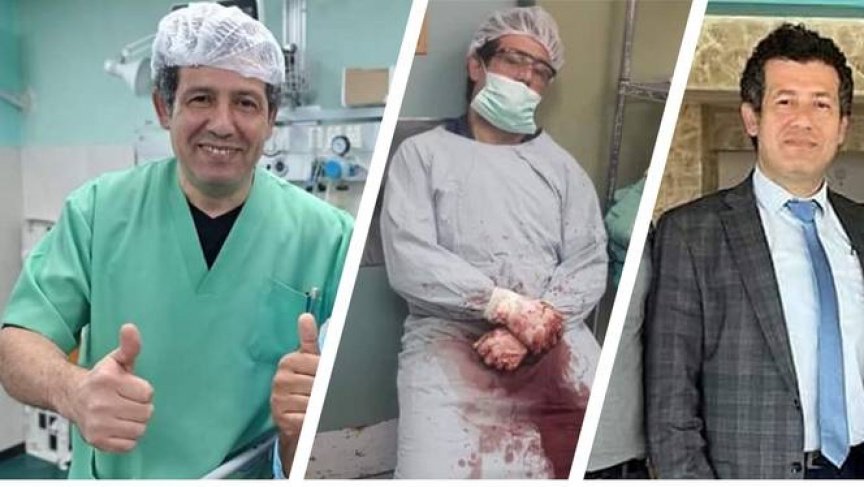
Gaza Herald _The wife of Palestinian orthopedic surgeon Adnan al-Barsh has revealed new details about his time in Israeli detention, saying Israeli authorities continued to make use of his medical expertise before he was killed in custody. Her account sheds light not only on the treatment he endured as a detainee, but also on the ambitions and hopes he continued to hold despite his imprisonment.
According to his wife, former Palestinian prisoners told her about aspects of al-Barsh’s life at Israel’s al-Jalama detention facility. They said an interrogator, reportedly more than 83 years old, was assigned to question the doctor. Al-Barsh would sometimes spend hours inside the interrogation room before being returned to his cell.
On one occasion, his fellow detainees noticed that he appeared unusually happy when he returned. When they asked him why, he reportedly told them that doctors from Tel Aviv University had come to the interrogation room to benefit from his medical knowledge.
“We exchanged medical consultations,” he told them, according to his wife’s account.
She said the incident was evidence that Israeli authorities continued to draw on al-Barsh’s expertise in orthopedic surgery even while he was being held in detention. She added that interrogators and prison guards also consulted him about medical issues of their own.
Al-Barsh was a prominent orthopedic surgeon who had dedicated much of his career to treating patients in Gaza. Despite the conditions of detention, his wife said he continued to speak with fellow prisoners about his hopes for the future, including rebuilding his family home and establishing a specialized hospital for orthopedic surgery.
Those dreams, however, were never fulfilled.
The Palestinian Prisoners’ Media Office has previously detailed the circumstances surrounding his death, saying that more than 20 prison guards beat al-Barsh before he died at Ofer Prison on April 19, 2024.
His death has since become part of the broader record of Palestinian detainees who have died in Israeli custody. His wife’s account also raises questions about the stark contradiction between the value placed on his medical expertise and the treatment he ultimately received while detained.
For his family, the loss was not only the death of a physician who had served his community, but also the destruction of a future he had continued to imagine despite years of war and hardship: rebuilding his home, returning to his profession and creating a hospital where others could receive the care he had spent his life providing.