
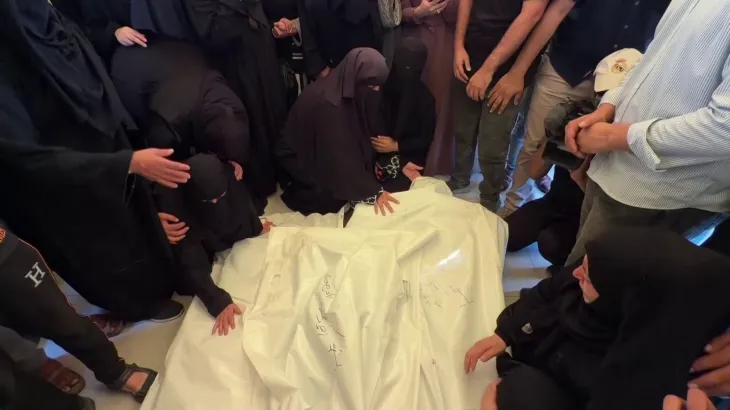
Gaza Herald – Umm Mohammad was not only mourning the loss of her eldest son; she was burying the last remaining pillar of a family shattered by genocide. With Mohammad’s killing, she lost her husband and seven of her children, after previously losing four sons and two daughters in Israeli strikes. His killing left behind two young daughters and an unborn child who will never know their father.
Standing beside her son’s body, the grieving mother remembered how Mohammad had taken responsibility for the family after his father’s loss. He became their sole provider, supporting his mother and siblings, and often promised that he would never leave her alone. But an Israeli strike ended his life, adding another name to the long list of family members lost under bombardment.
The tragedy of Umm Mohammad’s family is not an isolated story in Gaza. Similar scenes of mourning are repeated daily across the besieged territory, where funerals often follow one another as Israeli attacks continue.
In Gaza City, an Israeli strike on a residential apartment killed an entire family, including two children, one of them an unborn baby. Another strike in Khan Younis killed three Palestinians, including a child, while further attacks targeted a vehicle and a residential building in central Gaza, leaving more casualties and injuries.
The attacks come as political efforts and negotiations continue in an attempt to reach an agreement to end the genocide. However, the ongoing bombardment has raised questions over the prospects of a lasting ceasefire, as attacks continue on the ground.
Analysts say the intensification of attacks alongside diplomatic efforts reflects attempts to create new realities before any potential agreement is reached, while civilians continue to bear the heaviest burden and entire families are erased from existence.
In Gaza, many Palestinians are no longer waiting for the details of negotiations; they are waiting for a morning without the sound of aircraft, explosions, and ambulance sirens. Yet hopes for calm are repeatedly replaced by new funerals, grieving mothers, and children whose lives end before they even begin. In a city exhausted by war, funerals have become one of the most familiar scenes of daily life.

