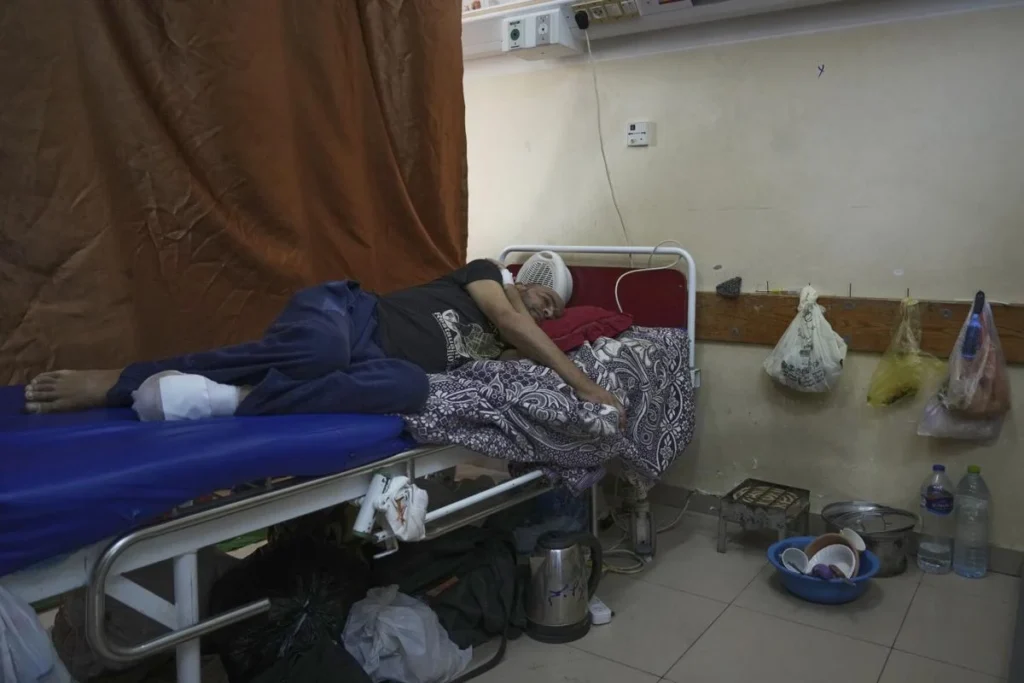
Gaza Herald – Inside a cramped dialysis ward at Al-Shifa Medical Complex in Gaza City, Maisar Al-Ghandour sits quietly in a dialysis chair. Her face is pale, her features drained, as if she has just emerged from a long and exhausting battle.
Dialysis Sessions Reduced
Her three-hour treatment session has ended, but the exhaustion remains.
Outside the room, her daughter watches her struggle to take her first steps after the session.
“Before, when she received three dialysis sessions a week, she was in much better condition,” she says. “Now, everything leaves her exhausted.”
Kidney failure patients in Gaza are no longer battling illness alone. They are also confronting severe shortages of medication, medical supplies, and one essential component that keeps dialysis machines running: sodium bicarbonate powder.
The substance, indispensable for operating dialysis equipment, has completely run out at Al-Shifa’s dialysis unit, forcing hospital administrators to make a painful decision to reduce the number of dialysis sessions.
Half a Life
For hundreds of patients, weekly treatment has been cut from three sessions to two, reducing dialysis time from 12 hours a week to just six, effectively cutting their lifeline in half.
Inside the department, rows of silent dialysis machines stand idle.
Of the hospital’s 51 dialysis machines, 25 are no longer functioning.
Meanwhile, around 240 patients share the same fear and uncertainty, asking the same question:
“What happens if all the machines stop?”
A handwritten sign attached to one of the walls captures the anxiety felt throughout the ward:
“I am a kidney failure patient. I don’t have the luxury of time or waiting. Kidney patients are in danger.”
Wael Skik, who has depended on dialysis for four years, says patients are not asking for the impossible.
“We only need the supplies that keep the machines running,” he says, warning that the shortage could cost lives because dialysis cannot simply be postponed.
Nearby, nephrologist Dr. Ghazi Al-Yazji explains that the crisis extends far beyond kidney disease itself.
Without regular dialysis, toxins accumulate in patients’ bodies, potassium levels rise dangerously, and excess fluid begins affecting the heart and lungs.
“Shorter dialysis sessions mean the body has less chance of surviving,” he says.
The department treats hundreds of patients, and every day without a solution further increases the risks they face.
More Than Statistics
Before the genocide, Gaza had approximately 1,100 kidney failure patients.
Today, only 650 to 728 remain alive.
Around 40% have died as dialysis services deteriorated and treatment centers were damaged or destroyed during the war.
The suffering does not end with reduced dialysis sessions.
Doctors also report severe shortages of Recormon (erythropoietin), a medication that stimulates red blood cell production. Without it, patients develop worsening anemia, dizziness, and increasing dependence on emergency care.
Patient Abdullah Abu Abli says he has been forced to drastically limit how much water he drinks in an attempt to avoid complications between dialysis sessions.
“We can’t eat or drink like other people,” he says with visible frustration.
On difficult days, he ends up in the emergency department suffering from shortness of breath and severe anemia, requiring blood transfusions instead of recovery.
Between hospital visits, he searches pharmacies for medications that have largely disappeared.
“Sometimes I’m just looking for a single pill,” he says.
Medical technician Mahmoud Flifel monitors the dialysis machines one by one, trying to keep a fragile system alive.
He knows that even a brief power outage or interruption in the water supply could bring treatment to a complete halt.
“Everything in this dialysis unit depends on continuity,” he says. “And every day, we fear that continuity will be broken.”