
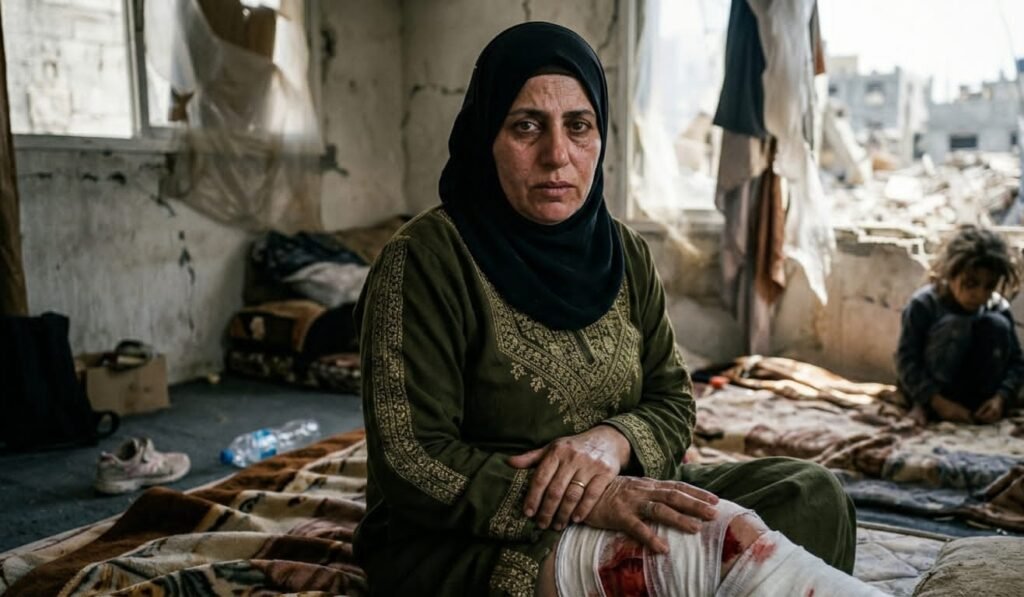
Gaza Herald – T.A., a 34-year-old Palestinian woman from Khan Younis, never imagined that the final days of her pregnancy would become one of the most terrifying experiences of her life.
Sheltering with her three children and dozens of relatives inside their family home in Al-Manara neighborhood east of Khan Younis, she listened as the sounds of tanks and artillery fire drew closer with every passing minute.
A Night Under Siege
On October 24, 2024, the entire area was suddenly placed under military siege.
As the family huddled inside a bathroom to escape heavy shelling, Israeli occupation forces stormed the home and deployed a military dog equipped with a camera to search the building.
The dog first attacked T.A.’s pregnant sister before turning toward her.
“I was nine months pregnant when it lunged at me,” she recalls. “It sank its teeth into my thigh and began tearing at my flesh. My husband and family members tried desperately to pull it away, but it would not let go.”
As her terrified children screamed, the dog dragged her nearly 15 meters across the home while blood covered the floor. It remained clamped onto her leg for approximately ten minutes before several soldiers arrived and, after multiple attempts, managed to force its jaws open.
Doctors later informed her that the attack left a deep wound measuring approximately eight centimeters in depth and twelve centimeters in length.
“I felt like my leg was going to be torn off,” she says. “My greatest fear was losing my baby because of the severe bleeding.”
Displacement and Return
T.A., a mother of three, had been living with her husband’s family in a two-story home in Al-Manara before the home suffered extensive damage during the genocide.
Months earlier, on November 13, 2023, her husband had been detained along with other Palestinian workers in Qalqilya and transferred to Anatot Prison. He had been working inside Israel under a daily work permit before being released five days later and returning to Gaza through the Kerem Shalom crossing.
As attacks expanded into Rafah in May 2024, the family was displaced once again to Al-Mawasi area of Khan Younis. Later, after Israeli occupation forces withdrew from Al-Manara, they decided to return to their damaged home, believing it would be safer than life inside overcrowded displacement tents.
Seven Hours of Terror
When military operations resumed in Al-Manara, the neighborhood quickly became a battlefield.
A neighboring home belonging to Al-Farra family was struck, killing 13 Palestinians, most of them children. The second floor of T.A.’s home was also directly targeted.
Around twenty family members were gathered on the ground floor when the siege began.
Following her injury, Israeli occupation forces took control of the home and positioned themselves on the roof while gunfire and artillery shelling continued for hours.
T.A. says an Israeli officer questioned her about her injuries but denied responsibility for the dog attack. She says the officer then forced her to uncover her abdomen to verify that she was pregnant.
The men were separated from the women and children, while frightened children continued crying throughout the ordeal.
According to T.A., the officer also threatened her directly, warning her not to speak publicly about what had happened or accuse soldiers of unleashing the dog. She says he threatened harm to her and her family if she did so.
Between Severe Bleeding and Pregnancy Complications
At approximately 2:30 a.m., Israeli occupation forces withdrew from the home after kidnapping her husband and another young man from the Al-Farra family.
The following morning, she was transported to Nasser Hospital after troops left the area.
Along the way, she witnessed dozens of victims, including women, children, and elderly people, lying in the streets as residents searched through rubble for loved ones.
Doctors diagnosed her with a serious thigh injury, dangerously high blood pressure, and severe pregnancy complications resulting from blood loss.
Because of Gaza’s strained healthcare system and shortages of medical supplies, treatment of her complex wound was delayed. On October 28, 2024, she was transferred to Mubarak Hospital.
There, doctors decided to perform an emergency cesarean section to save her life.
After hours of waiting under difficult conditions, the operation was carried out. Her baby did not survive.
“I lost my baby because of the pregnancy complications and severe bleeding I suffered,” she says.
Only hours later, she underwent a second surgery in an effort to save her injured leg amid severe shortages of medical equipment and supplies.
Lasting Physical and Psychological Trauma
After spending a week in intensive care at Nasser Hospital, her condition gradually stabilized.
Yet the effects of that night continue to haunt her.
She remains unable to walk normally and requires wound dressings to be changed twice daily. Shortages of medicine and disinfectants continue to hinder her recovery.
Psychologically, she says she suffers from recurring panic attacks, fear, and episodes of emotional distress linked to both the attack and the threats she says she received afterward.
Her young daughter, Sham, continues to struggle with severe fear and trauma-related bedwetting as a result of what she witnessed that night.
For T.A. and her family, the ordeal did not end when the gunfire stopped. The physical wounds remain, but so do the memories of seven hours that changed their lives forever.

