
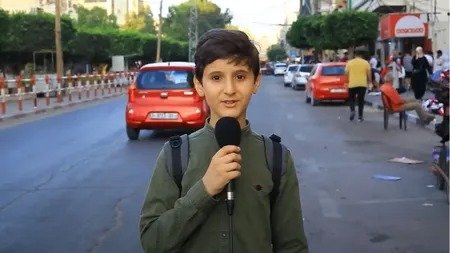
Gaza Herald – In August 2022, 12-year-old Palestinian child Awni Al-Dous stood in front of a camera, smiling, holding a simple microphone, and introducing himself with confidence: “I am Palestinian from Gaza, I am 12 years old, and my goal is for my channel to reach 100,000, or 500,000, or one million subscribers.”
He ended the video with a short greeting to his followers, who did not exceed a thousand at the time, and quietly walked away from the camera, without realizing that this farewell would later be viewed by millions, and a testament to a dream that would never be completed.
The Night of the Crime
On the evening of October 7, 2023, just hours after the outbreak of the Israeli genocide on the Gaza Strip, an Israeli airstrike targeted Al-Dous family home in Al-Zeitoun neighborhood, southeast of Gaza.
The three-story building, housing several families from their relatives, was destroyed after two bombs struck its roof without prior warning, according to his uncle Mohammad, who survived with his wife by a miracle.
That night, the family lost 15 members, including Awni, his parents, and his four siblings, Ibtisam (17), Ahmad (10), Rawan (15), and Zaid (3). The life of a child who only dreamed of becoming a successful content creator came to an end.
“Engineer Awni”
His aunt Alaa describes him as “a calm, confident child who loved life.” Family members nicknamed him “Engineer Awni” because of his deep passion for computers.
He used to imitate his father, a computer engineer, by taking apart laptops and trying to reassemble them. At school, he was far from an ordinary student, he participated in the “Young Teachers” program, confidently explaining technology lessons to classmates, winning several awards. His teachers described him as “always smiling.”
His YouTube Channel
Awni launched his YouTube channel in June 2020, posting videos of games like Pro Evolution Soccer and Counter-Strike, along with simple content he planned to develop into vlogs and interviews.
He followed content creators passionately and dreamed of becoming like them. He actively sought to learn and didn’t hesitate to ask his relative Ashraf, a programmer managing YouTube channels, for advice, even secretly using his father’s phone to send questions.
“Awni was very ambitious,” Ashraf said. “He wanted to compete with me one day.”
Fame and Messages Never Read
After his killing, Awni’s videos spread widely, and his channel’s subscribers surged to around 1.5 million, continuing to grow.
One comment summed up the heartbreak: “Please forgive us… I wish we had known you before you left.”
Later, old messages from Awni surfaced, including one sent to famous Kuwaiti content creator Abu Falah, in which he wrote: “Nothing compares to Gaza’s winter. We drink sahlab and eat chestnuts. I wish you could visit Palestine.”
In an emotional video watched by millions, Abu Falah appeared in tears after reading Awni’s messages, saying: “It is a shame that this child killed … We are all Awni.”
Simple Moments
Away from screens, Awni was a child living simple family moments like any other, spending evenings with his siblings, watching movies, and sharing snacks with laughter.
The last time his aunt saw him was during a family breakfast three weeks before his killing. She says: “I looked at him and said, Awni has become a man.”
A Dream Fulfilled After Killing
Awni’s story has become a symbol of Gaza’s children whose dreams are taken before they are realized. In a school broadcast speech, he once asked innocently, “Why do the enemies only see Al-Aqsa Mosque? Why do they only see my land?”
Despite the loss, his family holds on to what remains of him. His aunt Alaa says: “It is a gift from God that all these people love Awni. He dreamed of this, and now he is happier in paradise.”
Thus, Awni Al-Dous’s dream came true, but only after his killing. His voice reached millions, reminding the world of the tragedy of Gaza’s children, and that behind every number in war is a child who wanted to be heard and achieve a dream, not to be buried in a white shroud.
It is worth noting that Israeli occupation forces have killed more than 21,000 children by the end of 2025, around 30% of the total victims, during the genocide in Gaza, according to data from the Palestinian Central Bureau of Statistics.

