
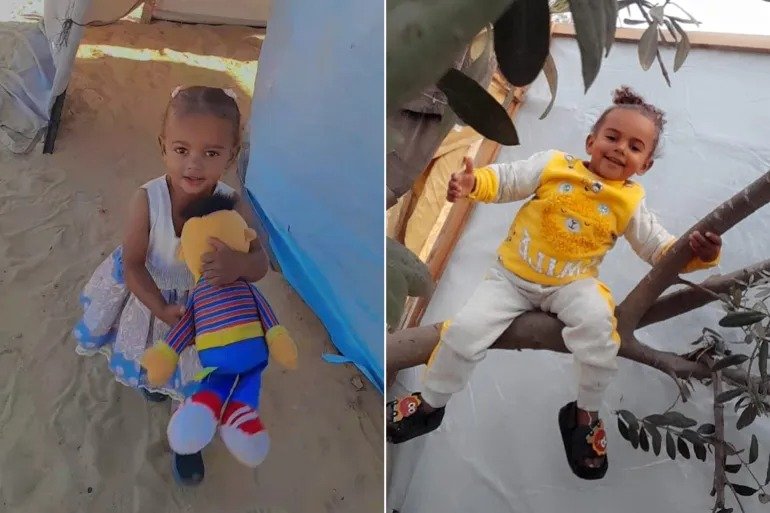
Gaza Herald – Nurse Amal Abu Khatleh (35) never expected that her routine work in the neonatal intensive care unit at the Emirates Crescent Hospital in Rafah would turn into a long human story, reflecting one of the most painful tragedies of war: survival without identity.
The turning point came during the attack on Al-Shifa Medical Complex in Gaza City in November 2023, after a siege that lasted around ten days and included kidnappings, storms, and forced displacement. The hospital’s vital departments, especially neonatal care, collapsed under the pressure.
In the midst of this breakdown, one of the most mysterious stories of the war began to emerge.
A Baby Without a Name
 After Al-Shifa Hospital was forced out of service, around 30 newborns were transferred to hospitals in southern Gaza. Among them was an infant girl, barely one month old, admitted to the Emirates Crescent Hospital in critical condition.
She suffered from severe malnutrition, extreme underweight, and blood infection due to a lack of medical care during the siege.
Her medical file contained only one line: “Unidentified child, survivor of Al-Sabra neighborhood strike.”
According to medical staff, an unknown paramedic brought her to the hospital, saying that he found her after a heavy bombardment on Al-Sabra in Gaza City. She was reportedly discovered on a tree after the blast force threw her away from the destroyed area, with no further details recorded.
The paramedic was never identified, and no additional documentation exists about the incident. Over time, no witnesses confirmed the account, and it is believed the rescuer may have been killed, cutting off the only lead.
Complete Uncertainty
From the very beginning, the infant attracted the attention of nurse Amal Abu Khatleh, not only because of her medical condition, but because of the complete absence of identity: no name, no family, no traceable records.
She explains: “When the children arrived at the incubator unit, I noticed a baby with a note saying she was an unidentified survivor from Al-Sabra.”
She adds: “I felt deeply attached to her, so I began caring for her closely. Her condition gradually stabilized after two weeks of treatment.”
However, medical stabilization did not end her suffering. Her unknown identity prevented her from being transferred for treatment in Egypt, as no legal guardian could be assigned, leaving her in hospital care.
During that period, the nurse personally cared for her, stayed by her side, and grew emotionally attached to her as the child developed strong bonds with her caregiver.
She says: “I decided to name her ‘Malak Al-Sabra’, after the area she came from, just to give her a temporary identity.”
Search Without Answers
Over time, it became increasingly unlikely that the child’s family could be found.
Civil registry estimates in Gaza indicate that around 2,700 families were completely wiped out during the war, while thousands of others were reduced to a single surviving member, mostly children.
Despite continuous efforts, no trace of her relatives was found.
“I contacted all possible institutions, hoping to find someone from her family, but all indications suggest they were killed in the strike,” the nurse says.
From Hospital to Home
In early 2024, under an official guardianship arrangement, the child moved from the hospital to the nurse’s home in Tel al-Sultan, Rafah, after her health improved and amid escalating threats of a military incursion.
“She became like my own daughter,” Amal says, describing how she cared for her, monitored her growth, and followed her development with specialists.
The child gradually began to live a more normal life, receiving regular nutrition, medical follow-up, and care to compensate for her early deprivation.
However, like many children in Gaza, she continued to face shortages in food, medicine, and essential developmental needs.
Displacement and Instability
Stability did not last. As Israeli military operations intensified in Rafah, Amal and her family were forced to flee to Deir al-Balah, where the child stayed with Amal’s sister during working hours.
There, she began her early social interactions, forming bonds with other children despite harsh conditions.
An Identity Still Missing
After the ceasefire in early 2025, the family returned to Rafah and rented a home after their original house had been destroyed.
In this environment, “Malak” slowly began to settle into family life, playing with children, learning to speak and walk, while her original identity remained unknown.
Amal describes her as a fast-developing child with strong social interaction.
“She calls me ‘mom’, and she has become part of the family,” she says, while continuing her search for any trace of the child’s biological relatives, although all signs suggest her entire family may have been killed in the strike on their neighborhood.
Over time, Malak’s story became part of a broader reality in Gaza, where identity itself is often lost.
Alongside her, five other children in the same hospital were also without known families or documentation.
They survived physically, but lost their names, families, and the identities they were meant to begin life with.

