
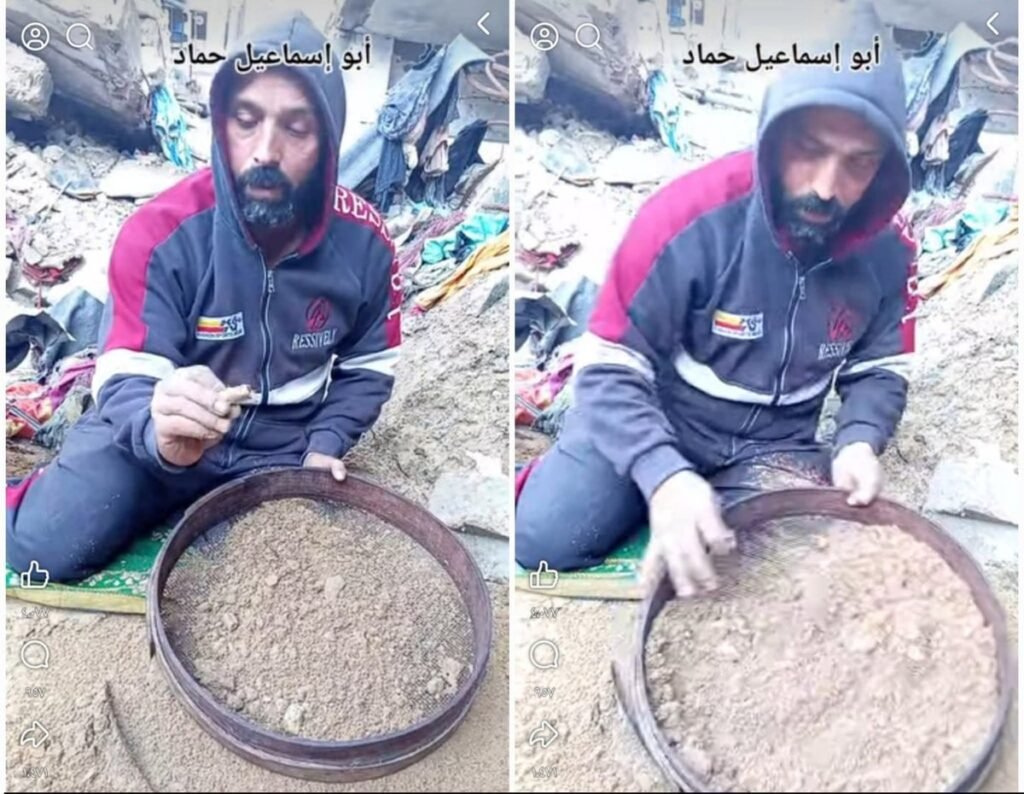
Gaza Herald_ Amid the shattered remains of what was once a six-story family home, Palestinian father Mahmoud Hammad sits on the rubble holding a crude sieve, slowly sifting dust and broken stone in a desperate search for the remains of his wife and children, killed during Israel’s genocidal war on the Gaza Strip.
Nothing recognizable remains of the building, erased entirely by Israeli airstrikes. What survived are fragments of concrete, scorched belongings, and a man left clinging to memory alone. In this haunting scene, ordinary household tools have become instruments of mourning, capturing the devastation of not just one family, but an entire besieged city crushed by war and blockade.
Hammad documented his search in a video shared on Facebook, showing himself methodically filtering debris by hand, stone by stone, in the hope of recovering even the smallest traces of his loved ones. Alongside the footage, he wrote: “I finally reached my wife’s remains. With these primitive tools, I am gathering what is left of her and her unborn child. God willing, I will find what remains of my sons and daughters.”
The video spread rapidly across social media, triggering widespread shock and grief. Activists described it as one of the most harrowing visual testimonies to emerge from Gaza, an unfiltered record of human loss unfolding amid relentless bombardment, extreme shortages, and the absence of rescue equipment.
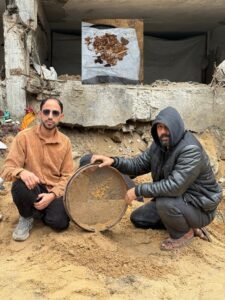 Hammad’s sister later shared a deeply personal account of his condition following the tragedy. “I can’t bear to look at my brother,” she wrote. “Not out of hatred, out of heartbreak. My twin, Mahmoud, is still among us in body only. His soul left with his wife and children. He looks like someone who has lived a hundred years, not two.”
She explained that Hammad once tried to stop searching, but could not bring himself to walk away. He returned to the ruins, sat among the debris, and continued sifting the soil by hand until he recovered the remains of his family. “The result was clear,” she wrote. “His face changed. His back bent. His spirit shattered.”
Online, Palestinians described the image as unbearable. “He is not sifting flour or wheat,” one post read. “He is searching through rubble for the bones of his children.” Others noted that thousands of families across Gaza have been forced to retrieve the bodies of their loved ones using bare hands and improvised tools, as Israel continues to block the entry of heavy machinery needed for recovery and reconstruction.
Commentators questioned whether history has ever recorded suffering of this magnitude. Mahmoud Hammad’s story, they stressed, is not unique; it is one among thousands. Countless Palestinian bodies remain buried beneath collapsed buildings, denied dignity in death as Israeli authorities prevent equipment from entering the Strip.
Before-and-after images of Hammad circulated widely, prompting anguished reactions. “Can you believe this is the same man?” one user asked. “These aren’t years that passed; these are funerals.” Another wrote: “War doesn’t kill everyone. Some people it leaves alive like this.”
Activists and human rights observers say what is happening in Gaza constitutes documented crimes, not isolated tragedies. Thousands of Palestinian remains continue to decompose under the rubble, while Israel, with full US backing, blocks rescue tools and reconstruction materials, turning survival itself into an act of resistance.
Israel launched its genocidal war on Gaza on 7 October 2023, with direct American support. Over two years of sustained assault, more than 71,000 Palestinians have been killed and around 171,000 wounded, the majority of them women and children. For those still alive, like Mahmoud Hammad, the war has not ended; it has simply changed shape, leaving them to mourn, search, and survive among the ruins.

