
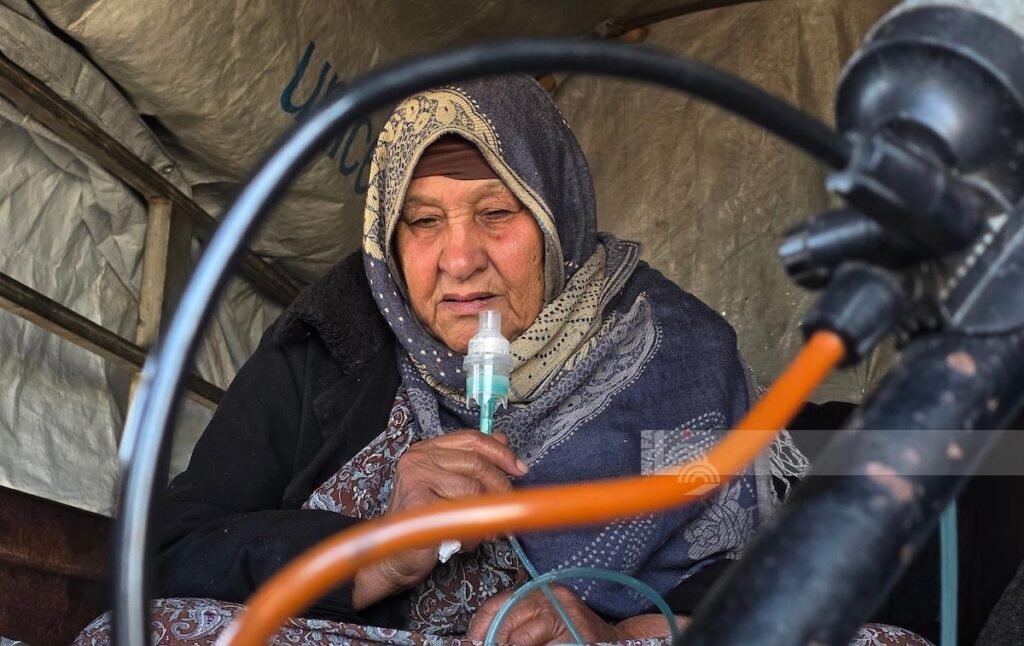
Gaza Herald_Amid relentless bombardment, siege, and the near-total breakdown of Gaza’s healthcare system, pharmacist Khaled Awda has turned his own home in Gaza City into a small-scale pharmaceutical laboratory, offering a rare example of self-reliance and humanitarian ingenuity under catastrophe. His initiative stands as a striking testament to how professional knowledge is being mobilized to confront life-threatening shortages of medicine across the besieged Strip.
Awda, a licensed pharmacist and certified trainer with the Palestinian Pharmacists’ Syndicate in pharmaceutical compounding, decided to act when essential medicines vanished from pharmacies and medical centers. Using what remained of his expertise and equipment, he began producing basic but critical medications that had become impossible to obtain due to the Israeli blockade and the collapse of supply chains. Some of these locally manufactured medicines were later approved by Gaza’s Ministry of Health and distributed in minimal quantities to pharmacies and medical points struggling to stay operational.
Rebuilding Pharmaceutical Production from the Ruins
In remarks to Quds Press on Tuesday, Awda explained that, before the war, active pharmaceutical ingredients were available in Gaza; however, importing finished medicines was cheaper and far easier than local manufacturing. The war, however, upended that reality.
Following the ceasefire and the partial return of residents to Gaza City, Awda discovered that some of his former laboratory tools had survived the destruction. He immediately began working with fellow pharmacists, doctors, and his own students to extract active substances locally and produce urgently needed treatments. These included disinfectants, dermatological ointments, pain relievers, and medications for chronic conditions such as high blood pressure and diabetes, manufactured under extreme constraints and constant risk.
Innovation Under Severe Scarcity
The greatest challenge, Awda said, has been the almost complete absence of raw materials. To overcome this, he and his colleagues resorted to unconventional solutions, recycling available inputs and substituting industrial materials with natural alternatives. Olive oil, for example, was used in place of standard pharmaceutical oils for ointments, while certain medicinal plants were processed to extract active compounds.
In other cases, Awda carefully re-evaluated medicines nearing their expiration dates, scientifically re-testing them and converting them into topical antibiotics and medical creams. These improvised treatments, he noted, proved effective when used in real medical settings, particularly for wounds, burns, and skin infections spreading rapidly among displaced populations.
He emphasized that local pharmaceutical production had not been a priority in previous years because medicines were generally available. Today, however, it has become a necessity as Gaza’s health system verges on total collapse.
A Small Effort Against an Enormous Need
Awda acknowledged that what he and his team can produce meets only a fraction of Gaza’s massive medical needs. Still, he stressed that the initiative is driven by a simple principle: saving as many lives as possible, even if the means are limited. In a context of widespread devastation, he said, even modest efforts can make a decisive difference.
Medical points and field clinics across Gaza have increasingly turned to Awda for support, hoping his work can help narrow the growing gap between urgent medical needs and what the shattered health system can provide.
A Health Crisis Spiraling Out of Control
This grassroots initiative unfolds against the backdrop of an unprecedented health emergency. Nearly 90 percent of Gaza’s population has been forcibly displaced, with hundreds of thousands now crammed into makeshift tents that lack the most basic conditions for healthy living. As a result, skin diseases are spreading rapidly, wounds are becoming infected, burns are worsening, and access to clean water and sterilization materials is critically limited.
In a recent warning, Gaza’s Ministry of Health said shortages of laboratory supplies have reached catastrophic levels. Around 75 percent of chemical testing materials are unavailable, while 90 percent of blood testing and transfusion supplies have been completely depleted. Vital diagnostic tests for cancer patients, those with endocrine disorders, kidney transplant recipients, and people suffering from electrolyte imbalances or blood diseases have been suspended. Additionally, nearly three-quarters of bacterial culture testing materials are no longer available.
For months, no laboratory or blood bank supplies have been allowed into Gaza, further obstructing diagnosis, treatment, and life-saving surgeries.
Endurance Under Ongoing Destruction
Since October 7, 2023, Gaza has been subjected to widespread destruction marked by mass killing, starvation, displacement, detention, and the systematic demolition of infrastructure. Entire cities and residential neighborhoods have been reduced to rubble, leaving behind staggering numbers of dead, wounded, and displaced.
Within this bleak reality, Khaled Awda’s improvised laboratory stands as a rare point of resistance against collapse, a reminder that, even under siege, Gaza’s people continue to fight for life with whatever means they have left.

