Gaza Herald _ In the unfolding tragedy of Israel’s genocidal war on the Gaza Strip, the past months have revealed one of the most complex and haunting humanitarian catastrophes: the destruction of cemeteries and burial grounds. The machinery of devastation has extended even to the resting places of the dead, leaving widespread ruin across gravesides and human remains.
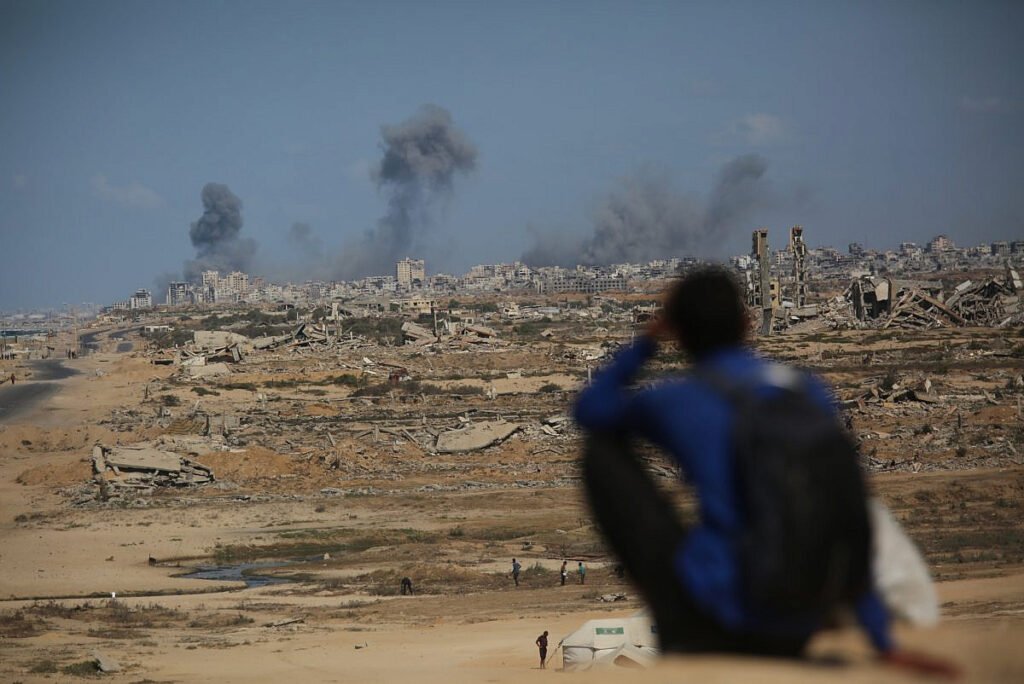
According to sources in the Ministry of Endowments and human rights organizations, thousands of graves have been bulldozed or directly destroyed by Israeli tanks and bulldozers, or obliterated by airstrikes. Satellite imagery shows extensive damage affecting no fewer than 16 central cemeteries across Gaza, including historical and internationally significant burial grounds, as well as cemeteries inside refugee camps and densely populated neighborhoods.
The destruction goes far beyond leveling graves and tearing down headstones. Several cemeteries have been turned into military positions for Israeli units or into logistical corridors used during ground incursions, defacing large areas of burial land and carving new pathways through what were once sacred resting places.
Under the pretext of searching for alleged tunnels or the remains of “hostages,” as claimed in the Israeli narrative, field reports confirm that Israeli forces have dug up graves and removed human remains in multiple locations, violations documented in on-the-ground video evidence and international human rights reports.
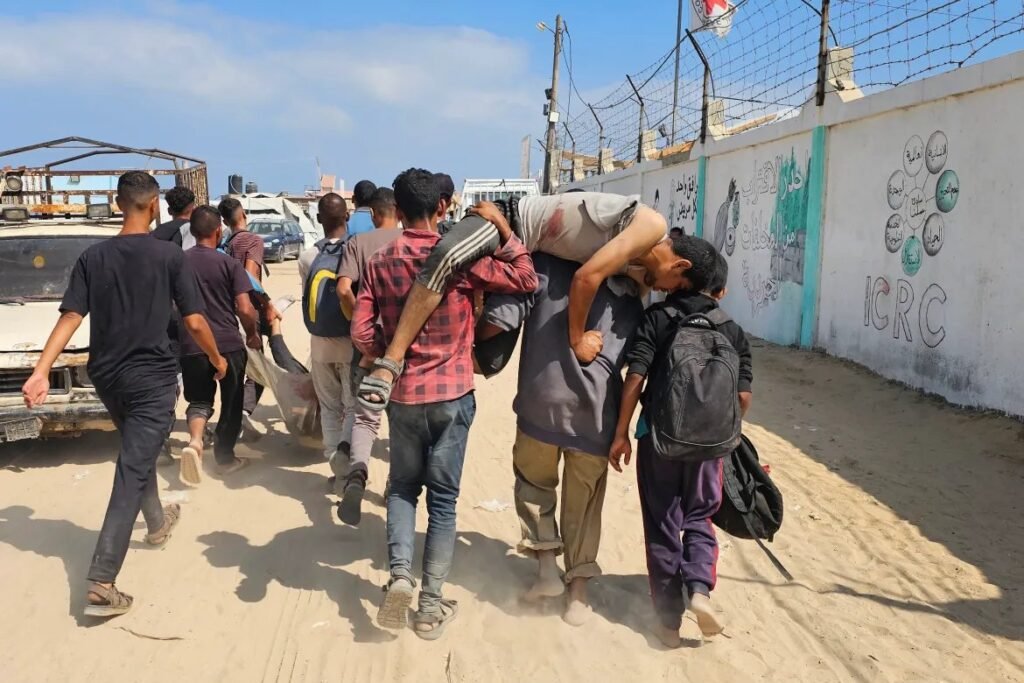
This reality has caused a massive collapse in Gaza’s burial infrastructure. Families have been forced to bury their loved ones in schoolyards and public parks after being denied access to cemeteries or finding them destroyed. Meanwhile, thousands of bodies remain trapped beneath the rubble, unreachable due to ongoing military operations.
Searching for Remains
Sabreen Balousha tells her story in a voice barely audible, as if her words themselves are ashamed to leave a throat exhausted by tears. She lost her only daughter, Lin, just four years old, after days of relentless bombardment on their neighborhood in eastern Gaza City.
She carried her child with trembling hands to the Batsh Cemetery, the small burial ground that had embraced generations of Gaza’s families.
Sabreen recounts to the Palestinian Information Center that on the day she buried her daughter, she stood by the grave for hours, speaking to her as though she were still breathing, promising to return every day to recite Al-Fatiha and leave a small flower on the soil.
But the ground invasion changed everything. Within weeks, the neighborhood filled with tanks, and bulldozers began carving their way toward the cemetery.
Sabreen describes the moment she returned to search for her daughter’s grave as if she had “stood on the edge of the world.”
There was no cemetery.
No headstones.
No trace of the place.
The entire ground had been leveled, as if a heavy hand had passed over it and erased everything.
She wandered frantically among the mounds of earth, digging with her bare hands, calling her daughter’s name, crying until her voice gave out.
She kept repeating:
“Even her grave… even her right to rest in peace… they stole it.”
Women from the neighborhood tried to console her, but her eyes remained fixed on the emptiness, searching for something that no longer existed.
She does not know where her daughter’s remains were thrown, whether the bulldozers shredded them, or whether soldiers took them.
What breaks her heart the most, she says, is not losing her daughter, death had taken her earlier, but losing her daughter’s final place, losing the ability to visit her, to touch the soil above her, to know that she still had an address in this world.
Sabreen now lives in a tent near a school-turned-shelter, sleeping each night with her hand pressed to her chest where her daughter’s small fingers used to interlock with hers.
When asked what remains for her, she says:
“They left me nothing (…) even the grave where I cried for her, they stole it.”
Across Gaza, the destruction of cemeteries is no longer an accident or a side effect; it has become part of an all-encompassing scene of annihilation, one that targets the land, the living, and even the memory of the dead.
Today in Gaza, the dead, too, have become direct victims of war, while the living are left to suffer twice, mourning their loved ones and witnessing the desecration of their graves, with no meaningful international action to stop the violations or hold those responsible to account.
A Crime Against the Living and the Dead
Ameer Abu al-Omareen, Director General of Gaza’s Ministry of Endowments, confirms that Israel still controls one-third of all cemeteries in the Gaza Strip, describing what is happening as a “compound crime that targets both the living and the dead.”
Speaking to the Palestinian Information Center, he explains that Israel is “deliberately striking at the core of human dignity and does not stop at violating the sanctity of the dead.”
Three major cemeteries, he says, are now under full Israeli military control. Burial has been prohibited in the largest graveyard in the Strip, the Martyrs’ Cemetery, which spans more than 300 dunams, since the earliest days of the war.
Cemeteries east of Salah al-Din Street have been completely sealed off, and Israel now controls most of the main burial sites in Gaza, deepening an unprecedented burial crisis.
Abu al-Omareen notes that Sheikh Radwan Cemetery, closed for three decades, was directly bombed, its graves damaged, and its remains exhumed. He stresses that an urgent international intervention is now essential so that Gaza’s dead may be buried with dignity.
He adds that Israel has stolen bodies from cemeteries and prevented the burial of others, leaving corpses in the streets until animals consumed them. Tens of thousands of martyrs remain under destroyed homes, and Palestinian families across Gaza are losing the ability to bury their loved ones.
He emphasizes that Israel has committed “fascist acts” targeting human dignity both in life and in death, and that the ministry possesses detailed records of dozens of cemeteries where burial is now entirely forbidden.
Human rights organizations describe the situation as a blatant violation of international humanitarian law, which protects cemeteries and religious sites from harm unless they constitute direct military targets. They warn that these actions may amount to war crimes, particularly amid repeated bulldozing, leveling of graves, and documented cases of forced exhumation.
As these violations continue, Gaza’s humanitarian crisis grows even more severe. Burial spaces are shrinking; gravestones have vanished; and thousands of families can no longer locate the resting places of their relatives, all amid the chaos of ongoing military operations, despite a ceasefire that has been nominally in effect for nearly two months.