
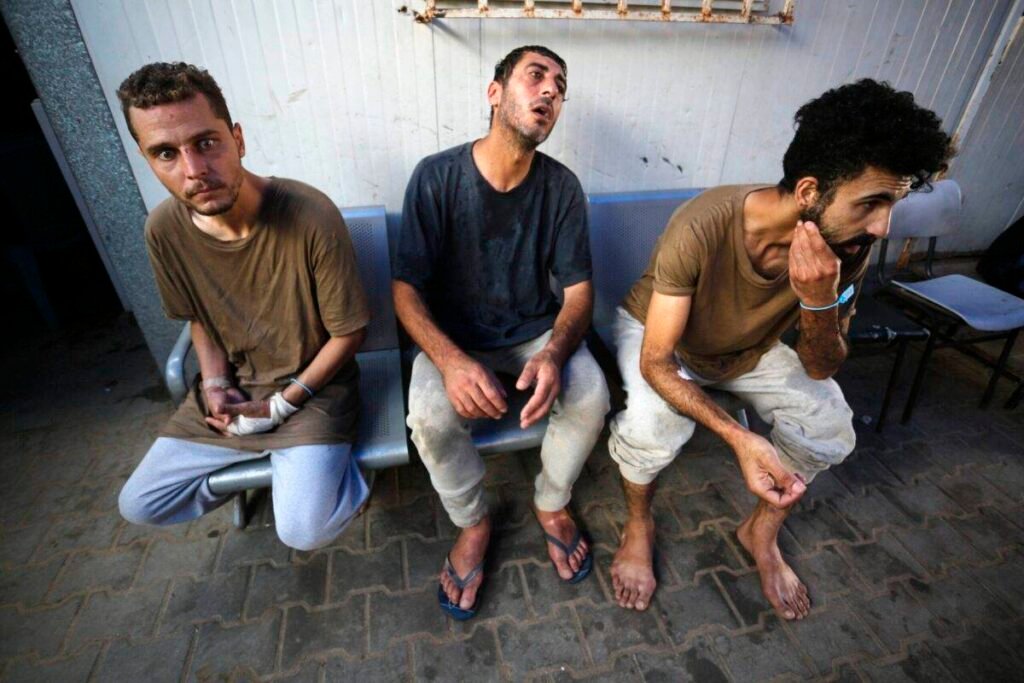
Gaza Herald_Freed Palestinian child detainees are recounting harrowing experiences of torture and abuse inside Israeli custody, according to a new report documenting the testimonies of three teenagers released in a recent prisoner exchange.
The boys, seized by Israeli forces while trying to access humanitarian aid, described beatings, starvation, psychological terror and conditions so brutal that they continue to suffer severe trauma after their release.
The interviews, conducted by Defense for Children International–Palestine (DCIP), reveal that Mohammad Nael Khamis al-Zoghbi, seventeen, Faris Ibrahim Faris Abu Jabal, sixteen, and Mahmoud Hani Mohammad al-Majayda, seventeen, were abducted near aid distribution zones and transferred to the notorious Sde Teiman detention compound in southern Israel. All three said they were tortured, deprived of food and sleep, and subjected to abusive interrogations that left them unable to rest at night and terrified by recurring nightmares. One of the boys described the experience as something that “stole his childhood.”
Jabal, who was seized with his father near the Morag Corridor on September 11 while trying to collect aid, recalled being beaten so violently during questioning that his forehead split open and required stitches. He said he endured hours without food or water and was so frightened he could not ask to use the bathroom and frequently lost control of his bladder. He explained to DCIP that the only thing he felt during interrogation was pain.
The boys also described being taken to what guards called the “disco room,” a concrete chamber where they were forced to lie on the floor as deafening Hebrew music blasted from speakers for more than twelve hours. Jabal recounted that one soldier appeared to treat the torture like a game. When the soldier lost a level on his phone, he would stand up and strike Jabal out of irritation. Jabal said he was kept in that room all day, repeatedly beaten, kicked, slammed against the wall and dragged by his hair.
During another interrogation, an Israeli officer showed Jabal a digitally manipulated photo of his mother, edited to imply she had been assaulted and killed. When the boy reacted in distress, guards suspended him by handcuffs a meter above the ground and beat him again. Since being released, he struggles to stand, continues to experience bladder issues and wakes up in terror from nightmares. His mother told DCIP that she often wakes to his screams as he pleads not to be hit.
Majayda, also seventeen, was taken by Israeli forces on August 7 while seeking humanitarian aid at a distribution site run by an Israeli and US-backed organization in Rafah. He said he was blindfolded, beaten and electrocuted during interrogation, then marked with an “X” on his back,a signal that he would be transferred to prison. Like the others, he spent more than twelve hours in the “disco room,” and was later stripped, blasted with freezing air and left alone in an empty room for two days. He was then placed in solitary confinement for another two days, his hands and feet bound so tightly that he could not sleep or move without sharp pain. He said he was so terrified that he repeatedly lost control of his bladder.
The cell, he said, was infested with insects, and he suffered from multiple untreated skin infections, including scabies. When he begged for medical care, his requests were ignored. He also said that an Israeli intelligence officer tried to recruit him to act as a human shield for the military, offering a monthly salary of thirty thousand shekels. When he refused, he was thrown back into the “disco room” and beaten again.
Back in his cell, soldiers regularly unleashed dogs on him and hurled stun grenades at night. The torture drove him to attempt suicide twice. Since returning home, he has been unable to sleep because the moment he closes his eyes, he relives the same scenes, faces and cell. He told DCIP that prison had taken away his childhood and left him needing to relearn how to sleep, how to feel safe and how to laugh.
Zoghbi, seventeen, was seized on July 11 while trying to receive aid at a distribution center in Rafah. During his interrogation, soldiers tightened his handcuffs so severely that he heard the bones in his arm crack. He said prison guards carried out nightly raids on his cell at around 2 a.m., releasing dogs and hurling stun grenades as detainees slept. If he failed to wake quickly enough, he was beaten. Since coming home, he still wakes at exactly 2 a.m., bracing for another raid. He said he feels drained, unable to describe the emotional weight of what he endured, and often breaks down crying when the memories return.
DCIP stated that the boys’ treatment was intentionally designed to break their identities and force false confessions. The organization emphasized that Israel’s detention system for Palestinians has nothing to do with justice or security, describing it instead as a mechanism meant to scar an entire generation in order to suppress resistance to apartheid and deny Palestinians their basic rights. The group added that Israel’s systematic torture and imprisonment of Palestinian children violates the Geneva Conventions and the Rome Statute, and as a state party to the Convention against Torture, Israel is legally obligated to prevent, investigate and prosecute acts of torture.

