
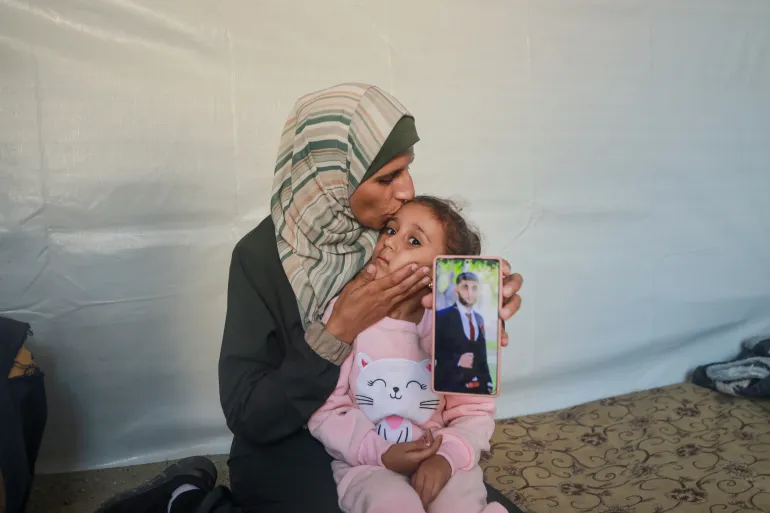
Gaza Herald — In Gaza, where families are still searching for answers after two years of relentless devastation, the simple act of identifying a loved one has become a long, haunting journey. With bodies returned in disturbing condition and no proper forensic tools allowed into the enclave, countless Palestinians are left navigating an unbearable process: searching through images of the dead to find husbands, sons, daughters, and brothers who vanished in the chaos of war.
A Woman Searching for Her Husband and Brother Among the Dead
Every time another group of bodies is sent back from Israel, Israa al-Areer sits before a massive screen, watching photo after photo flicker past. It has become a ritual she never imagined for herself. At Nasser Hospital in southern Gaza, forensic workers document each body, uploading the images so desperate families can try to identify those they’ve lost.
Israa is not looking for one person, she is looking for two: her husband, Yasser al-Tawil, and her younger brother, Diaa al-Areer. She is almost certain they are both gone.
The last time she heard from either of them was October 7, 2023, the day the war broke out. Both were believed to be near the fence separating Gaza from Israel, and neither has been heard from since. On October 14, four days into the ceasefire deal, she began traveling repeatedly from her home in Deir el-Balah to the hospital in Khan Younis, where Israel had just transferred 45 bodies.
Her mother and mother-in-law begged her not to go themselves; they said they could not bear the sight.
“I never thought my life would reach this point,” she said. “That I would be searching among the dead for the faces of my husband and my brother. All we want is to bury them, to have a grave, a place to pray and remember.”
But nothing could have prepared her for what she saw. Countless bodies were decomposed or mutilated; many showed clear signs of torture. Israel provided no identifying details , no names, ages, or context.
“Every picture shattered me,” she said. “I compared the images on the screen to the memory of my husband’s face, and the contrast nearly drove me mad.”
She saw mouths filled with sand, stones, and metal. Bodies blindfolded, hands tied. Severed fingers. Missing limbs. Others crushed as if by tanks.
“It was barbaric,” she whispered. “Cruel in a way I never imagined. I cried the whole way home.”
Despite staring at the screen for nearly four hours, she found no trace of Yasser or Diaa.
The Day Everything Fell Apart
Yasser was in his early thirties and usually spent Friday nights with his friends before returning home at dawn. The last time Israa spoke to him was early on October 6. She remembers calling him at 1am because their daughter, Abeer, had a fever. He told her he would be home by 6am.
Instead, she woke to explosions.
She tried calling him, but his phone was dead. With no electricity or internet, she rushed to a neighbor’s home to understand what was happening. Later, she managed to reach one of Yasser’s friends, who told her the men had gone toward eastern Khan Younis out of curiosity after hearing about the assault near the border. But everything there had been chaos, and they were separated. He had no idea what happened to Yasser.
At the same time, Israa learned her younger brother, Diaa, had disappeared after heading toward the border area with friends.
A friend advised her to search the hospitals.
“I left my daughter with the neighbors and ran between the bodies,” she said. “I prayed not to find him there , and prayed at the same time that I would.”
She found nothing. Neither did her relatives searching for Diaa.
That night, the house felt unbearably empty.
“Our life was perfect,” she wept. “Yasser was loving, kind, everything. Losing him broke me.”
Two Years of Searching, With No Answers
For two years, Israa has not been able to grieve. Her family appealed to every authority they could, but received no information. There’s a small chance Israel took the men, but the family believes they were killed that day.
Meanwhile, like most families in Gaza, Israa endured endless displacement, nine times in total , fleeing bombardment after bombardment.
“To survive, I forced myself to work again,” she said. “I worked with various outlets just to distract myself from drowning in grief.”
But the ceasefire deal brought a sliver of hope: maybe, finally, the bodies would return.
Israa now makes regular trips to Nasser Hospital, repeating the same painful routine. When the internet works, she reviews the photos again on the Ministry of Health website. But the condition of the bodies makes identification nearly impossible.
Sometimes families ask the forensic team to zoom in , a hand, a bruise, a scar, anything that might confirm identity.
She recalls a mother collapsing upon recognizing her son from his clothing.
“There was pain, but also relief. She finally knew,” Israa said. She searched the hands of every body, hoping to find Yasser’s wedding ring.
Once, she was certain she had found him. She went to the hospital full of grief and relief. But the clothing and body shape did not match.
Many families fought over the same body until forensic workers located an old scar and confirmed the identity.
“It’s unjust,” Israa said bitterly. “For Israeli bodies, they bring in full excavation teams and advanced detection machines. Here in Gaza, they don’t allow even one DNA device. And our people are buried every day without names.”
Her loved ones begged her to stop.
“They said, ‘You’ll destroy yourself. We will bury you before you bury them.’ But I can’t stop. What if they’re there? What if no one recognizes them?”
All she wants, she says, is dignity:
“To bring them home, give them a grave, and honor their memory.”
In Gaza, where tens of thousands remain missing and so many bodies return unrecognizable, Israa’s story is shared by countless families living in limbo. Until proper forensic tools are allowed into the enclave and accountability is enforced, Palestinians like her will continue searching through the horrors of war alone, desperate for closure, dignity, and the right to say goodbye.

