
Gaza Herald- When a fragile ceasefire was declared earlier this month, Moaz Abo Rokba could not wait to return home. For nearly two years, he had been displaced by Israel’s devastating assault on Gaza, longing to see what was left of his neighborhood in Jabalia.
Ordinarily, Moaz would wait several days after a truce before heading north; he knew too well how temporary “ceasefires” could be. But this time, hope got the better of him. He set out on his bicycle to inspect his family home and his destroyed veterinary clinic.
Hours later, his brother Abdelrahman tried calling him repeatedly, but the phones were dead. Israel’s bombardment had obliterated much of Gaza’s telecommunications network, leaving families cut off from one another. The next morning, as Abdelrahman prepared breakfast in their crowded shelter in Deir al-Balah, a cousin called with shattering news: witnesses said Moaz had been killed in Jabalia during an Israeli air strike after the ceasefire had already taken effect.
Since October 11, when the truce was announced, Israel has continued to violate the agreement, launching waves of attacks that have killed more than 200 Palestinians, many of them civilians, trying to return to their homes. The overall death toll since October 2023 has now surpassed 68,000, the vast majority of whom are women and children.
A Lifelong Dream to Heal
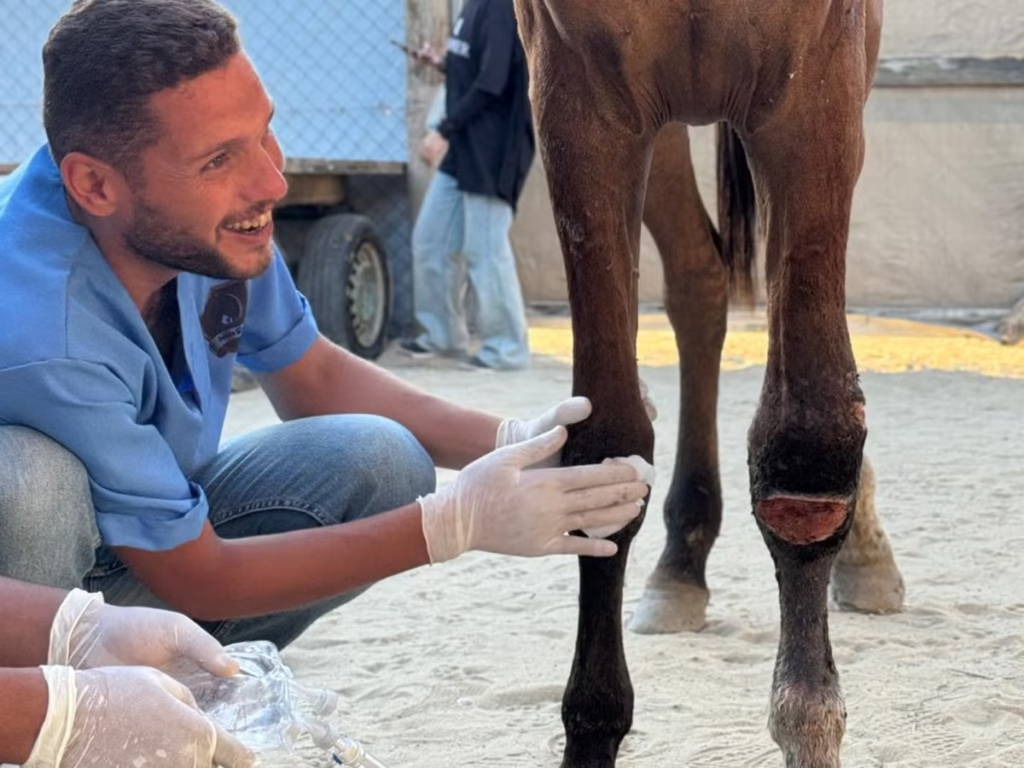
Moaz, 30, was one of Gaza’s few veterinarians capable of performing surgical operations on animals. Passionate about his work and known for his compassion, he had saved countless pets and stray animals across the Strip.
After graduating with honors from Egypt’s Zagazig University, since veterinary medicine was not yet taught in Gaza, he returned to Jabalia in 2019, joining the local municipality as a food quality inspector. Later, he worked with the Ministry of Health, ensuring the safety of livestock products and dairy sold in local markets.
By 2023, he had opened his own small veterinary clinic in western Gaza City. It became a place not just for treatment, but for rescue and care, a haven for animals suffering under blockade and bombardment alike. His clinic also helped sustain his family after his father’s death.
“Moaz was kind-hearted, generous, and dedicated,” his brother Abdelrahman said. “He loved his job more than anything. He even inspired me and many of our friends to study veterinary medicine.”
With limited tools in Gaza, Moaz often improvised equipment to perform surgeries, uterus removals, amputations, and treatments for poisoned animals. He was preparing to carry out Gaza’s first platinum implant surgery on a cat with a broken leg before the war began.
The War Took Everything
When Israel began its bombardment in October 2023, Moaz fled Jabalia with his family just before their home was flattened. Despite displacement, he never stopped helping animals. In Deir al-Balah, he treated injured pets and strays wherever he found them, often coordinating with local rescue groups.
“He was terrified of the bombings,” his brother recalled, “but he couldn’t just stand by. Even under fire, he would go out to treat or feed animals left behind.”
As famine tightened its grip on Gaza, Moaz also struggled to feed his own family. He would spend hours searching for a single sack of flour or a few tins of food from the rare aid convoys allowed in through Rafah.
“He used to fall ill from exhaustion and stress,” Abdelrahman said. “He prayed every night for the bombing to stop. He didn’t want to die; he just wanted to live and work.”
When the ceasefire was declared, the family celebrated with a single can of peaches, a luxury they had not tasted in months. Moaz gathered his belongings and rode north to Jabalia. Days later, word came that he had been struck by an Israeli air strike.
Searching Among the Ruins
Abdelrahman and his uncle set out to search for him but found Israeli tanks still positioned around Jabalia, firing at displaced residents who dared to return. “People warned us to stop,” he said. “Then an artillery shell landed nearby, tearing a man’s legs apart. It wasn’t a battlefield where civilians.”
He spent hours asking for news of his brother, showing photos, describing Moaz’s bicycle and backpack, but no one had seen him. He returned to the south empty-handed.
Days passed in agonizing uncertainty. Friends began circulating Moaz’s photo on social media, hoping someone would recognize him. Eventually, a stranger called: he had seen Moaz’s body on the day of the ceasefire.
“He said Moaz was riding his bicycle when the missile struck,” Abdelrahman recounted. “He moved the body near a wall and covered it with cardboard.”
When Abdelrahman went to the site, he found only his brother’s cap and backpackriddled with shrapnel. The family believes someone later buried him nearby.
A Family Torn Apart
Moaz’s wife, Rania Abu al-Foul, 26, clung to hope for eight days, searching prison lists to see if her husband had been detained. “When I saw his blood-stained belongings, I knew he was gone,” she said quietly.
Rania had already lost much of her family; her father, brother, and three uncles had been killed in Israeli strikes. Another brother, recently freed during the ceasefire, returned home only to offer condolences for Moaz’s death.
Together, she and Moaz had two little boys, Yossif, three, and Talat, one. “He wanted to build a future for us,” she said. “He encouraged me to finish my pharmacy degree. He dreamed of opening a small pharmacy next to his clinic. We used to sit by the sea after work, drinking coffee and planning our lives.”
Her voice trembled. “He promised to take me to Egypt to see where he studied. But Israel destroyed everything: our home, our dreams, our peace. Everyone in Gaza knew he was innocent. He only wanted to heal animals. And they killed him.”
She paused, then added firmly, “Israel kills those who carry light, those who think, create, and build. They killed him because he was one of Gaza’s bright minds.”

