
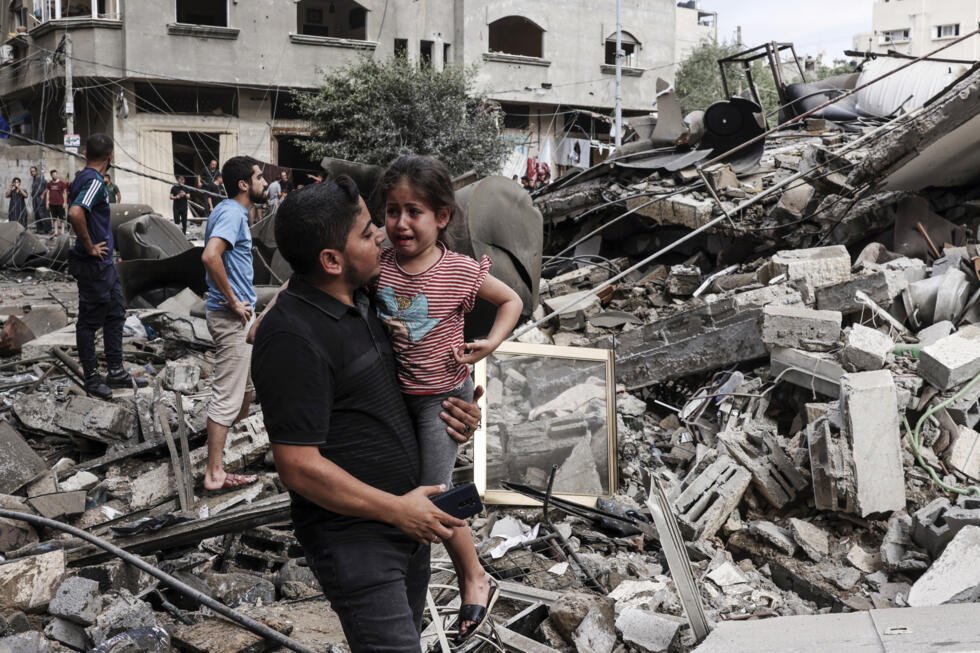
Gaza Herald_ After two years of relentless Israeli aggression on Gaza, a new and horrifying term has entered the lexicon of emergency medical aid: “wounded child with no surviving family” (WCNSF). This term reflects the unimaginable reality faced by thousands of Palestinian children who have lost their entire families while sustaining severe injuries.
The crisis has intensified over more than two years of bombardment and starvation, making it nearly impossible to track children separated from their families amidst the chaos of continuous Israeli airstrikes, ground invasions, and mass evacuation orders that shatter communities.
According to the Gaza Ministry of Health, as of early September, 2,596 children had lost both parents, while 53,724 lost one parent, including 47,804 fatherless children and 5,920 motherless children. Precise figures for injured children who are now orphans are unavailable, but Gaza now suffers from “the highest rate of child amputations in any modern conflict”, according to The Guardian.
Among these children is three-year-old Wissam, who lost her entire family grandparents, parents, and siblings when Israeli forces bombed her home in Gaza City on August 13. Wissam sustained critical injuries to her legs and abdomen, suffered liver and kidney tears, and is dealing with severe psychological trauma. UNICEF confirmed she urgently requires medical evacuation abroad for advanced treatment, particularly to save her left leg from amputation.
Thousands of other children in Gaza are similarly orphaned and injured, with doctors marking many of their records simply as WCNSF. Kieran King, head of humanitarian affairs at War Child UK, explained that this is the first conflict requiring such a term, created by medical emergency teams to deal with the unprecedented challenge of protecting wounded children without family support.
Jacob Grainger, emergency coordinator for Doctors Without Borders in Deir al-Balah, said that these children are transported to field hospitals without any family presence, and even after treatment, they have no stability or social support system. “There are agencies or community efforts that try to find families for these children, but it’s just a drop in the ocean,” he added.
UNICEF provides short-term emergency care to ensure immediate safety, while social workers attempt to locate long-term caregivers. War Child actively searches displaced persons camps for unaccompanied children, aiming to integrate them with willing families, though food scarcity and high costs make this extremely difficult. Injured children often have amputated limbs and cannot travel south under Israeli evacuation orders, while transportation costs remain prohibited.
Many children survive by scavenging for food or gathering at aid distribution points, and exposure to trauma is altering their behavior. Grainger notes: “Many children are on the streets all day. Their behavior becomes abnormally aggressive. A six- or eight-year-old may scream as if he were a forty-year-old man in rage.”
Even children with surviving families face profound psychological trauma. Twelve-year-old Ahmad Abu Hilal dreamed of becoming a doctor and loved football, but an Israeli shell tore through the back of his thighs, leaving him in severe physical and psychological distress. His mother fears he may never walk normally again.
Grainger emphasized, “Imagine the mental impact on a child who, each time he tries to stand or walk, recalls the moment he lost his legs and family. This trauma will last a lifetime. The basic conditions needed to recover physically and mentally simply don’t exist here. Gaza is unsafe for its own children.”
The children of Gaza are growing up amid war, orphanhood, and injury, their lives shattered by two years of systematic Israeli attacks backed by U.S. support, leaving a generation in urgent need of protection, medical care, and justice.

